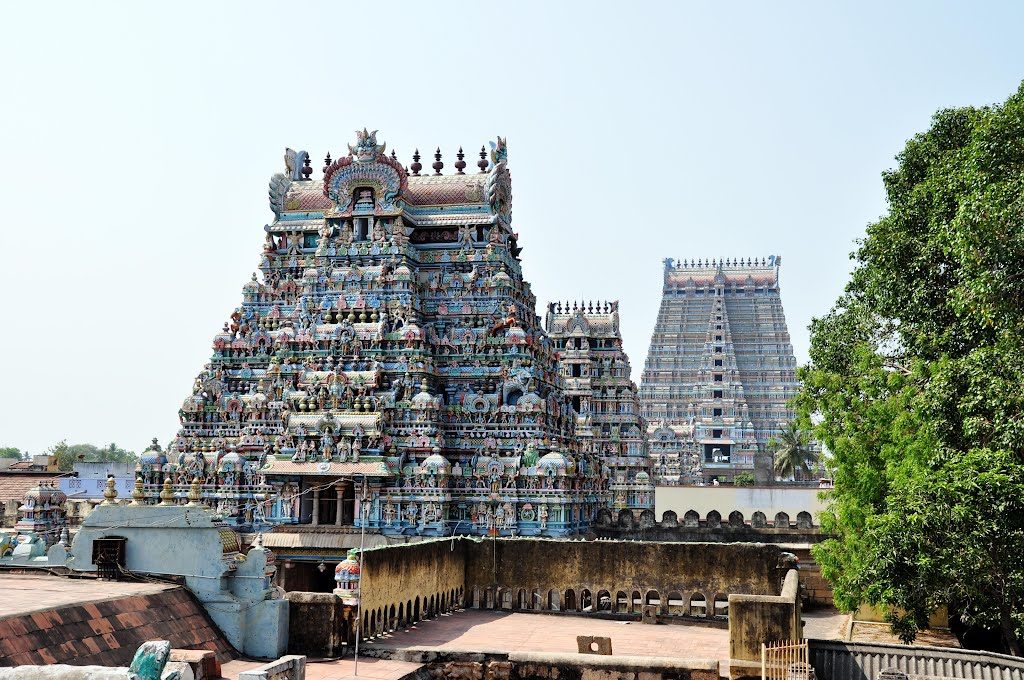
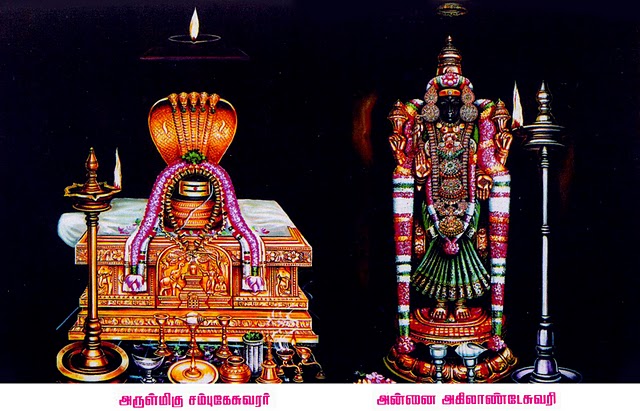
Jambukeshwar or Thiruvanaikava is a famous Shiva temple in Tiruchirapalli (Trichy), in the state of Tamil Nadu, India. The temple was built by Kochenga Chola, one of the Early Cholas, around 1,800 years ago. It is located on Srirangam island, which has the famous Ranganathaswamy temple. Jambukeshwar is one of the Panchabhoota Sthalams representing the Mahābhūta or five great elements; this temple represents the element of water. The sanctum of Jambukeswara has an underground water stream and in spite of pumping water out, it is always filled with water. the stream of water which is said to emerge from the linga is usually demonstrated as the soaking wet clothes in which Lord is draped. The water flow increases significantly during the Monsoon. The main deity of the temple is Jambukeswara, representing the element water. Jambukeswara is depicted sitting under a jambu tree, which grows over a small stream that engulfs the deity during the rainy season. The temple is also considered the abode of the goddess Akilandeswari, one of the forms of the goddess Parvati. As Akilandeswari worshipped Lord Shiva in this temple, even today at noon the priest dresses like a female and does Pooja to Jambukeswara and ‘Go Maata’ (Cow). Legend maintains that the wall was built by Shiva working with the laborers. The temple’s deities are installed opposite to each other – Such temples are known as Upadesa Sthalams. As the Devi was like a student and Jambukeswara like a teacher in this temple, there is no marriage conducted in this temple for Shiva and Parvati, unlike the other Shiva temples. The garbhagriha of the goddess Akilandeshwari and the garbhagriha of Prasanna Vinayaka are in the shape of the pranava mantra called “Om”. It is believed that the Amman in the temple was in deep anger hence during one of Adi Sankara’s visits he installed the Prasanna Ganapathy idol right opposite to her Sannathy and installed a pair of Sri Chakra ear-rings to reduce her anger. The holy tree here is the White Jambuka, found growing along the south-eastern wall of the sanctum sanctorum.

The sanctum sanctorum is divided into the Ardha Mandapam or Antaralam (whose western wall bears the window) and the Garbha Griha where the deity of Jambukeswarar is housed. At the center, the Brahma Sthana is the self-manifested linga of Jambukeswarar. The upper conical part of the Linga is of the color of copper, whereas the Yoni-Bhaga or the pedestal is of black granite. A brass ring is seen at the point of attachment of the Linga to the pedestal. The height of the Linga is about 3 feet from the floor of the sanctum. The Garbha Griha and the Ardha Mantapa are unadorned from the inside, the only source of illumination within the sanctum being ghee lamps.
Sthala Puranam- The Story
 Once Parvati mocked Shiva’s penance for the betterment of the world. Shiva wanted to condemn her act and directed her to go to the earth from Kailasa (Shiva’s abode) to do penance. Parvati in the form of Akilandeswari as per Shiva’s wish found Jambu forest to conduct her penance. She made a lingam out of the water of river Cauvery under the Venn Naaval tree and commenced her worship. The lingam is known as Appu Lingam (Water Lingam). Siva, at last, gave darshan to Akilandeswari and taught her Siva jnana. Akilandeswari took lessons facing East from Shiva, who stood facing west.
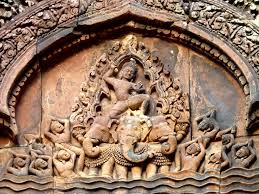
Another story is about two Siva Ganas ‘Malyavan’ and ‘Pushpadanta’ Who lived in Kailasa. They always quarreled with each other and fought for one thing or other. In one fight ‘Malyavan’ cursed ‘Pushpadanta’ to become an elephant on earth and ‘Pushpadanta’ cursed back making him become a spider on earth. The elephant and the spider came to Jambukeswaram and continued their Siva worship. The elephant collected water from river Cauvery and conducted ablution to the lingam under the Jambu tree daily. The spider constructed his web over the lingam to prevent dry leaves from dropping on it and prevent sunlight directly falling on it. When the elephant saw the web and thought it was dust on the lingam. The elephant tore them and cleaned the lingam by pouring water and the practice continued daily. The spider became angry one day and crawled into the trunk of the elephant and bit the elephant to death, killing itself. Siva, in the form of Jambukeswara, moved by the deep devotion of the two, relieved them from the curse. As an elephant worshipped Siva here, this place came to be known as Thiru Aanai Kaadu (Thiru means holy, Aanai is an elephant, Kaa (Kaadu) means forest). Later the name ‘Thiruaanaikaa’ become ‘Thiruvanaikaval’ and ‘Thiruvanaikoil’.
As an outcome of making sin by killing the elephant, in the next birth, the spider was born as the King Kochenga Chola and built 70 temples and this temple is the one among them. Remembering his enmity with the elephant in his previous birth, he built the Siva sanctorum such that not even a small elephant can enter. The entrance on the sanctorum of Jambukeswara is only 4 foot high and 2.5 foot wide.

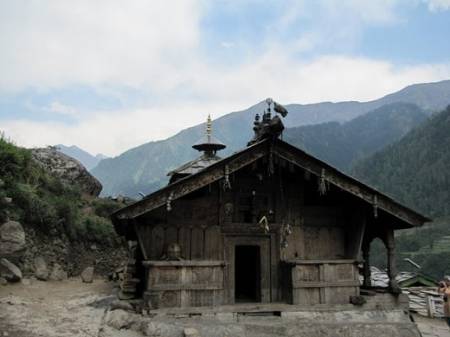 One of the largest temples dedicated to Duryodhana in the Mahabharata is found at Oslo in Uttarkashi District in Uttarakhand. The popular belief is that the soldiers and people who supported Duryodhana escaped from the Kurukshetra and took refuge in this area of Uttarkashi. They built temples in memory of Duryodhana and Karna here. Today they are the protecting deities of the region.