May 2019

Dhumavati- A Widow Tantrik Goddess

Dhumavati is a tantric widow goddess in the Dasha Mahavidya pantheon. She is the only Mahavidya without a consort. Unlike other Goddess that have exhibit immense beauty and attractive appearance, Dhumavati is old and rather ugly widow associated with strife, loneliness, unfulfilled desires and inauspicious things of life. Dhumavati is the embodiment of tamas guna, associated with ignorance and darkness. She likes meat and wine, both tamasic in nature. As an ancestor or Grandmother Spirit, she embodies a great teacher and guide, granting knowledge of the ultimate truth of life and death. Dhumavati is called ‘Arikshyaykar’ or ‘one who destroys both the external as well as the internal enemy’.

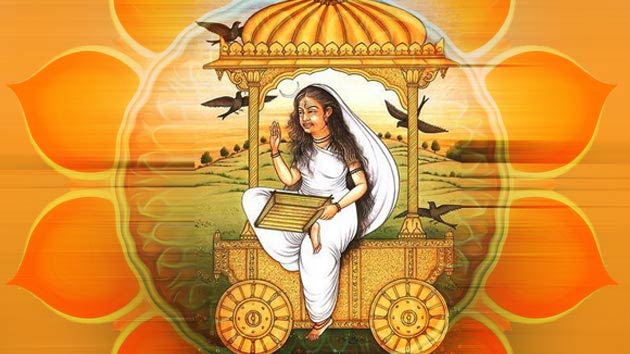
The Dhumavati Tantra describes her as an old and ugly widow with a body made of smoke (Dhumara). She is thin, tall, unhealthy, and has a pale complexion. Her face is wrinkled without any charm. She is described as restless and wicked. Unadorned with any jewel, she wears old, (Galit Ambara )dirty clothes and has disheveled hair (Mukta Keshi ). Her eyes are (Ruksha Netra) dry and fearsome, She has a long crooked nose along with ugly rough ears. She possesses long fang-like teeth (Viral Danta )of which some have fallen out, leaving her smile with gaps. Her ears are ugly and rough; her breasts hang down. In one of her trembling hands, she holds a (Shurp Hasta) winnowing basket, while the other makes a boon-conferring gesture (varada-mudra) or knowledge-giving gesture (chinmudra).

She rides a chariot pulled by crows and has a flag with crow emblem (Kak Dwhajini). She has a voice of howling jackals.  Dhumavati is also said to be fierce, frightening and fond of blood. She is astute and crafty. Always hungry and thirsty, Dhumavati initiates quarrels and invokes fear (Kalaha Priya). Dhumavati is often said to appear at the time of Maha-pralaya, the great dissolution of the cosmos and is equated with the dark clouds that rise during Pralaya.

In the Prapancasarasara-samgraha, Dhumavati is described as having a black complexion and wearing ornaments made of snakes. Her dress is made of rags taken from cremation grounds. She holds a spear and a kapala in her two hands. The spear is sometimes replaced by a sword. Another description in the same text says Dhumavati is aged with a wrinkled, angry face and cloud-like complexion. Her nose, eyes, and throat resemble that of a crow’s. She holds a broom, a winnowing fan, a torch, and a club. She is cruel and frowning.  she wears the simple clothes of a beggar. Her breasts are dry and hairs are disheveled, grey, her teeth crooked and missing, and her clothes old and worn.

She is attracted to smoke as smoke symbolizes destruction. She prefers insane offerings and smoke from the pyre; also she likes white flowers and clothes, liquor or wine, Bhang , cigarettes or chillam , especially salted items. She does accept the offering which is not made up of smoke.

The Shaktisamgama Tantra says that Dhumavati can be worshipped for the Uchhatana (eradication) of a person. A worshipper should imagine the world and the goddess’s mantra as grey. He should blacken his teeth and wear black clothes and observe regulations, such as eating little, sleeping on the ground, and subduing his senses. In this worship procedure called kakakarma (crow-procedure), he should “transform his mind into a crow” by which one can cause harm to a person.

Dhumavati’s worship is performed in the night in a cremation ground, bare-bodied with the exception of a loincloth. The fourth lunar day of the dark fortnight (Krishna Paksha) is considered the special day to worship her. The Sadhaka should observe a fast and remain silent for a whole day and night. They should also perform a homa (“fire sacrifice”), wearing wet clothes and a turban, repeating the goddess’ mantra in a cremation ground, forest, or any lonely place

Though legends connected to the origin of Goddess Dhumavati is not very – popular, we can still find references in the texts.

In Durga Saptasati (5.120) Durga vows that “He who conquers me in battle, removes my pride and is my match is strength in the world shall be my husband.” Since It has not happened so far, she is still unmarried. She is without wealth and husband. 

According to Pranatosini-Tantra Once Parvati, the spouse of Lord Shiva sat near him in Kailash. She was extremely hungry and her body racked with pain. She urged Lord Shiva to give her something to eat, as she was famished. Lord Shiva, told her to be patient and to wait for some time, after which he would give her whatever she wanted to eat. Saying this, he went back to continue with his meditation. She appealed, again and again, urged her husband to provide her with some food to eat, but Shiva again told her to wait for a while. After urging for a long time, she lost her patience as she felt that she would starve to death.

Lord Shiva was also not paying proper attention towards her asking for food. Soon she became indignant and put Shiva himself inside her mouth and gulped him down. After a little while, Lord Shiva persuaded her to disgorge him, as smoke began to rise from Parvati’s body. She appeared with smoke covering her entire body; this smoke was her Maya or Magical Power of illusion. Then Lord Shiva came out of her body and shouted, O Devi! You are a woman without a husband, it’s called a widow. She must remove her ornaments and marks of married women. The smoke from her took the form of Dhumavati.

Another story in Devi Bhagavat says that when Sati performed self-immolation at the yagya of Daksha Prajapati, While getting burnt, Sati came out of her body in the form of smoke and came to be known as Dhumavati. 

 The Moola mantra of Dhumavati is

“Dhum Dhum Dhumavati Svaha”, It has the Dhumra Beeja ‘Dhum’.

 The old and widowed appearance of Dhumavati symbolizes Shaktiman or Purusha, which is Shiva the enjoyer of Shakti or Prakriti. Energy cannot be utilized in pure form, it needs to be used through a medium. The medium is Shiva, when the energy is enjoyed by Shaktiman it is bright, opulent and happy. When there is an absence of the enjoyer, everything becomes barren, ugly and spreads unhappiness. For example, if there is no rain the fertile earth cannot produce and becomes dull and barren.

Another symbolism associated with Dhumavati points out to the negative aspects of life, asking us to develop a sense of detachment and ultimate perfection. She guides devotees to rise above the glimpse of material opulence to the real truth of life that is the state of ultimate knowledge which is above the Opulence. By obscuring or covering all that is known, Dhumavati reveals the depth of the unknown. Dhumavati obscures what is evident in order to reveal the hidden and the profound. Dhumavati’s youth and freshness are burnt out, and what remains is the smoke of her spent  life. And like smoke, she is restless and wandering.

Dhumavati also symbolically portrays the disappointments, frustrations, humiliation, defeat, loss, sorrow and loneliness that a woman endures.   Goddess also represents a stage of a woman’s life that is beyond worldly desires, beyond the conventional taboos of what is polluting or inauspicious. Dhumavati is the knowledge that comes through hard experiences after the youthful desires and fantasies are put behind. 


The bowl of fire she holds burns ignorance, ego and also indicates that all things are eventually destroyed. The winnowing basket is “viveka” or intelligence, the power of discrimination that separates the grain (real) from the chaff (unreal). On an outer level, she seems like poverty, destitution, and suffering, the great misfortunes that we all fear in life. But in truth, she directs us to look beyond the small ambitions.

Dhumavati’s worship is considered ideal for bachelors, widows, Sannyasins, and   Tantrics, It is advised that people who are married should not worship Dhumavati, as She instills a desire to be alone and an aversion to worldly things. She encourages a certain kind of aloofness and independence; and sets one on the spiritual path; this can hinder the married life.

Dhumavati is the primordial darkness and ignorance, from which rises the world of illusion. She represents the darkness/ignorance before creation and after decay. This ignorance, which obscures the ultimate reality, is necessary because, without the realization of this ignorance, true knowledge cannot be achieved. Dhumavati also represents Yoganidra, the pre-creation state of consciousness or the voids in which all creation would dissolve and reach the ultimate reality of Brahman. This void is pure consciousness, the cessation of movements of the mind, and silence. Dhumavati’s ability to spread disease is also considered positive, as disease punishes the wicked and restores cosmic order. Dhumavati is also associated with the heart or middle region of the body.

Dhumavati also shares her characteristics with Nirriti, Jyeshta and Alakshmi. All three goddess personify inauspiciousness, ugliness, poverty, quarrels and never-ending hunger.

 

Bagalamukhi- The crane headed Tantrik Goddess

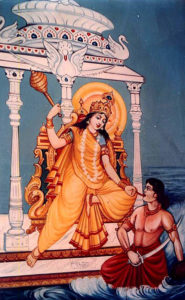
Bagalmukhi is a tantric deity in the Dasha Mahavidyas pantheon. She has a distinct iconography she is said to have a crane head giving her name “Bagalamukhi or crane headed. She is a three-eyed goddess depicted having golden skin and wearing bright yellow clothes. A crescent moon adorns her head. She is seated on a corpse or on a golden throne holding the tongue of a demon and striking with a Club like weapon. Signifying the ability to paralyze the speech of demon and cause confusion. In the Sankhyayana-tantra, Bagala is connected to Brahmastra. Mritunjay Shiva is the consort of Goddess Bagalamukhi, and she represents the Rajasika guna.

Bagalamukhi is also the goddess of opposites, she is the secret presence of the opposites wherein each thing is dissolved back into its un-manifest state. The represents knowledge that everything has it’s opposite hidden inside and time will turn things the other way around. There is sorrow in happiness and, in success, there is a failure, life is death also vice versa. She also turns speech into silence and silence into speech, ignorance to knowledge and knowledge to ignorance. The un-manifest lies in manifest and manifest in unmanifest.

The are many legends connected with the origin of Bagalamukhi. 

As described in Swatantra Tantra once upon a time in Satya Yuga during the time of great deluge a cosmic storm threatened to destroy the Universe. Many of the creators of the Universe and people were killed in that storm. Lord Vishnu went to the holy pond named Haridrakhya or Turmeric ocean, a yellow color pond, in the state of Saurashtra and prayed to Aadi Shakti to find a solution to this problem and started penance. Aadi Shakti became pleased with Lord Vishnu’s penance and appeared as Bagalamukhi and starts playing in that turmeric pond.
As a result, strong dashing rays came out of that yellow pond and spreads over in every direction, which controls that pacified storm and saves the Creation from destruction. Therefore she is also known as “Pitambari “That strong and powerful rays that measured the universes became the Brahmastra, no one in three worlds is able to stands when the weapon is detonated. The goddess is also known as Brahmastra Rupini or form of weapon Brahmastra.

Once a demon called Madan performed great penance and got the boon that whatever he said would come true. After receiving the great power he started troubling the innocent and the pious ones. All the humans and the gods prayed to Adi Shakti and the supreme Goddess, took the form of Baglamukhi who pulled out the tongue of the demon to still it. When Baglamukhi was about to kill the demon, he surrendered to the goddess and asked her to bless him to attain an exalted position. Since then he is also depicted with Bagalamukhi.

According to Narada Pancaratra once Sati or Parvati, the spouse of Lord Shiva sat near him in Kailash. She was extremely hungry and her body racked with pain. She urged Lord Shiva to give her something to eat, as she was starving. Lord Shiva, told her to be patient and to wait for some time, after which he would give her whatever she wanted to eat. Saying this, he went back to continue with his meditation. She appealed, again and again, urged her husband to provide her with some food to eat, but Shiva again told her to wait for a while.

After urging for a long time, she lost her patience as she felt that she would starve to death. Lord Shiva was also not paying proper attention towards her asking for food. Soon she became indignant and put Shiva himself inside her mouth and gulped him down. After a little while, Lord Shiva persuaded her to disgorge him, as smoke began to rise from Parvati’s body. She appeared with smoke covering her entire body; this smoke was her Maya or Magical Power of illusion. Then Lord Shiva came out of her body and shouted, O Devil! You are a woman without a husband, it’s called a widow. She must remove her ornaments and marks of married women. That woman, who you left her husband by swallowing or before she ate, she is a Baglamukhi and the smoke from her became Dhumavati.

 The moola mantra of Bagalamukhi is:-

 Om Hreem Baglamukhi Sarvadustanaam Vaacham Mukham

Padam Stambhay Jihvaam Kilay Budheem Vinashay Hreem Om Swaha

Oh Mother Baglamukhi, I take refuge in you. Let the speech, feet, and organs of my enemy is stilled and let his intelligence be disabled so that he does not move further to harm me.

 She is associated with Stamban, i.e to stop, immobilize or paralyze the enemies, she is invoked if the Sadhaka needs to immobilize someone’s thoughts, actions or desires. Bagalamukhi represents the power of speech that stuns others and leaves them gasping for words. Using Stamban any individual, army, fire, water or even the devatas can be immobilized. She is a woman with immense beauty who can transfix or lure anyone. The head of the crane signifies her deceitful nature, just as a crane with its ability to stand still attracts its prey, lures it into a false sense of safety and then devours it quickly.

 She can lure her enemies and then immobilize their speech and thought in one strike of her weapon. Along with the ability to immobilize she has the ability to grant Vak-Siddhi, the power to make everything one utters come true. She is also invoked for granting success in speech, debates, bargains, paralyzing the enemy.

 Bagalamukhi wrenching the tongue of the demon with her club is symbolic of removing the impurities associated with speech and tongue. The tongue is the organ of speech and taste. And, often it is involved in telling lies or concealing the truth. The tongue, therefore, could unwittingly get caught up with mischief, vanity, and deceit. The pulling of the tongue is a symbolic act of punishing the demon and cleansing his impurities.

 Bagalamukhi is often called Pitambari Devi, the yellow hued. Her complexion, clothing, ornaments, and garlands are in varying shades of yellow. Her devotees are dressed in yellow, wear the rosary of turmeric and offer her yellow things. Yellow is also the color of attraction, energy, and luring.  The color if overused has a disturb focus and consciousness. Too much yellow causes loss of focus and makes it hard to complete a task. This also signifies her ability to confuse and make the enemies loose focus.

 Bagalamukhi sitting upon a corpse while pulling the tongue of the ‘enemy’ is interpreted in many ways. The corpse stands for inert or static matter, as also for ignorance. The death of the flesh also means the liberation of the spirit. A corpse is, therefore, a symbol of death and a new beginning for the spirit. This is also said to be associated with the extreme tantric ritual of Shava-sadhana. The tantric texts mention specific guidelines to do the shava sadhna- the location of cremation ground or forest is to be chosen.

The right kind of corpse has to be arranged. It is mentioned that the corpse should be undamaged and preferably of a young Candala (untouchable or the outcast) who has committed suicide, drowned, died from a snake bite or lightning, or killed in a battle. The corpse of an immoral person, one died of starvation, one who was famous or one who was lusty has to be avoided. The Sadhaka would then sit on the corpse and do the Japa. After the Japa, the Sadhak has to do 1/10th yagya, 1/10th Marjan, 1/10 tarpan, and 1/10 charity. The Sadhna has to be done in the night, wearing yellow clothes, with a rosary of turmeric. This tantric ritual is that it transforms the aspirant, awakening in him or her to an expanded consciousness; and grants him a new identity.


Nava- Narasimha of Ahobilam

The Brahmanda Purana states that Ahobilam was the kingdom of Hiranyakasipu in the Satyuga and Lord Narasimha comes out of a pillar from the place of the demon.

Ahobilam, located in Karnool district of Andhra Pradesh in the hills of the eastern ghats, In addition to the nine shrines, there is a temple for Prahaladavarada Varadhan in the foothills of the mountain. The entire Eastern Ghats range is believed to be Sri Adi Sesha – the great serpent bed of Lord Vishnu. On his seven hoods lays Tirupati, on stomach Ahobilam and on its tail lays Sri Shailam.

The hill of Ahobilam is known as Garudadri, after taking darshan of Jwala while walking towards Prahalad Mettu you will see the shape of the mountain as if it is like an eagle. Garuda once desired wished for a vision of Lord Nrisimha in the form of the Avathara. To fulfill his wish, the Lord settled in the hills around Ahobilam in the midst of dense forests in nine different forms. For this reason, this hill came to be known as Garudadri,

When lord Narasimha appeared and killed Hiranyakashypu he was in Ugra form, his roars gave shivers to all three lokas. The devatas, rishis were terrified.  Witnessing this wonderful pastime, the Devatas glorified Lord Narasimha with the following sholka

“Aho Veeryam Aho Souryarn Aho Bahuparakramah
Naarasimham Param Daivam Ahobilam Aho Balam.

Oh! what a great valor he has! oh, his great gallantry! oh those great powerful shoulders of the greatest of the Gods Lord Narasimha, and what a mighty cave it is! and what a mighty divine strength He has!

In this sacred Place Garuda, Brahma, Parashurama worshiped the Lord Narasimha. It is believed that when Sri Rama was in the forest, we know from Seshadarma that he prayed to the Lord of Sri Ahobila with Panchamrita Stotra. In the Archavatara, Lord Srinivasa, who is the giver of many boons in the Maluyuga had married Padmavati only after offering worship to Sri Narasimha of this mountain. It is held that the shrine of Lord Srinivasa, to the south of Narasimha’s temple within the enclosure, lends the view.

The Nava Narasimhas

There are nine temples of Lord Narasimha in Ahobilam which house the self-manifested Deities of the Lord.

jwala ahobila malola kroda karanja bhargava

yogananda kshatravata pavana nava murthayaha

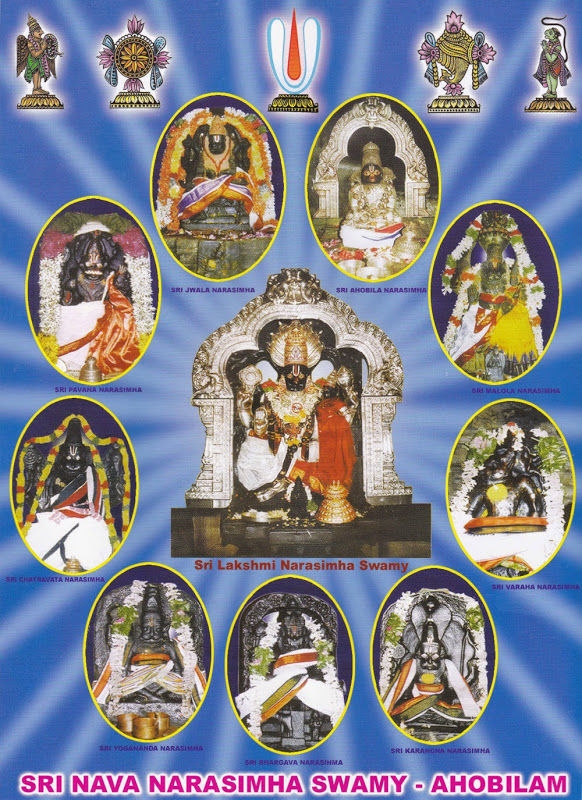
The nine Deities are Sri Jwala Narasimha , Sri Ahobila Narasimha , Sri Malola Narasimha , Sri Kroda Narasimha , Sri Karanja Narasimha , Sri Bhargava Narasimha , Sri Yogananda Narasimha , Sri Kshatravata Narasimha  and Sri Pavana Narasimha .

Ugra Narasimha or Ahobila Narasimha.

garudadri guhagehe gajakhundasarittate

hiranyasthaanvahankaarhaari simhaya mangalam

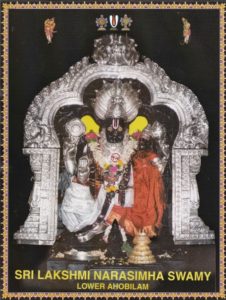
This is the oldest temple among the nine temples in Ahobilam.  This is also the main temple where the deity is situated in a cave. Here the Lord resides in shaligrama form. Ugra Narasimha is seen sitting in sukhasan pose tearing the chest of Hiranyakashipu. 

Sri Kroda Narasimha

varahkundey medhinyai varaahaarthapradhaayiney

dhanthalagna hiranyaksh dhamshtra simhaaya mangalam

After killing Hiranyakashipu, Lord Narasimha was very angry with Lord Brahma because of the boon he had awarded to Hiranyakashipu. He summoned Lord Brahma but Brahma was afraid to come near the Lord. While he was coming to see the lord Vedas slipped from his hands and fell down. The Vedas when hit the earth it was absorbed inside, Bhumi Devi held them. The Devtas requested Narasimha dev to retrieve the Vedas. Lord Narasimha took the Kroda form (one horned boar) and dived inside the earth to come out with Vedas and Bhumi Devi sitting on his shoulders.  Lord took this very special form. In this cave shrine, there are two deities, one of Lakshmi-Narasimha and another Sthanaka figure of Varaha Narasimha with his consort, goddess Bhudevi. The goddess is shown as embracing the ‘snout’ portion of the lord, just as she did while being raised by him up from the ocean waters after piercing Hiranyaksha with his tusks and then slaying him. Varaha stands in a tribhanga posture with only two hands, the head of the boar and the tail of the lion on a human torso.

Sri Malola Narasimha

vaarijaavaaritha bhayay vaneepathi mukhaiswarai

mahithaaya mahodhaara malolyasthu mangalam

The Deity of Lord Narasimha here is in a peaceful form since Lakshmidevi is also present. Ma means Mother Lakshmi and Lola means beloved. The Supreme Lord Narasimha is the beloved of mother Lakshmi and hence is glorified as Malola Narasimha. This place is also known as Markonda Lakshmi Kshetra. The God is seen seated here in Sukhasana posture with his left leg folded while the right leg is shown dangling at an angle. The goddess is shown seated on the left thigh of the Lord with Kataka and Parisaritya vamahasta. The feet of the goddess rests on padma which appears to have sprouted from the earth. The Lord’s two upper hands hold Chakra and Sankha, his lower right hand is in abhaya pose and the lower left hand is shown embracing his consort.  

Sri Jwala Narasimha

hiranyashtambha sambhuthiprakhyat paramaatamaney

prahladhaarthimushey jwaala narsimhaya mangalam

The temple of Sri Jwala Narasimha lies on a hill called Achalachaya Meru and is on the base of Ugra Stambha.  This is the exact place where Lord Narasimha killed Hiranyakashipu. It was here that the anger of Lord Narasimha was on its pinnacle. The first pair of hands catch hold of       Hiranyakasipu’s crown and renders him motionless, while the other pair by tightly gripping the sword-carrying hand of Hiranyakasipu completely disarms and overpowers him. The second pair of hands is engaged in tearing open the entrails of the demon lying on the folded right leg of God. The pair of hands holds Sankha and Chakra and the fourth pair holds the intestine of the demon in the shape of a garland.

There is a small pond near this temple called Rakta Kunda Tirtha. Here Lord Narasimha washed His blood-stained hands and hence the color of the water of this Kunda turned red. Today also one can see the red stains around this tirtha. The water of this tirtha is crystal clear and is very sweet.

Ugra Stambha

atyam vidhathum nijabruthya bhaashitham

vyaaptham swabhutheshu swachirey swachaathmanaha

adhrushyathaam adhbutharoopam udhvaham sthamba

sabhamam na mrugam na manusham na bhootho na ambharey mruthyuhu na naraih na mugrairapi surasura mahorakhai

This mountain is the remain of the pillar from which Lord Narasimha appeared. It is said that when the Lord emerged out of the pillar, the whole pillar was shattered to pieces. His first step produced 172 sounds which are the first basic tenets of 172 classical ragas. Of these only 52 melakarta ragas exist today and even these cannot be mastered by any individual of this material creation. This is also called as Ukku Stambha. Ukku in Telugu means steel. Atop Ugra Stambha there is an impression of the lotus feet of Sri Chaitanya Mahaprabhu who visited this place during His south Indian trip.

Pavana Narasimha.

bharadwaja mahayogi mahapaathaka haariney

thaapaneeya rahasyartha paavanayasthu mangalam

This temple is on the banks of the river Pavana and hence the Lord is known as Pavana Narasimha. This is the most peaceful form of the Lord amongst the nine Narasimha temples. The Lord here liberates devotees from all the sins of past lives and the present lives which might have been committed knowingly or unknowingly. Sage Bharadwaja rid himself of the great sin of Brahma-hatya at this place. The main deity is actually a Lakshmi Narasimha deity, with four hands. The upper two hands carry Sankha and chakra. The lower right hand is in abhaya pose, while the lower left hand is shown as embracing Lakshmi seated on His left thigh. The Lord is seated in Sukhasana posture on AdiSesha with His left leg folded while the right leg is bent at the knee. Dangling down over the head of Narasimha is found a seven-hooded snake (Adisesha) spread like an umbrella. Lakshmi is shown seated on the thigh of the Lord with the right hand embracing God.

Sri Yogananda Narasimha

chathuranana chetobja chitrabhaanu svaroopine

vedadri gahavarasthaaya yogaanandaaya mangalam

After killing Hiranyakashipu, Lord Narasimha dev here taught Prahlada few yogic postures to practice. This form of the Lord is seated in a padmasana with yogapatta around His legs. 

Sri Chatravatha Narasimha

haahaa hoohoo vakya gandharva nrittageetha hritaatmaney bhavahantritat chathravataimhaya mangalam

Ever seen Narasimha dev smiling, this deity of He is famous as Chatravatha Narasimha, he is smiling and seem to be enjoying music. The left hand of the Lord is in the tala mudra. This tala mudra is not seen in any other form of the Lord in any other place.

Once two Gandharvas named Haha and Hoohoo came from Meru parvat to entertain the lord. Hearing their ecstatic music Narasimha dev became engrossed in the music so much so that he started smiling and started giving tal on his left thigh.

The deity is seated in the padmasana pose on a low padmapitha. The two upper hands hold the Chakra and Sankha. The Lower right hand is in the abhaya posture, while the lower left hand is a Katihasta, placed on the waist and the left thigh.

Sri Bhargava Narasimha

bharagavakhya tapasveesa bhaavanaa bhaavithathmaney

akshaya theera theerthastu bhargavayaasthu mangalam

Here Lord Parashurama, who is also known as Bhargava, performed penances to please Lord Narasimha. Lord Parashurama wanted to have darshan of the Lord right at the moment when he tore apart the chest of Hiranyakashipu. Pleased by the penances of Parashurama, Lord Narasimha gave Him the desired darshan. When the Lord was giving darshan, Hiranyakashipu who was lying on the lap of the Lord, looked towards Parashurama. Parashurama then requested Narasimha dev to manifest Himself in that form. And from then on the Lord is being worshiped here and is known as Sri Bhargava Narasimha  Swamy. This is one of the most ferocious forms of Lord Narasimha in Ahobilam. This temple is located on the banks of Akshaya Tirtha which is considered on par with the sacred Pushkara Tirtha. Parashurama would bathe in this Kunda and use this water for the worship of Lord Bhargava Narasimha. Sage Vasishtha and other sages had performed penances here. One can also have darshan of Prahlada at the lotus feet of the Lord.

 Sri Karanja Narasimha

karanjamoole maatharaste yathra saarangaschakra dhrutham gobhoo

hiranya nirvinna gobila gnyanadhayiney prabanjan sunaaseera kaaranchaayasthu mangalm

The Deity of Lord Narasimha is under the Karanja Tree, hence He is known as Karanja Narasimha. Once Hanuman was performing austerities in Ahobilam and was continuously chanting the holy name of Lord Rama. Immediately Lord Narasimha  appeared before him and asked, “Yes you called me?” Hanuman was surprised and said to Narasimha, “You are disturbing me. Please go away.” Narasimha replied, “I am Rama. Because you called Me, I have come.” Hanuman was again surprised and asked, “How can you be Rama? You don’t have a form like that of Rama.” Immediately Lord Narasimha manifested Himself like Rama with a bow in one hand and Sudarshana in the other hand. Hanuman got convinced and from then on started to worship the form of Sri Karanja Narasimha. There is a small altar of Hanuman in the temple. The deity of the Lord appears to be seated in meditation, with a hooded cobra over the head. The upper right-hand holds a Chakra and upper left hand has Sarangaor bow. The lower hands are in Dhyana mudra.

Sri Prahlada Varada Temple

The temple of Sri Prahlada Varada is situated in Lower Ahobilam. Here Lord Narasimha is blessing Prahlada Maharaja. The family Deity of Sri Srinivasa of Tirupati is Lord Narasimha in Ahobilam. Because the Lord was in the fierce form, Srinivasa installed the Deity of the Lord in the Shantha form and worshiped Him before His marriage with Padmavathi Devi. The utsava Deities of Sri Pavana Narasimha and Jwala Narasimha are worshiped in this temple. This place is also called as Chinna Ahobilam or Diguva Tirupati.

God who burnt his Hand

Lord Vishnu in form of Alarnatha, situated at Brahmagiri, a hilly area, at a distance of 24 km from Jagannatha Puri, once burnt his hand while honoring food offered by a small boy, if you happen to visit there the priest would happily show you the burnt finger of the Lord.

Lord Alarnatha (or Alalanatha) here is a four-handed Deity of Lord Vishnu showing Abhaya-mudra in His right hand. Ramanujaacharya of the Alwars worshipped this deity; hence the deity is known as Alarnatha or Lord of the Alwars.

Long ago Sri Ketana, was a priest who worshiped Alarnatha, he lived there with his wife and son Madhu. Sri Ketana and his family only lived on the prasadam, eating the food after offering to the lord. One day Sri Ketana had to travel to some other village for some urgent work. Sri Ketana asked his son to offer food to the Lord while he was away. Young Madhu expressed his inability to do it as he did not know any mantras or procedure to make the offering. Sri Ketana told him not to worry, if he just places the plate of food in front of the deity and requests the lord to accept the offering, the omnipresent lord will honor the offering.

The next morning, Madhu’s mother called him and handed over the plate to him and asked him to make the offering. Madhu went with the plate and placed it in front of the lord. He prayed and requested

“Lord I do not know any mantras or procedures, I am placing this plate of food in front of you as my father instructed, please honor the food”.

Madhu then went out to play with his friends. When Madhu came back he saw that the food was still there. He was not aware that the Lord honors the food by a mere glance. Madhu then again asked the lord

“You have still not eaten; please accept this prasadam, the way you accept when my father makes the offering.”

He went out to play again. The third time when he came back he found that the food was the way he had kept it. He then started crying and calling the lord

“ Lord  I am a small boy, and I do not know how to make the offering, I am just following the instructions of my father, If you don’t accept the food, my father will be angry with me. This time I am going again please eat the food.”

Madhu now went out to play the third time, now when he had returned the plate was empty. He was very happy that the lord had eaten the food. When Madhu returned home, with empty plate his mother got furious and asked him where the prasadam was, he said that lord ate it all. his mother slapped him and told him “ you are a son of a Brahmin, you should not lie, if you have eaten the food and shared it with your friends  you should accept it” Madhu kept on insisting that “the lord really ate the food” The family had to fast for that day as there was no prasadam.

This kept on happening for three days continuously till Sri Ketana had returned.  When Sri Ketana heard what was happening, he got furious and asked his son, what really happened? Madhu said, “I kept the food as you instructed and then lord ate it all”. Sri Ketana had no faith in his son’s words and he wanted to investigate the truth.

He asked his wife to prepare the lords plate. He asked Madhu to make the offering the way he is been making for the past three days. Madhu went with the plate and made the offering. Sri Ketana was hiding and keeping an eye on Madhu.

Lord Alarnatha manifested from the deity and picked up a bowl of Kheer (Sweet Rice). Seeing this Sri Ketna was unable to believe his sight, Sri Ketana came from hiding and rushed to the Lord and grabbed His arm to prevent Him from taking it, the hot sweet rice spilled out and fell on the Lord’s body causing burns. Sri Ketana Prayed to the Lord, “How will we eat if you eat all the offerings? We have never heard of a Deity that eats. Being a Deity of stone, how can you eat and talk?”

The Lord then said that he is omnipresent, as said in Bhagavad Gita 10.8 aham sarvasya prabhavo ,mattah sarvam pravartate , iti matva bhajante mam, budha bhava-samanvitah. Lord Says I am the source of all spiritual and material worlds. Everything emanates from Me. The wise who know this perfectly engage in My devotional service and worship Me with all their hearts.

Lord said that he was pleased with the simple devotion of Madhu, and any offerings made without love and devotion does not please the Lord. No matter how opulent the offering or who makes the offering if it is made without complete love and surrender it is worthless. In Bhagavad Gita 9:26, Krishna says patram puspam phalam toyam, yo me bhaktya prayacchati ,tad aham bhakty-upahrtam, asnami prayatatmanah. It means If one offers Me with love and devotion a leaf, a flower, fruit a water, I will accept it. The most important is the love and devotion that takes the food to the gods.

The burnt marks manifested by Lord Vishnu on His body is visible even today.