
Disappearance of Krsna and Balarama
The supreme personality of godhead incarnates in this material world to establish righteousness and punish the evil. The supreme personality of Godhead when incarnates in this material world has to take the material form and be bound by the laws of material nature. Although the lord can never be bound he has to abide by the laws, otherwise, it would not look normal. However, the supreme lord after their pastimes is over they tend to go back to the abode. The disappearance pastimes are generally not discussed. But I would like to describe the disappearance as mentioned in Srimad Bhagavatam’s 10th Canto.
The Yadavas could not be destroyed by the outside force as they are always surrendered to Krsna, so Krsna planned to destroy them from internal conflict as they had become corrupted and unlawful. Two major curses led to the disappearance of Krsna and Balarama.
The curse of Gandhari
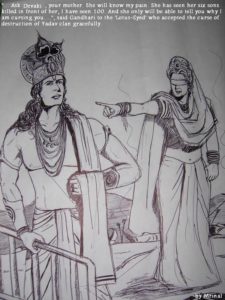 Lord Krsna executed the Mahabharata war with great expertise; he made sure that all the sinful people were killed in the war. After the war was over Pandavas along with Krsna and Draupadi went to see Dridhrastra and Gandhari. Gandhari held Krsna responsible for the total annihilation of the Kuru dynasty. she felt Krsna allowed this great bloodshed, and this could have been prevented. Gandhari cursed Krsna just “because of you my dynasty is over similarly your yadu dynasty will also be destroyed, the yadvas would fight amongst themselves and kill others until there is no yadava left on the earth. Krsna smiled and accepted the curse. Krsna said that it was gandhari that gave encouragement to the Kauravas to sons become unlawful and unjust.
The curse of Narada and Visvamitra.
Once Great sages such as Visvamitra, Asita, Kaṇva, Durvasa, Bhṛgu, Angira, Kasyapa, Vamadeva, Atri and Vasistha, headed by Narada performed holy rituals for the welfare of mankind and to reduce the effect of Kali-Yuga, at a place called Pindaraka. Yong yadava boys in order to play a prank with the sages, They dressed up Samba the son of Krsna and Jambavati as pregnant women and went to Pindaraka. They playfully approached the great sages and asked them “O learned Brahmanas; this black-eyed pregnant woman is about to give birth and is very desirous of having a son, please tell us whether her child will be a boy or a girl.” The sages ridiculed and insulted by this prank cursed that an iron club will be born of this belly and this iron destroys the Yadu dynasty. It is with this iron that Yadvas will fight each other till death. Then immediately samba gave birth to the Iron Club. The boy went to King Ugrasena for help and told him what had happened, Ugrasena then powdered the club and threw it in the ocean. After the powdered iron was thrown in the ocean one fish swallowed a piece of iron and rest of the iron came to the shore. On the shore of the ocean grew sharp iron canes form the powdered iron. The fish that had swallowed the iron was caught by a fisherman and the iron inside the fish was used by hunter Jara to make an arrow.
Lord Balarama leaves the planet.
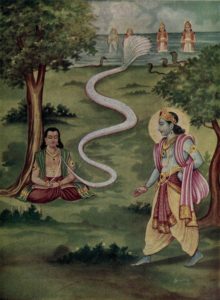 Suddenly Krsna saw bad omens that were hinting at something terrible. Krsna asked the Yadus to go to Prabhasa-kshetra, and worship the devatas. There the Yadus happened to drink intoxicating beverage Maitreya, that sparked the quarrel amongst the Yadavas. The Yadavas even attacked Krsna and Balarama, to which Krsna and Balarama had to retaliate and fight with their own people. Saddened by the destruction of his own dynasty Balaram sat under a tree and took his original form of Ananta Sesa and left the material world, as per some versions a white snake came emerged from Balarama mouth and he went to his abode.
Lord Krishna leaves the planet
After the disappearance of the Balarama and destruction of Yadu dynasty, Lord Krishna sat down on the ground under a pippala tree. The Musula Parva also mentions one more prediction that is made by Durvasa. Once when Durvasa came to visit Krsna he asked him to apply payasam throughout his body, however, because his legs were resting on the ground, Krsna could not apply under the feet, seeing this Durvasa said that “Krishna! you have not applied Payasam to my foot. Your death is in your foot.”
Jara, a hunter who was none other than Vali in the previous birth came there. Vali was killed by Rama in an unjust way, he was shot from behind a tree, the dying vali surrendered to Rama and asked why he had to be killed in an unjust way. Rama said that this is decided by the Kaal-chakra and that is why this had to happen. Rama also promised Vali that he would be given a chance of avenging his unjust murder in the next life when Vali would be born as Jara and Rama would be present in the form of Krsna. When Jara found Krsna sitting under a tree, he shot an arrow which he had fashioned from the remaining iron fragment of Samba’s club. Jara pierced the foot of Krsna mistaking it to be an animal. When Jara came to know what he had done he was repenting for the sin that he committed a grave sin. But Krsna being merciful told him that it is my desire that you executed. Then Krsna immediately left this material world and went back to his original abode.
There is often a misconception in minds of people that Krsna was killed, it is when Krsna could not be even touched by so many powerful demons how can he be killed with just one arrow. It is not the arrow but it is the honoring the curses and desires of his devotees. To honor the curses or boons lord has to create situations otherwise people would not be able to digest a lot of things, even after creating so much drama around people cannot understand Krsna then how would they dream of understanding if it was done just as God is supposed to, just by desire. Krsna tried not to use much of his ultimate powers during his time in the material world. It is said that when the lord comes he brings his entire spiritual abode with him, after completing the pastimes Lord goes back with everyone.

 The discovery of tea is credited to Bodhidharma, a Zen Buddhist monk. He is known as Daruma in Japan. Bodhidharma is also credited to create Shaolin kungfu. He traveled from India to China around the year 475 CE. Bodhidharma was born as a prince of southern Indian Pallava kingdom. He then was converted to Buddhism in his youth and was instructed by his spiritual master to go to China and preach. Bodhidharma came to China in wearing a simple robe and carrying an alms bowl to observe his vow of poverty. He preached that nirvana or enlightenment can be attained through meditation. He adhered to a routine of harsh self-discipline and extreme asceticism, rigorous practices that he transmitted to his followers. Bodhidharma is accredited to strong vows of uninterrupted meditation, his mediation tales say that he meditated up to an extent where his arms, legs withered away he even lost his shadow. One such vow led to the discovery of tea.
 Once Chinese emperor Shen Nung , was relaxing under a tree, on a serene warm afternoon. He had asked his attendants to boil some water for him. While the attendant was boiling water, a mild breeze caused some tea leaves to fall in the pot. The servant is a bit lazy decided not to boil another pot of water, he just served the water as it. Drinking the different tasting water the emperor loved the refreshing experience, making the world’s first cup of afternoon tea.
 Legend of Iced Tea