Mehul Vora

When was Jesus Really Born ?

Long time Ago Bethlehem,
So the holy bible said,
Mary’s Boy Child Jesus Christ,
Was Born on Christmas Day,
Hark Now hear the Angels Sing
A king was born today
Mary’s Boy Child Jesus Christ
Was Born on Christmas Day
The Holy Bible did Say that “Mary’s boy child was born but he was not born on Christmas Day. There was nothing Like Christmas till 4th century.  Then when was Christ Actually born? What does the bible say about the story of Jesus birth?
 
What the Bible and Gospels have to say?
 
The exact date of Jesus’ birth is unknown, as the Bible does not give specifics as to the dates of either His birth or conception. However, his crucifixion date that is celebrated as Easter is mentioned in the bible. In the ‘New Testament’ (1 Corinthians 5:7–8: “Our paschal lamb, Christ, has been sacrificed. Therefore let us celebrate the festival…”). Each of the Four Gospels provides detailed information about Jesus disappearance. According to ‘John’, Jesus is crucified just as the Passover lambs are being sacrificed. This would have occurred on the 14th of the Hebrew month of Nisan, just before the Jewish holiday began at sundown. In Matthew, Mark, and Luke, however, the Last Supper is held after sundown, at the beginning of the 15th. Jesus is crucified the next morning. Details of Easter is very much mentioned in the Bible.
 
However, with regards to the birth of Jesus, only early writings of ‘Mathew’ and ‘Luke’ illustrate accounts of his birth but provide no hint of day, date or time. In the gospels such as ‘Infancy Gospel of Thomas ‘ and ‘Proto-Gospel of James’ also there is no specific mention of day, date or time. The only difference occurring is that in the ‘Gospel Of James’ is Jesus is born in a cave while according to ‘Luke’ of the New Testament Jesus was born in a manger. Apart from the Birth details, all the pastimes of Jesus are mentioned in great details in the gospels. So we can say that at least with evidence from the bible and gospels the time, date and day are mot mentioned. But still, we will try to investigate a bit more.
 
Jesus was not born at Midnight
 
We are not even sure that Jesus was born during the day or at Midnight. ‘Luke 2.8’ says that a few shepherds were watching their flock by the night and they heard that Jesus was born. This may also indicate that Jesus might have been born at dawn or the news that reached the shepherds had reached at night as according to the verse Jesus had already been born. If we take a look at ‘chapter 18 -20’ of the ‘Gospel of James’ then according to the gospel it is said that Joseph saw everything frozen, he saw grazing sheep’s frozen, birds frozen, river, goats everything stood still while Mary was resting in a cave. Joseph ran down the hill and found a midwife and asked her to help Mary. When the midwife came to the cave dark clouds surrounded the cave. This indicates that the time according to the events was before sundown at least. As with sundown one loses the visibility of events in such great details. And when we refer to Luke then comparing the two we can make out that Jesus must have born during the time period of sundown or late afternoon. But one thing is sure that it is not Midnight.  
 
The Two Christmas Days or Two birth dates of Jesus
 
There is great uncertainty but by the fourth century we find references to two dates that is 25th December in the Western Roman Empire that is during the pagan festival of ‘Saturnalia’ or ‘Winter Solstice’. And January 6th is celebrated as the birth of Jesus in the eastern region that is Egypt and certain parts of Asia. I would talk about the 25th December date a little later but let us look at the January 6th date first.
 
January 6th Christmas.
 
‘Epiphany’ also known as ‘Three Kings’ Day’ is a Christian feast day that celebrates the birth of Jesus Christ popularly in the east. Whereas in Western Christianity, the feast commemorates principally the visit of the Magi to the Infant Christ. Thus Jesus’ physical manifestation to the Gentiles. The observance had its origins in the Eastern Christian Churches and was a general celebration of Incarnation of Jesus Christ. It included the commemoration of his birth; the visit of the Magi, all of Jesus’ childhood events, up to and including his baptism in the Jordan by ‘John the Baptist’; and even the miracle at the wedding at Cana in Galilee. The earliest reference to Epiphany as a Christian feast was in A.D. 361, by Ammianus Marcellinus St. ‘Epiphanius’ says that January 6 is’ Hemera Genethlion Toutestin Epiphanion’ (Christ’s “Birthday; i.e. His Epiphany”). He also asserts that the Miracle at Cana occurred on the same calendar day. The modern Armenian church continues to celebrate Christmas on January 6; for most Christians. However, December 25 would prevail, The period between became Christmas and Epiphany was later known as the 12 days of Christmas.
 
Why 25th December?
 
25th December has its roots in connection to Preaching and spread of Christianity. The most popular theory for December 25th being the date is that it was borrowed from the ‘pagan calendar’. When Romans had their winter festival of ‘Saturnalia’, and December 25th was established as the feast of the birth of ‘Sol Invisctus’ the Roman Sun God by Roman emperor ‘Aurelian’. {To know what is Saturnalia and Sol Invisctus you can read my article “The Original Christmas” on my Blog}.
Early Christians deliberately chose these dates to encourage the spread of Christmas and Christianity throughout the Roman world. If Christmas looked like a pagan holiday then more pagans would be open to both the holiday and the God whose birth it celebrated. Therefore such a decision would be of great aid to preach and convert Pagans to Christianity.
 
One manuscript writings of the Syriac Biblical Scholar ‘Dionysius bar-Salibi’ of the 12th century states that in ancient times the Christmas holiday was actually shifted from January 6 to December 25 so that it fell on the same date as the pagan ‘Sol Invisctus’ holiday. In the 18th and 19th centuries, Bible scholars also claimed that because the early Christians didn’t know when Jesus was born, they simply assimilated the pagan solstice festival for their own purposes, claiming it to be the Birthday of Jesus.
 
Also, a lot of Christmas rituals such as feasts, Christmas trees, gifts, and many such seem to be adopted from the pagan rituals. The Christmas tree, for example, has been linked with late medieval Druidic practices. This has only encouraged modern audiences to assume that the date, too, must be pagan.
 
Is January 6th Real Christmas Day.
 
Not too sure as there is no proper reference but the first dating reference that we find is for January 6th, the earliest reference of January 6th is dated 361 AD, that is just 300 years after Christ. As compared to December 25th. So we can consider giving January 6th preference.
 
Concluding the argument over Birth-Dates of Jesus, the Birth-Dates still remains unknown and uncertain whether it is December 25th or January 6th. Jesus being the son of the supreme God He will always be unborn and eternal and will shower his mercy and love to all of us eternally. Amen

The Original Christmas

 
Merry Christmas, Christmas is Here, The festival of Christmas trees, Sweets and Santa clause, family feasting and how can we forget Christmas gifts? Christmas is a popular Winter holiday celebrated by large numbers of people all around the world. On this day people have a family get-together, sing Christmas Carols, exchange gifts and children hang stockings and wait for Santa Clause to arrive with their gifts.
But ever wondered What was really a Christmas Holiday? When did really Christmas begin? is Christmas originally Christmas? However, the Bible does not mention the celebration of Christmas unlike the celebration of Passover. Then what is the Mystery of its origin?
The Real Christmas Holiday.
Christmas, A winter holiday was actually a Roman Pagan Holiday that was called Saturnalia which was a week-long fest starting December 17 till December 25 in honor of the Roman God Saturn. The holiday was celebrated with a sacrifice at the Temple of Saturn, followed by a public banquet, private gift-giving and continual partying in a carnival-like atmosphere. That overturned Roman social norms where gambling was permitted, and masters provided table service for their slaves. This day Masters and slaves were on equal status. The slaves enjoyed the utmost freedom from slavery. The poet Catullus called it “the best of days”.

Who is Saturn?

Saturn was a Roman agricultural deity who reigned over the world during the Golden age. He was also said to be a Greek equivalent of Cronus. Cronus was a Greek Titan God that overthrew his father Uranus and ruled the world.

 How Cronus became Saturn?

There is a story of how Cronus became Saturn. Cronus married Rhea and their offspring were the first Olympians. just to make sure that Cronus was safe He started to eat his own offspring and Rhea was really saddened by the loss of her children. When Zeus was born to Rhea, she tricked Cronus to swallow a rock instead of Zeus. years later when Zeus grew up he revolted and battled his father and titans and banished them to the underworld. Cronus managed to escape to Italy and ruled as a Roman God Saturn during the golden age. 

What is Saturnalia?

 Not much is known about the festival of Saturnalia in the ancient sources, however certain Roman literature gives a brief understanding of the festival and its customs. Latin Writer Macrobius coined the word Saturnalia in his dramatic multi-volume work. which was then used as a name for the festival. In his interpretation of the festival, Saturnalia is a festival of light leading to the winter solstice, with the abundant presence of candles symbolizing the quest for knowledge and truth.

 How Kronia became Saturnalia.

 Most of the Practices and Rituals of Saturnalia were adopted from the Greek festival Kronia which was celebrated in Honor of Cronus when he was ruling the world. Kronia was celebrated as a harvest festival and a festival of freedom as well where masters and slaves dined together and played games such as dice, board games, etc. It was this time when slaves were released from their duties and were allowed to participate in the festivities alongside the slave owners. Slaves could do anything run around the city, have riots, shout, make noise and live free of restrictions. Kronia then evolved to the festival of Saturnalia just as the Greek god evolved to the Roman.

Practices and rituals in celebration of Saturnalia.

The statue of Saturn at his main temple had its feet bound in wool, which was removed for the holiday as an act of liberation. The sacrifice was then officiated by a priest with his head covered by a special fold of the toga.  Following the sacrifice, the Roman Senate arranged a meal that was offered to the god Saturn. The days were supposed to be a holiday from all forms of work, including Schools, the city administration, and also law enforcement.
It was celebrated as a festival of complete freedom. After the public rituals, observances continued at home. On 18 and 19 December, which were also holidays from public business, families conducted domestic rituals. They bathed early, and those with means sacrificed a newly born piglet, as a traditional offering to the earth deity.  
The Head of slaves had the responsibility to sacrifice to the god and also to make all the arrangements. when everything was arranged according to annual customs they would then summon the masters to the dinner table and dine with them. Saturnalia also permitted slaves to disrespect their masters without the threat of punishment. Slaves were treated to a banquet of the kind usually enjoyed by their masters. This festival embarked on equality among Men, Women, and Slaves. Gambling and dice playing were otherwise prohibited but were allowed during the festival and even slaves could part take. Coins and Nuts became the stake for the Gamble.

Time for Gifts.Then on 19th December, the Gift-giving Day Sigillaria was celebrated. gifts such as pottery, wax figurines called Sigillaria, candles, or joke gifts were made especially for this day and were exchanged as part of celebrations. Children were gifted toys.  Also, there are mentions in poems about Saturnalia about gifts such as writing tablets, dice, moneyboxes, combs, hat, hunting knives, crockery, perfumes, animals, slaves, clothing, and many more. The gifts Whether exotic or not, they were a token of love and friendship the individuals had. along with gifts, verses accompanied them as an expression of feelings and thoughts.

New year celebration  in Ancient Rome


The renewal of light and the coming of the new year was celebrated in the later Roman Empire at the Dies Natalis Solis Invicti, the “Birthday of the Unconquerable Sun”, on 23 December. Sol Invictus was the sun god of Romans. However, was Sol Invictus really the foundation of the ancient Roman soar deity sol is debatable. But in 274 AD the Roman emperor Aurelian made it an official cult alongside the traditional Roman cults. and Sol Invictus was worshiped as the sun god.


Saturnalia and Sol Invictus connection.


According to Porphyry a Modern Platonic Philosopher, the Saturnalia occurred near the winter solstice because the sun enters Capricorn, the astrological house of Saturn, at that time. In the Saturnalia of Macrobius, the proximity of the Saturnalia to the winter solstice leads to an exposition of solar monotheism, the belief that the Sun ultimately encompasses all divinities as one. Therefore Saturnalia became a prominent winter holiday.
The popularity of Saturnalia continued into the 3rd and 4th centuries AD, and as the Roman Empire came under Christian rule, many of its customs were recast into or at least influenced the seasonal celebrations surrounding Christmas and the New Year.
 All the rituals of Saturnalia were transformed into Christmas when Europe came under the rule of Christianity and it was called Christmas. Christmas became a notable holiday during the renaissance period and the American revolution. It was during the 1800s when America started observing Christmas as a popular holiday.  Christmas and the Birth of Jesus are two different aspects. Jesus was not born on Christmas Eve but it is celebrated as such. The Bible gives no written evidence of the birth of Jesus nor does any gospel. Then what does the bible say about the birth of Jesus? How did Christmas day become the birthday of Jesus ?. This will be answered in my next article on Christmas.

Who really is the Dark Age Kali ?

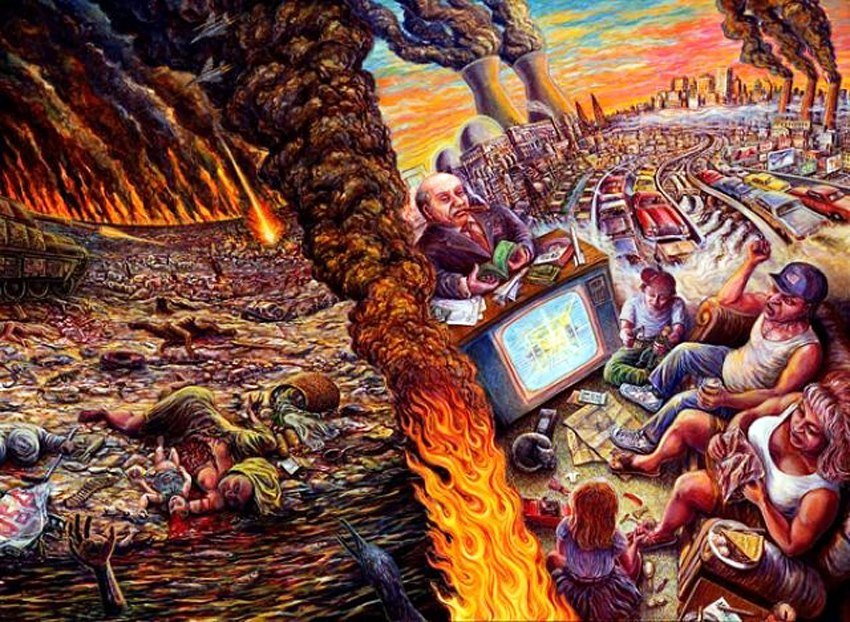
The Dark Age of Misery, The Age that we are living in is called the Age of Kali. (Not to be confused with goddess Kali). In this age, there is no Dharma (Righteousness) and we are spiritually degraded heavily. It is believed that human civilization degenerates spiritually during the Kali Yuga, which is referred to as the Dark Age because in it people are as far away as possible from God. 

In the Sat Yuga, everything was free from deceit, slyness, and greed; and morality was like a bull, with all four legs complete. In the Treta Yuga sin took away one of these legs and morality had three legs. In the Dwapara Yuga, sin and morality got mixed up and morality was left standing on two legs only. In the Dark Age of Kali Yuga, Sin overpowered Morality, and the left is hanging on one leg which is said to collapse soon and Sin will be at its Peak in Kali Yuga. The Age of Kali started when Lord Krishna left this planet for his abode. In this age, the evil force will proclaim the weak and the weak will just be tormented more and more.

Mahabharat’s  Vana Parva, Section CLXXXIX says that in Kali Yuga there will be no morality, each one will be deceitful, cows will be extinct, Brahmins will stop doing fire sacrifices, the land will eventually become non-cultivable, and many more terrible mishaps are revealed in there.

Ever thought who is this Kali? How was He born? Why is He so Evil?

The Birth of Kali 

All sages were gathered at the Naimisharanya forest and they all wanted to know of Kali’s birth they asked Suta to enlighten them to which Suta said.

After the annihilation of the universe, Lord Brahma, from the Dirt (Maleen) accumulated from his back a son was born, having a black complexion. This son was named Adharma (Irreligion). This Adharma married a beautiful cat-eyed lady named Mithya (Falsehood) and they begot a son named Dambh (Pride) who was always very angry and energetic and a daughter named Maya (Illusion). Dambh went into his sister Maya and begot a son named Lobha (Greed), and a daughter named Nikrti (Cunningness). Lobha also went into his sister Nikrti and they begot a son named Krodha (Anger) and a daughter Himsa (Envy). Again Himsa and Krodha performed incest and got a son Kali. Thus Kali was born. Kali is always seen to be holding his genitals in his left hand. His complexion is pitch black. Kali’s abdomen is like that of a crow, his face is frightening to behold, and his tongue is red and appears to be full of greed. His appearance is very fearful and a bad smell emanates from his body.

Kali is very fond of playing chess (gambling), drinking wine (intoxication), enjoying the company of prostitutes (illicit sex), and associating with gold merchants (greed). Further, Kali’s sister was Durukti (Harsh Speech). From Durutti’s womb, Kali begot a son named Bhay, (Fear), and a daughter named, Mrtyu (Death). Bhaya begot a son named Niraya (Hell) from the womb of Mrtyu and Niraya begot ten thousand sons in the womb of his sister, Yatana (Excessive Pain). All these relatives of Kali were the destroyers of sacrifice, the study of the Vedas, and charity because they transgressed all the Vedic principles of religion. They were reservoirs of mental distress, disease, old age, destruction of religious principles, sorrow, lamentation, and fear. Such is the Monstrous evil Kali and his clutches.

Let us try to Analyze the birth of Kali as according to Human traits, the first thing born is Irreligion, when we remove religion from a person’s life we are removing faith, belief, and fear of a higher power which when removed takes away disciple, etiquette and many things. Now let us mix this irreligion with Falsehood, the person at once becomes fake, unfaithful, and also untrustworthy and that leads the person to his own world of Pride and Illusion.  Such a person starts to think that he is really on a higher platform and starts to quench for power, by becoming a leader, Godman, or being the center of attraction in any way. Improper leaders make misguided improper followers. People who gain positions of leading society automatically get so attracted to a sense of gratification that they become blinded with Pride and Illusion making them crave more power, followers, and the ability to fulfill their desire. With every desire getting fulfilled emerges more and more leading to Greed and with Greed to stay in power and in position comes strange ideas, Cunningness. 

When Cunning ideas grow with greed and at times if things are not going your way or if you fail in something then such a situation will lead to Anger and if someone else is getting the success then Envy is sure, that Envy can drive a sane man Insane and all intelligence, choosing what is right or wrong vanishes, and then that every person becomes a personification of Kali. A monster that is on a Rampage to bring the world under him by all means.

Don’t we see cases of a Child killing parents for money or, property? Don’t we see cases when a father rapes his daughter or sells off his daughter for some money just to buy his drinks? We see friends getting violent, mortals claiming to be God, no helping hand during an emergency; Doctors focused on minting money without caring for humanity.

All this is nothing but a Personification of Kali and the goal is to satisfy the senses and enjoy gambling, spend lavishly on intoxication and also indulge in illicit sex.  To talk of Kali’s progeny Fear and Death, it is Fear that does not let us take a stand and Death is the ultimate suffering but for a pious person death is happiness, and with Death and sin comes Hell and in Hell, there is Extreme Punishment for the sins The idea of Kali is not just Literary but it is Practical and we can experience in our day to day life. 

To save ourselves from Kali we need to first eliminate the root cause of the birth of Kali that is Adharam (Irreligion) we need to Serve the Supreme Personality Of Godhead and by his Mercy, we will be freed from the evil clutches of Kali.  And serving God will take away our sins which will free us from any misery of this material world.

The Buddha Mystery

The greatest confusion that I came across is that Buddha mentioned in the Dasha Avatars of Vishnu is mixed or referred to be Gautama Buddha or Shakyamuni Buddha and the Buddhist deny of it. If Gautama Buddha is different from the Vishnu Avatar Buddha then were there Two different identities that got mixed up and people denoted to be the same. ? To answer this confusion I thought of writing this article.


Who is a ‘Buddha’?


‘Buddha’ is a title and this given to anyone who has achieved Buddhahood or enlightenment. The word Buddha means “awakened one” or “the enlightened one”. “Buddha” is also used as a title for the first awakened being in a Yuga era.


Were there more Buddhas before Gautama Buddha?


In most Buddhist traditions, Siddhartha Gautama is regarded as the Supreme Buddha of the present age. Also, he was the last one to achieve Buddhahood but the Theravada Buddhism shows that there were 27 Buddhas that preceded Gautama Buddha and Maitreya will be the Buddha of the future. Also According to Mahayana tradition, each kalpa has 1,000 Buddhas. The previous Kalpa was the Vyuhakalpa, and the present Kalpa is called the Bhadrakalpa. the Buddha of the present Kalpa is Gautama Buddha. So now we come to a conclusion that Gautama Buddha was not the only Buddha, he was but the last one till now as we are awaiting Maitreya Buddha of the future. Some famous Buddhist texts like Prajna-Paramita Sutra, Astasahastrika Prajna-Paramita Sutra, Sata-Shastrika Prajna-Paramita Sutra, Lalita Vistara, reveals the three categories of Buddha, namely:


Human Buddhas: Personalities who became Buddha after enlightenment.
Bodhisattva Buddhas: Personalities who were born enlightened.
Adi Buddha: the Primordial Buddha.


Who is Vishnu Avatar Buddha?


Avatar Buddha is the first Buddha who is also known as Adi Buddha or Primordial Buddha, Mahayana and Vajrayana sects of Buddhism believes Vairochana or Mahavairochana to be the Primordial Buddha and Sakyamuni Buddha to be the Incarnation of Vairochana Buddha. we find the reference of this in  “Brahmajāla Sūtra”:


                       “Now, I, Vairocana Buddha am sitting atop a lotus pedestal; On a thousand flowers surrounding me are a thousand Sakyamuni Buddhas. Each flower supports a hundred million worlds; in each world, a Sakyamuni Buddha appears. All are seated beneath a Bodhi-tree, all simultaneously attain Buddhahood. All these innumerable Buddhas have Vairocana as their original body.”


This verse clearly says that there is one eternal Buddha and there are infinite Sakhyamuni Buddhas all sitting beneath Bodhi tree.


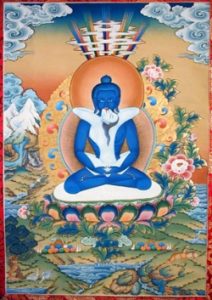
Also, there are some schools of Vajrayana Buddhism and Tantric Buddhism that refer to Vajradhara Buddha or some also say Samamtabhadra Buddha to be Adi Buddha or the Primordial Buddha. therefore the Concept of the First Buddha or Primordial Buddha is well established in Buddhist Literature.


Before looking deeply at the Vishnu Avatar Buddha Let us examine the Cause of Lord Vishnu incarnating as Buddha. In Jayadeva Goswami’s Gita Govindam it is said that he came to stop slaughtering of animals in name of Vedic sacrifice.


nindasi yajna-vidher ahaha sruti-jatam
sadaya-hridaya-darshita-pashu-ghatam
keshava dhrita-buddha-sharira jaya jagadisha hari


           “O Keshava! O Lord of the universe! O Lord Hari, who have assumed the form of Buddha! All glories unto You! O Buddha of compassionate heart, You decry the slaughtering of poor animals performed according to the rules of Vedic sacrifice.”


In the Srimad Bhagavatam 1.3.24, Lord Vishnu’s Advent as Buddha is mentioned as :
tatah kalau sampravritte
sammohaya sura-dvisham
buddho namnanjana-sutaha
kikateshu bhavishyati


       “Then at the beginning of Kali-yuga, the Lord will appear as Buddha, son of Anjana, in the province of Kikata Pradesh (Gaya), just for the purpose of deluding those who are envious of the faithful theist.”


Also in chapters 3.17-18 of Vishnu Puran and Srimad Bhagavatam’s 10th Canto mentions a prayer by Akrura once when he saw Krishna in his four-handed form, he prayed with the following verse mentioned in Srimad Bhagavatam (10.40.22)


namo buddhaya shuddhaya daitya-danava-mohine
mleccha-praya-kshatra-hantre namas te kalki-rupine


           “O, Lord! I offer my obeisance unto Your form of Buddha, who, possessing a faultless nature, deluded the miscreants by composing anti-Vedic scriptures. I also offer obeisance unto Your Kalki form, the annihilator of the wicked kshatriyas who are no better than barbarians.”


There is another prayer by Indra in Srimad Bhagavatam (6.8.19), buddhas tu pashanda-gana-pramadat. Indra prayed, “O Lord Buddha! Save me from the defect of indifference born out of atheistic hypocrisy.”


Madhavacharaya Mentions a Story referring from Bhramanda Puran in His Treaties Bhāgavatatātparya.
mohanārthaṃ dānavānāṃ bālarūpī pathi-sthitaḥ
putraṃ taṃ kalpayām āsa mūḍha-buddhir jinaḥ svayam
tataḥ saṃmohayām āsa jinādyān asurāṃśakān
bhagavān vāgbhir ugrābhir ahiṃsā-vācibhir hariḥ
                                           — Brahmanda Purana, Bhāgavatatātparya by Madhvacharya
“To delude the demons, he stood on the path in the form of a child. The foolish Jina (a demon), imagined him to be his son. Thus the Lord Sri Hari expertly deluded Jina and other demons by his strong words of non-violence.”


There are many mentions in Scriptures about Vishnu incarnating as Buddha to delude demons and people from the path of Vedas, the mentions can be found in Harivamsa (1.41),Vishnu Purana (3.18), Garuda Purana (1.1, 2.30.37, 3.15.26),Agni Purana (16),Naradiya Purana (2.72) Linga Purana (2.71),Padma Purana (3.252). we can thus identify with the cause of the advent of Lord Vishnu as Buddha. People of those times were not following the Vedas correctly, the religion was deteriorating so to establish the philosophy of non-violence and to convince followers of Vedic customs who were bent towards animal slaughter in name of sacrifice and rituals, to give up such violent acts and follow him on the path of Non-violence.

The Birth of Adi Buddha
Adi Buddha was born in Kikata Pradesh which is now Bodh Gaya to Mother Anjana and father Hemasadana.

“After the passing of 3600 years of Kali-yuga, Lord Buddha, the avatar of Vishnu, the savior of dharma, will appear in the Magadha territory from the womb of Anjani, fathered by Hemasadana. He will perform many glorious tasks and rule over the earth containing seven islands, for sixty-four years. Then, safeguarding His glories
with His devotees, He will retreat to His abode.” beginning of Kali-yuga. the reference for this we can find in Srimad Bhagavatam’s above verse (1.3.24) and also in the 40th chapter of Maheshvara section of Skanda Purana.
The following verses from Nirnaya-Sindhu show the time of the birth of Adi Buddha: ” jyaishtha shukladitiyayam buddhajanma bhavishyati” “Buddha will take birth on the 2nd day of the Shukla Paksha of the month of Jyaishtha.”


Birth of Shakyamuni Buddha or Gautama Buddha

 
Gautama Buddha was born as Siddhārtha at Lumbini, which is in present-day Nepal on full moon day of the month Vaisakha. His father was a king named Suddodana, and his mother was the Mayadevi. Siddhārtha lived in luxury with trouble and hard work kept far from him; A seer predicted that if Siddhārth stayed inside his palace his whole life, then he would become a great king. However, if he left the palace, then he would become a great ascetic. The king did not want his son to become
an ascetic so he kept his son in the palace.
 

When he was older, his father found a woman for Siddhārtha to marry at the age of 16. He married the woman named Yashodhara, and they had a son, Rahul. Although Siddhārtha had everything he could want, he still was not happy. He wanted to learn the meaning of his existence.

Once he got out of the castle against his father’s orders. He saw the “Four Passing Sights”: an old crippled man, a sick man, a dead man, and a holy man with no home. Right then, Siddhārtha knew that nothing can stop people from being born, becoming old, getting sick, and dying. He decided to give up his worldly life. He would look for the answer to the problem of birth, old age, sickness, and death. He left his home and decided to find answers. After a great search he reached Gaya and found a fig tree where he sat down in meditation for 49 days while he was meditating a demon by the name Mara attempted to distract Buddha with numerous attempts like hurling weapons, fire, taking form of beautiful women and so on but Siddhārtha was not affected and all attempts of demon failed and thus Siddhārtha conquered Mara and achieved enlightenment and found answers to all his questions and how could he end the suffering of material world.

Siddhārtha ‘s Guru was Gautama so he took his name and was called as Gautama Buddha, and since he was of Sakhya clan he got the Name Sakhyamuni.

Was Gautama  Buddha aware of this primordial Buddha?
The Buddhist Scriptures say that Gautama Buddha was very well aware of the primordial Buddha, as we saw earlier that Gautama Buddha was the Human form of the Eternal Buddha, and the Scriptures also suggest that Vairochana or Vajradhara, Samamtabhadra Buddha incarnated as Shakyamuni Buddha and will incarnate as Maitreya the Buddha of future.  there is the Buddhist text Lalita Vistara, Chapter 21, page 178, where it is described how Gautama Buddha meditated on the same spot as the primordial Buddha or Vishnu avatar Buddha:
cha dharanimunde purvabuddhasanasthaha
samartha dhanur grihitva shunya nairatmavanaiha
klesharipum nihatva drishtijalancha bhitva
shiva virajamashoham prapsyate bodhim agryam


       “The one seated on the hallowed earth of the previous Buddha’s birthplace is on the path of voidism and renunciation. With his weapon, the powerful bow, he vanquishes the enemies of distress and illusion. Thus with wisdom, he will attain the auspicious state of grieflessness and worldly detachment.”


This verse proves that Buddha meditated on the birthplace of the primordial Buddha (Purvabuddhasanasthaha), that very place where the primordial Buddha is said to be born is Kikata Pradesh, modern-day Gaya and it is this place Gautama Buddha got Nirvana.


Thus concluding we can see that Gautama Buddha and Vishnu Avatar Buddha are two different Personalities not to be considered the same. the Principals of Buddhism was started by Adi Buddha which was carried by succeeding Buddha’s and last Buddha being Gautama Buddha.


I am listing out the differences once again in the table below to identify the two personalities.


Adi Buddha
Gautama Buddha
Birth Place
Kikata Pradesh (Present day Gaya)
Lumbini  (present-day Nepal)
Parents
Father- Hemasadana
Mother- Anjani
Father- Suddodana
Mother- Mayadevi
Time of Birth
Shukla paksha Purnima
Month of Birth
Jyestha
Vaisakha
Position in Hierarchy
First Buddha
28th Buddha
Enlightenment
Became enlightened after 49 days of meditation
Eternally enlightened
Demons fought
Jina
Mara
Seat
Lotus Pedestal
Bodhi tree


Twelve Narasimha Temples of Tamil Nadu- Part 4

10. Lakshmi Narasimha of Singar Kovil
 

Lakshmi Narasimha of Singar Kovil

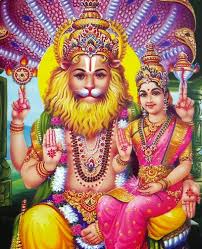
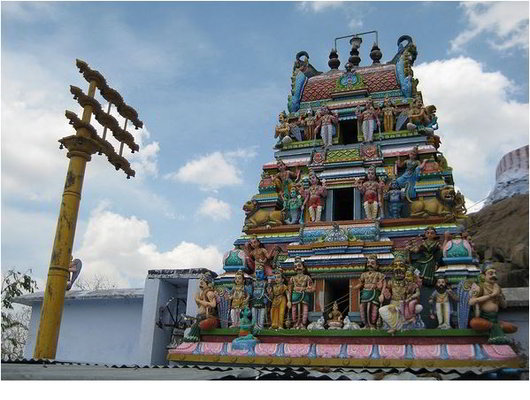
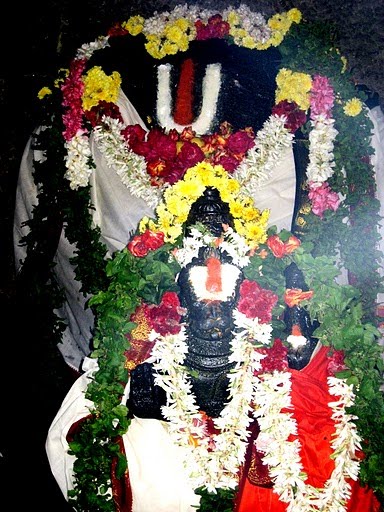
This temple is situated at a distance of about 25 km from Vellore and is off the main road from Vellore to Polur. It is an exclusive shrine for Lord Lakshmi Narasimha and is believed to be at least 1,300 years old. This temple is on a small hillock, which is nearly 80 to 90 feet high and can be reached after climbing about 50 steps. A tiny river flows in front of the temple and we have to cross the river by foot. Here Lord  Lakshmi Narasimha is six feet tall and is seen in a sitting posture with four hands — two hands hold the Shanka and Chakra. His third hand is on his lap and his fourth hand is around the goddess Lakshmi.
The Legend


Not much is known about the temple. This 10th-century shrine is said to have been built by the local chieftain, Rajavarman, at the behest of Lord Narasimha, who appeared in his dream.


11. Narasinghapuram Shanta Narasimha
Narasinghapuram Shanta NarasimhaA 1400-year-old temple Narasimha temple located about 55 km from Chennai and 21 km from Arakkonam, in Narasingapuram, Thiruvallur, dating back to the early Pallava Period where Lord Narasimha is seen as a ‘Shaanta Narasimha  ’. The deity also has the name ‘Sri Kalyana Lakshmi Narasimha ‘ since Lord Narasimha embraces Goddess Lakshmi closely. Here Garuda is seen with 16 kinds of snakes around him. It is believed that those who worship this temple for about nine Swathi Nakshatrams are entitled with complete bliss and are blessed with health, and wealth, and are freed of any associated problems those Regards. I couldn’t find any legend associated with the creation of this Temple.
12. Dakshina Ahobilam of Avaniyapuram


This is a very special temple it is also called Dakshina Ahobilam (Ahobliam in the south), here you can have Darshan of 5 Divya Desam deities and also Nava Narasimha, this temple is. this temple is located at Avaniyapuram is located 20 km from Cheyyar and is on a small hillock. Avani means lion and the Lord is said to have obliged Brigu Maharishi by appearing before him in the forms of five Divya Desa deities.


Dakshina Ahobilam of Avaniyapuram
At Avaniyapuram, Lord Narasimha is found in a small cave. There is Yoga Narasimha on the same hill at a higher altitude where Lord Venkateswara is housed. Here Lord Narasimha is in a sitting posture, Mahalakshmi who has the face of a lioness is seated on his left thigh. His left arm is around His Consort and His right hand is in Abyaha Hasta position. His upper hands are holding the chakra and the conch.
 
There is a separate shrine for Mahalakshmi near the Narasimha temple. There are five Narasimha deities all looking alike next to the Mahalakshmi temple. Thus we have eight Narasimha deities and it makes a total of nine including the Yoga Narasimha atop the hill.
The abode of Lord Venkateswara is at the top of the hill. Here Lord Venkateswara is standing armed with Chakra and Shanka. There is a separate cave-like enclosure in the prahara of Lord Venkateswara where we see Lord Varadaraja and Perundevi Thayar. Lord Ranganatha is seen on His serpentine bed with Ranganayaki Thayar. Yoga Narasimha is in a sitting position along with Amirdavalli Thayar. 
Thus we see all the main Pancha Divya Desa Deities — Kanchi, Srirangam,
Sholingur, Tirumala and Ahobilam.
The Legend
 During the time of Treta Yuga Lord Brahma was doing a fire scarifies and that time from the fire of the Sacrifice Lord Narasimha appeared in front of him. Due to the heat Lord didn’t have a face when he came from the fire. Seeing this Mahalakshmi told to Narasimha how you will give Darshan to Devotees without a face hence please grant me your face to me. Pleased by the Mahalakshmi lord gives his face and hence in this Kshetra Mahalakshmi with lion face giving darshan to all and this day is celebrated once in 60 Years of Sarvadhari Samvathsarm Aani Month 9th day.
Narasimha-Killing-Hiranyakashipu-Prahlada-Garlanding-the-Lord_HDR

Twelve Narasimha Temples of Tamil Nadu- Part 3

7. Polur Lakshmi Narasimha

Polur Lakshmi NarasimhaSri Lakshmi Narasimha Temple is located at Polur. Polur is situated on the state highway between Tiruvannamalai and Vellore districts.  The hill is called Sampathgiri and the main deity is the Swayambu Sri Lakshmi Narasimha. There are two vultures that fly around the hill and people believe that they are the two brothers Koasthiya and  Pularshtriya. The hill which is opposite Sampatha Giri is called Sapthagiri. It is believed that the 7 sages still reside in this mountain

The Legend

One legend that I came across reading is once A group of workers was breaking down stones on a hill called Sampathgiri in Polur village in Thiruvannamalai district of Tamil Nadu. Workers were busy doing their job. One of the worker’s spear hit a rock, and to everyone’s shock, it started bleeding. They were frightened and left for the day. On the same night, Lord Narasimha appeared in one of the devotee’s dreams. Lord Narasimha said that he has come on his own to Sampathgiri as Shanta Murti. The next day, the devotee informed the villagers. All the villagers came to see the idol. They were all shocked to see the Lord bleed. All the villagers came together and built a  place of worship for Lord Narasimha. A temple was built atop the hill for Lord Narasimha. Later people installed Lakshmi- the consort of Lord Narasimha.

Lord Narasimha later invited two brothers namely Sage Kolasthiya and Sage Pulasthiya to this temple. These two Sages were ardent devotees of the Lord. These two sages did penance to please Lord Narasimha. Pleased by their Devotion, Lord Narasimha gave them a mango. A fight broke up between the two brothers as to who would take the mango. In the spur of the moment, Sage Pulasthiya chopped his younger brother Kolasthiya’s hands. Even after losing both hands, Sage Kolasthiya continued to worship the Lord with great devotion. He took bath at ”seyyar” for 48 days and circled the Sampathgiri. After the 48th day, Kolasthiyar’s hands reappeared magically! This not only surprised the sage, but also others present. It was Lord’s plan that Ustav Murthi should be installed by Kolasthiya. Lord came in Kolasthiya’s dream and gave direction as to where the Utsava Murti was. It was in a place called Karapoondi in Seyyar. The sage went to look for the Utsava Murti with the direction given by the lord. He found the Utsava Murti and established a temple.


8. Yoga-Narasimha of Chintalavadi

 Yoga Narasimha of Chintalavadi

Chintalavadi Yoga-Narasimha temple is situated in a small village called Chintalavadi on the banks of river Kaveri. The place is about 50 KMs from Trichy on the way to Karur. The temple is located in a serene environment with a lot of greenery around with the trajectory of Kaveri flowing just beside the temple.
The Legend
Once Lord Yoga-Narasimha appeared in the dream of a pious Brahmin by the name Aryaachar from Srimushnam. The Lord mentioned to the Brahmin that a  washerman was actually washing clothes on his back and told him about the exact location. He also asked him to locate the stone on which the washerman was washing and then carry it in a particular direction until the stone gains weight. At the point where he can no longer carry the stone, he asked him to keep it down.
As per the instructions of the Lord, Aryaachar went looking for the washerman and found him. When the stone on which the washerman was washing the clothes was turned they found Lord Yoga-Narasimha carved on the bottom side of the stone.
 
Aryaachar then carried the stone in the direction as instructed by Lord and when he came to the banks of Kaveri he had to put it down. This place is Chintalavadi.  Another Legend says that this place was experiencing lot of difficulties like drought, forest fire, etc. At this time Vysarayaru was camping at Srirangam and on hearing the news about Chintalavadi, he apparently traveled there and located the Yoga Narasimha Vigraha and started worshiping and the place prospered.
 
9. Namakkal Narasimha

Namakkal Narasimha

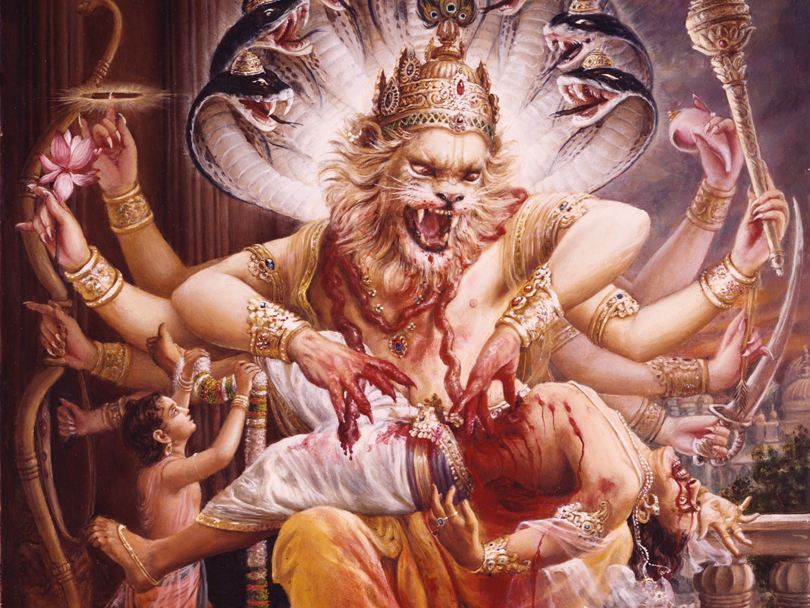
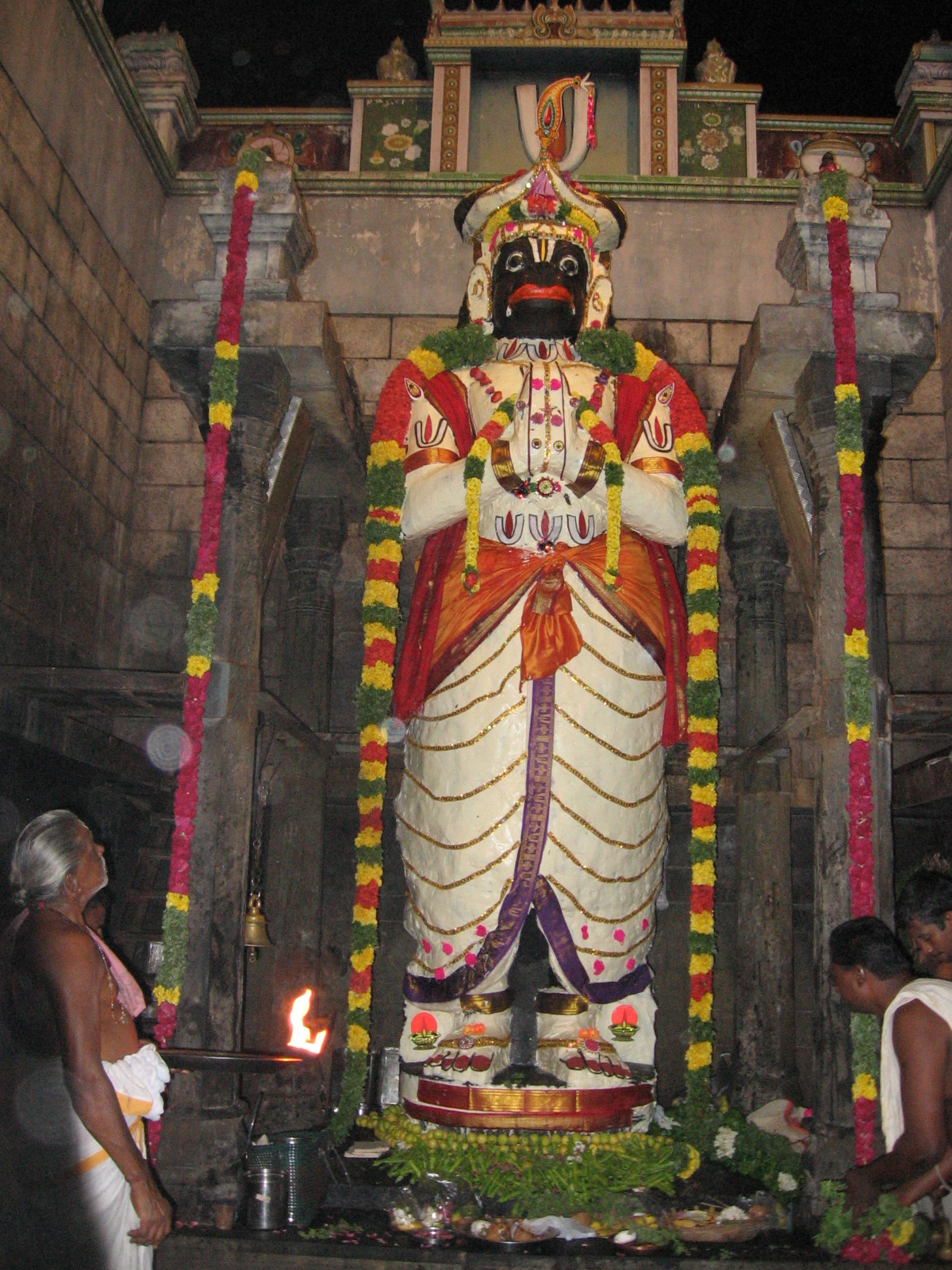
Located about 55 km from Salem off the Bangalore- Kanyakumari NH 7 is the Narasimha temple at the Salagram Cave Hill in the Namakkal district of Tamil Nadu. Opposite the Narasimha temple is the Anjaneya where he is seen standing 18 feet tall with a Japamala in hand and a sword in the waist facing Lord Narasimha. Lord Narasimha here is depicted with sharp nails used to kill Hiranyakashyapu with palms having stains of blood. There are Janaka, Sanadhanar, Sun, Moon, and Brahma around Him.  The Lord is generally known as Sri Lakshmi Narasimha if the goddess Lakshmi is on his lap.  In this temple, Sri Mahalakshmi has Her place on the chest of the Lord. The idol is 18 feet tall


The Legend
During the Rama Incarnation, Hanuman had to fly to Himalayas to get Sanjeevni Herb to save Lakshman’s life, Hanuman however could not find the Herb so he brought a hill from there and also flew back to replace it. on his return, after replacing the hill he stopped to bathe in river Gandaki in Nepal, where he found a Salagram Shila and brought the Shila back.

While he was flying back the sun had risen and Hanuman had to bath and perform his morning rituals, but he could not hold the Salagram as it Namakkal Anjaneya

cannot be placed on earth. That place where Hanuman stopped is the place where Goddess Mahalakshmi was doing Penance.  Hanuman determined to do his morning Rituals asked Goddess Mahalakshmi if she can hold the Salagram. Goddess Mahalakshmi agreed on the condition that She would place it down if he did not return with a stipulated time. Lakshmi could not bear the weight and Hanuman could not come in time so Goddess Mahalakshmi placed the Salagram at this place, which grew into a mount before Hanuman could return. when Hanuman returned he tried to lift the Salagram. But he could not lift it. Narasimha appeared before both of them and set his abode at this place telling Hanuman to proceed to Lanka to help Lord Rama. also, Narasimha said  If you want to worship me, you will come here after Lord Rama returns to Vaikuntha and pray ever in front of me in Kaliyuga.
 
Thus Sri Hanuman is even now at Namakkal Sthalam in the western side of the rock standing in the open air, worshipping Lord Narasimha.
prahlada-narasimha

Twelve Narasimha Temples of Tamil Nadu- Part 2

 
4. Patalathri Narasimha of Kanchipuram
Patalathri Narasimha of KanchipuramSingaperumal Kovil near Chengalpet is Situated in the Kanchipuram District of Tamil Nadu is Singaperumal Kovil which is home to a frequently visited ancient Patalathri Narasimha. Patalam means red.  Athri means hill.  As Lord Narasimha appeared here furiously with red eyes and the huge size of a hill so the place came to be known as Patalathri.
 
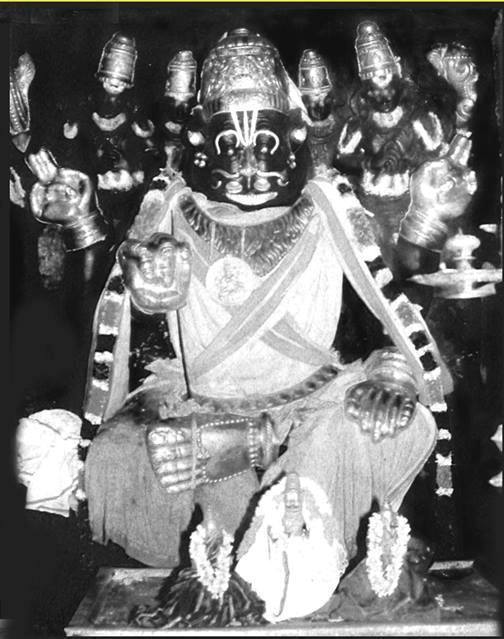
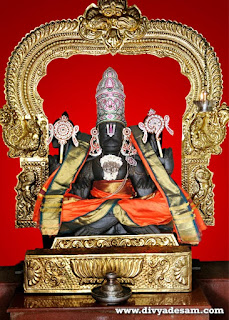
Lord here graces with four arms, two of them holding Sudarsana and Panchajanya and the third in Abaya Hastha” Mudra with the fourth pointing towards the earth. in a sitting posture, He graces along with Sridevi and Bhudevi.  Lord Patalatri Narasimha has three eyes and wears the Salagrama and Sahasranama garlands. It is believed that if one gets the darshan of the Third Eye, all misery in life would be removed. You can get a darshan of the third eye during arati when the priest would lift tilaka.
The Legend
This temple has been referred to in Brahmaanda Purana. This place was surrounded by dense forests during the period of the Narasimha avatar. Maharshi Jabali performed intense penance in this place seeking the desire to see Lord Narasimha. Lord granted the sage’s Desire and appeared in front of him during the twilight time. Based on the event, Abhisheka is performed to the Lord at this time on Pradosha days.
Annavillappan
Another legend says that Appachiaranna a great devotee of Lord Narasimha had a son named Annavillappan who learned Ubhaya Vedantham from Daasarathi Appai and Kandadai Appan. Annavillappan was extremely devoted to his Kuladevta Narasimha. Patalathri Narasimha appeared in his dream and told him to spruce the jungle and bring out his temple drowned in a sand dune at Patalathri. This place is now known as ‘Singa Perumal Kovil ‘. Annavillappan rehabilitated the Patalathri Narasimha deity which had drowned under a sand dune, as per Lord Narasimha‘s directive, and created the village and also brought and settled people to serve the Lord in Temple. He constructed the tower, etc., and worshiped him.


5. Lakshmi Narasimha of Poovarasankuppam
Lakshmi Narasimha of Poovarasankuppam
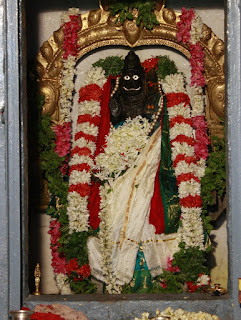
One of the foremost shrines of Lakshmi Narasimha is Poovarasan Kuppam, near Villupuram district Tamil Nadu; The presiding deity is Lakshmi Narasimha. This temple is approximately 1200 years old. It is said that for the first time, after killing Hiranyakashipu at Ahobilam, Lord Narasimha appeared at Poovarasankuppam in the same form and gave Darshan to the Sapta Rishis as Lakshmi Narasimha. therefore it is believed that one who cannot have the darshan of Narasimha at Ahobilam, Andhra Pradesh Can Have Blessings By Visiting This temple In Poovarasankuppam. A unique feature here is the posture of Mahalakshmi, who is seated on the lap of Lord Narasimha and has one eye towards the Lord and the other eye gracing devotees.
The Legend
Lord Narasimha took an instant incarnation as answering the prayers of his devotee Prahalada to slay the demon Hiranyakashipu. After slaying the demon, his anger did not subside and he roamed all over India. At Poovarasankuppam on the Northern shore of the river South Pennai in South India, the Saptha Rishis prayed to the Lord to have his darshan. Lord appeared here in front of the Sapta Rishis. However, Rishis could not bear the intensity of heat emitting from the Lord and requested his consort to calm him down. Goddess Lakshmi, obliged and sat on the Lord’s lap and looked at him with one eye and the Rishis with the other. This act of the Goddess Lakshmi brought a soothing and tranquil effect on the Lord. To this day, it is only at this temple in the whole world that Lord Lakshmi Narasimha is in such a pose.


6. Yoga Narasimha of Sholingur

Yoga Narasimha of SholingurLocated about 90 km west of Chennai and about 25 km from Arakkonam, atop a hill on a single stone is the Yoga Narasimha temple in Sholingur, also called Thiru Kadigai. There are three separate shrines of Vishnu in the form of Narasimha, Bhaktavatsala Perumal, and Hanuman. They are situated on the larger hill, at the base of the larger hill and on the smaller hill respectively.  Vishnu Purana and Padma Purana refer to this place as Kadigai and since Vishwamitra got his Brahmarishi title here, it became Simhapuram
The Legend
Here at Solingur Sage Vishwamitra undertook penance here and was blessed by Lord Narasimha who appeared within a fraction of time (one Kadigai) and also he gained a Brahmarishi title with his prayers to Lord Narasimha. Ages Passed by towards the end of Rama Avatar, Following the footsteps of the Vishwamitra, Some Sages too undertook penance here at Sholingur wanting a darshan of the Narasimha Avatar and hoping to get the darshan within a fraction of time. It is said that even if we sleep for 1 Kadigai in this Dham, we will get liberation. That kind of nature and specialty, this Kshetram has got. The sages doing penance here were troubled by demons named Kalan and Keyan in the region and they prayed to Lord Rama, for protection.
Yoga Hanuman of Sholingur


At the end of the Rama Avatar, Hanuman wanted to join Rama in his abode at Vaikuntam. However, Rama had other thoughts and asked Hanuman to go to Sholingur to protect the Sages from demons Kalan and Keyan. Hanuman could not initially kill the demons and he prayed to Lord Narasimha. Lord Narasimha appeared before Hanuman and gave him Shanka and Chakra with which Hanuman Killed the Demons also Lord Narasimha asked Hanuman to remain here, as Yoga Anjaneya, with the assurance that he would take Hanuman into Vaikunta Dham during Kali Yuga.

Abiding by the Lord’s wishes, Hanuman is said to have remained here atop the small hill and is seen here with four hands in a Yoga posture with Conch, Chakra, Japa Mala, and the fourth hand with counting the Japa.


This is the only Divya Desam with such special prominence for Lord Hanuman.

Sri-Nrisimhadeva-in-Mayapur

Twelve Narasimha Temples of Tamil Nadu- Part 1

 
In Sat Yuga the two gatekeepers of Vaikunta due to the curse of the four kumara were born as demons Hiranyakashipu and Hiranyaksha, Hiranyaksha was killed by Mahavishnu in his Varaha or boar incarnation rescuing Bhoomi Devi. The elder Hiranyakashipu to take revenge on Lord Vishnu did severe penance and got a boon from Lord Brahma, that he will never meet death by human beings, animals, earth and sky, by any instruments in and out of the houses, etc. Then Hiranyakashipu, on the Power of the boons, troubles everyone and forced everyone to worship him.  Hiranyakashipu had a son Prahalad who was a great devotee of Vishnu, Hiranyakashipu then even tortured and tried to kill his own son and then Lord Vishnu took the Narasimha incarnation and killed Hiranyakashipu according to the conditions of the boons received by Lord Brahma. Lord Narasimha is said to appear in Ahobilam, Andhra Pradesh, and is widely worshipped in South India. Here I am enlisting the twelve important Places of worship in Tamil Nadu.


1. Lakshmi Narasimha – Anthili


Anthili Lakshmi Narasimha

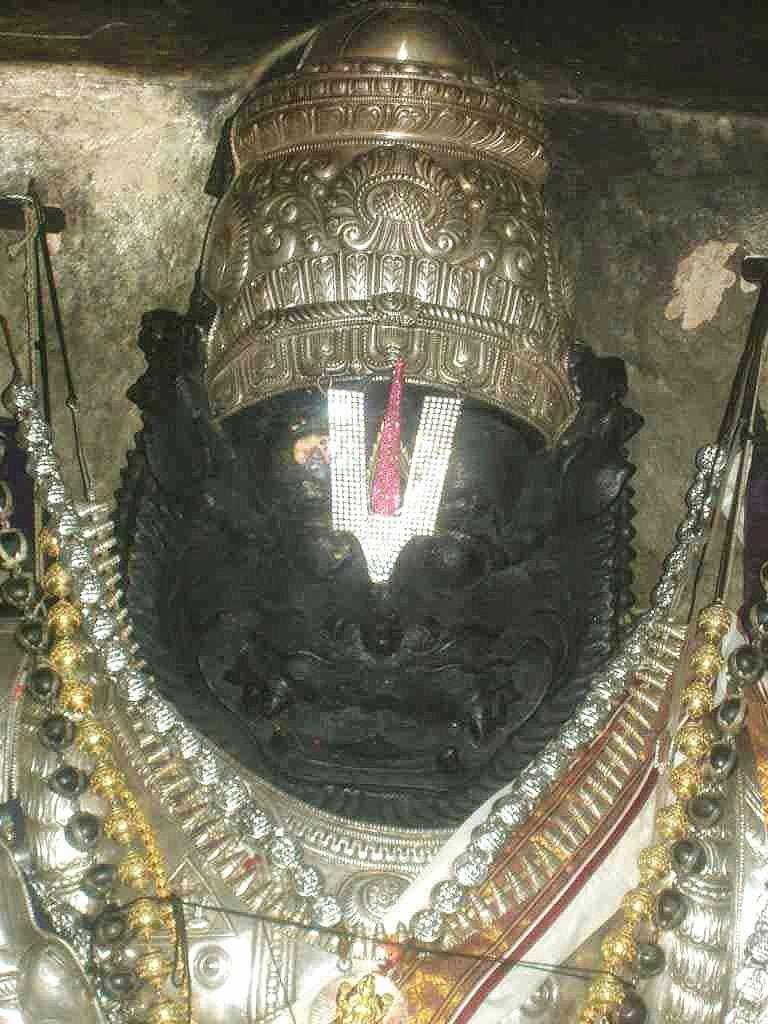
A very famous 1600 years old Narasimha temple was built on a rock in a Garuda shape. is Located 195 km South West of Chennai off the Villupuram-Thiru Kovilur SH7 on the banks of Pennai River. It is also noteworthy that the rays of the Sun fall on the presiding deity on all 365 days of the year

 The Legend

Lord Narayana comes to the rescue of His devotees without any delay. In the avatar of Narasimha, Lord rushed to help his devotee Prahlad. In his swift action, he did not wait for his mount Garuda but appeared instantly from a pillar and protected Prahlad. This caused much anxiety to Garuda who felt being left out. Garuda wanted to know whether he had committed anything offense. So He left Vaikunta and started intense penance without food and water at Anthili.

 The severe penance of Garuda pleased the Lord who appeared before him and asked him the reasons for his penance. Having stated the reasons, Garuda requested the Lord to relieve him of his anxiety. Then and there the Lord gave him darshan as Lord Narasimha with Mahalakshmi seated on his lap. Garuda pleaded that this darshan should be to the people at large.

2- Lakshmi Narasimha of Parikkal
Parikkal Lakshmi Narasimha An 1800-year-old Lakshmi Narasimha temple in Parikkal city of Viluppuram district in the state of Tamil Nadu. Narasimha is generally seen in his furious form embracing  Goddess  Mahalakshmi while she is seated on His lap. This is the only temple in India where Lord Narasimha and  Mahalakshmi are seen embracing each other. This is to show that Lord Narasimha has shed His fury and graces devotees with all mercy.
The Legend

 A king Named Vasantharaja a great devotee of Lord Narasimha ruled this place with his capital at Vriddachalam and wanted to build a temple for Lord Narasimha.  He was constantly troubled by a demon named Parakalasura who was said to be a relative of Hiranyakashipu. King Vasantharaja undertook great penance here as directed by his Guru. Answering his prayers, Lord Narasimha appeared here and killed the Parakalasura. Having only seen the destructive mood of an angry Narasimha, King Vasantharaja invoked the blessings of Goddess Lakshmi to provide Darshan with the Lord displaying his softer form. Goddess Mahalakshmi is said to have sat on his lap, cooled him down, and provided Darshan to king Vasantharaja, and to all the Demigods and sages at this place. Delighted seeing Lord Narasimha in this form, king Vasantharaja requested that this place be named after the Demon who provided the king with the opportunity to have a Darshan of the Lord. Hence, this place was referred to as ‘Parikala’puram, which in course of time became ‘Parikkal’.


3. Ugra Narasimha of Singri   


Singri Ugra Narasimha

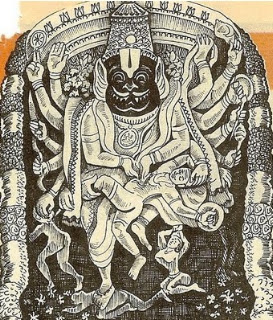
Singarkudi is a famous temple of Ugra Narasimha situated between Pondicherry and Cuddalore. Here Lord Ugra Narasimha appears very furiously with 16 hands as at the time of destroying Hiranyakashipu.

In each one of the sixteen hands, either an action or a gesture is shown or a weapon is held in the following manner.

 To the right: 1. Banner, 2. Sudarsana Disc set to motion, 3. Hand–Dagger, 4. Arrow, 5. Severing the demon’s head, 6. Knife, 7. Holding down Hiranyakasipu’s leg, 8. Tearing out Hiranyakasipu’s intestines.

 To the left: 9. Holding up a garland of demon’s intestines, 10. Conch, 11. Shield, 12. Bow, 13. Mace, 14. Severed head, 15. Pressing down Hiranyakasipu’s head, 16. Tearing out Hiranyakasipu’s intestines.

He killed Hiranyakashipu facing west, here too the Lord is facing west. On the left of Narasimha is Hiranyakshyapu’s wife Neelavathi and are three demons seeking His darshan, Prahladha, Sukra, and sage Vasista on the right. Yoga Narasimha and Bala Narasimha in small form face the north. This is a rare portrayal of three Narasimha in a Garbgriha


The Legend


Nimi Chakravarthy belonging to the solar race was endowed with a sharp intellect. A devout person he conducted many Fire sacrifices s and secured many boons from the Devas. He wanted to perform Indra Fire Sacrifice for the welfare of mankind. Thus the king approached his guru Vasishta and informed him about the Fire Sacrifice and also requested Vasishta to conduct the Fire Sacrifice. Since Vasishta was reluctant to perform Fire Sacrifice for Indra he expressed his inability to perform but assured that he would visit him the following day.
The king, however, decided to go ahead with the Fire Sacrifice with help of Sage Koushika, after conducting the Fire Sacrifice successfully he wanted to take a rest and retire to his palace. He ordered his guards not to allow anyone to visit him. At this juncture, Sage Vasishta wanted to have a rendezvous with the king and asked the guards to allow him into the palace. The guards refused permission. Enraged at this act the Sage Vasishta cursed the king to lose his identity and wander in the atmosphere without a body. The king knew about the Incident and for his part cursed the Sage likewise. The king felt that it is not proper for a Sage to curse anyone while he is asleep. Thus the sage and the king were roaming in the atmosphere without a body aimlessly. All sages assembled and wished to perform a Fire Sacrifice to redeem them of the curse. But the king did not want to assume his normal self instead he wanted to worship God through the eyes of mankind.
Sage Vasishta approached his father Brahma and sought his guidance. The four-headed Brahma at once asked him to proceed to Singarkudi and do Penance propitiating Narasimha. As suggested by his father the sage went to Singarkudi and attained salvation through penance. Narasimha pleased with his devotion gave darshan to him.
Goddess

Goddess from the Epics you wouldn’t want to meet.

 
There are many Goddesses and quite can be violent in around world Mythology and Cultures. But I came across really brutal and violent Goddesses from the two great Epics the Canaanite Epic Ba’al and the Finish Epic Kalevala. These goddesses are such that you would definitely not like to meet them. Epics generally show a Hero’s journey but these two epics mention brutality by Goddesses
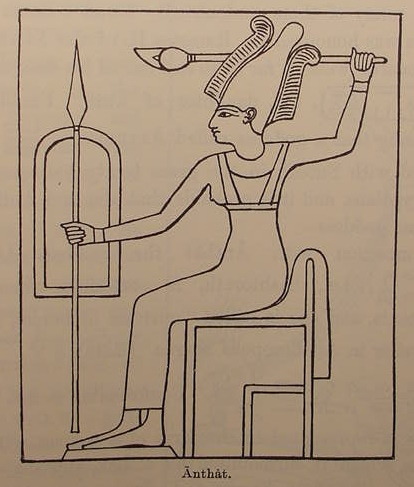
 Goddess Anat

From The Epic of Ba’al (Ugaritic Mythology)


From The Epic of Ba'al Ugaritic MythologyAnat was one of the chief deities of the Canaanites, people of Syria and Palestine in the ancient Near East. A goddess of love, fertility, and war, she was the sister and wife of the god Baa. In the  Ugaritic mythology, Anat appears as a fierce, wild, and furious warrior in a battle, wading knee-deep in blood, striking off heads, cutting off hands, binding the heads to her torso and the hands in her sash, driving out the old men and townsfolk with her arrows, her heart filled with joy.

‘Anat is a violent war goddess, a virgin who is the sister and, according to a much-disputed theory, the lover of the great god Ba‘al Hadad. Ba‘al is usually called the son of Dagan and sometimes the son of El, who addresses ‘Anat as “daughter”. ‘

In the 14th century bc Ugartic text The Epic of Ba’al, She defends Her brother the storm-God Ba’al. But Mot triumphs against Ba’al and sends Him to the land of the dead; Anat, with help from the sun Goddess Shapash, Who has access to the Underworld, brings Him back to life. Anat then takes revenge on Mot, cutting Him up into tiny pieces, winnowing Him like grain, grinding Him up, and then sowing Him in the fields. Before Anat goes into battle She anoints Herself with henna and ambergris. She dresses in saffron and purple-dyed clothing. She then proceeds to slaughter the enemies of Ba’al, across west and east, hanging severed heads from Her back, and affixing hands to Her belt. Laughing and rejoicing, She wades to Her knees in the blood of soldiers, “to Her thighs in the gore of quick warriors.” When the slaughter is finished, She then washes in the rainwater of Her brother Ba’al and again adorns Herself with ambergris.


Goddess  Loviatar, From the Finish Epic Kalevala


Goddess  Loviatar From the Finish Epic KalevalaThe goddess of death, disease, and desolation of Finnish mythology. She is the blind daughter of Tuonetar and Tuoni, Goddess and God of the Underworld.  She is mentioned in the 45th rune of the Finish Epic Kalevala. The epic describes her as the most wretched daughter with the blackest of hearts bent on unleashing the most wicked and terrible illnesses upon the mortal lands. She is known for being blind, ugly, and old, a virgin.

Loviatar is credited as the mother of the most horrifying evils in the world. Each of her nine sons is the most appalling disease. The epic Kalevala provides a description of Loviatar’s impregnation and the birth of the nine terrible children.  Loviatar is made pregnant by the east wind. She is greatly distressed and burdened by their weight.  She travels “by the mountain springs and fountains, by the crystal waters flowing, by the sacred stream and whirlpool, by the cataract and fire stream”, all the while blind and in great pain over her labor.  When she went into labor, Loviatar went to Louhi, the Goddess of sorcery, who helped her to give birth to nine sons. The first eight of these sons she named Pistos (consumption), Ähky (colic), Luuvalo (gout), Riisi (rickets), Paise (ulcer), Rupi (scab), Syöjä (cancer), and Rutto (plague). The ninth, who personified envy, was not named. Thus due to the birth of such nine dreadful children, Loviatar is the most violent of the goddess.

Goddess Lakshmi

Why Lakshmi never visits Brāhmaṇas ?

 
Brāhmaṇas are first in Vranashram, born out of Purusha’s mouth “Braahmanno-Asya Mukham-  Aasiid” (Purusha Suktam RV.10.90) the head of the society responsible to impart knowledge and take care of the places of worship. Advisors to the rulers during ancient times remain always poor with monetary riches but poses a wealth of knowledge. Monetary wealth is caused when Goddess Lakshmi the Goddess of wealth visits one’s house, along with her she brings riches, but Goddess Lakshmi refuses to grant riches to Brāhmaṇas, wonder why?  


Brāhmaṇa’s occupation is teachers and people who carry out deity worship and perform rituals, generally live on donations they get, they are not supposed to accumulate wealth. As stated in Manu Smriti (Laws of Manu)
          
To Brahmanas he assigned teaching and studying the Vedas, sacrificing for their own benefit and for others, giving and accepting of alms (Chap 1, verse 88).

 A learned Brahmana must carefully study them, and he must duly instruct his pupils in them, but nobody else shall do it. (Chap 1, verse 103).


Bhramanas According to Vedic Culture. A Brāhmaṇa is supposed to devote his whole life to understanding Brahman. Brahma jānātīti Brāhmaṇa: one who knows Brahman is called a Brāhmaṇa. charity is offered to the Brāhmaṇas because they are always engaged in higher spiritual service and have no time to earn their livelihood. As the householders are engaged in family affairs and have forgotten their actual purpose in life. As it is said in the Vedas, one should awake and achieve what is due to him in this human form of life.  There are also a few legends associated with the Brāhmaṇa being poor. the legends illustrate why the goddess of wealth Lakshmi never sets foot in the house of Brahmana and thus Brahmanas remain poor.

Sage Bhrigu’s Fault.

          Once Sage Bhrigu was given a task to test the divine trinity Brahma, Vishnu, and Shiva as to who should be the presiding deity for sacrifices. Upon being entrusted with the task Maharishi Sage Bhrigu decided to test Lord Brahma first. He went on to see Lord Brahma in Brahmaloka. Where Lord Brahma did not welcome Sage Bhrigu   Maharishi, to the inhospitality of Lord Brahma, Sage Bhrigu  Cursed Lord Brahma that he won’t be a worshipable deity. After which Sage Bhrigu went on to visit Lord Shiva at Kailash Parvata. On reaching Kailash Parvat,  Nandi stopped him from going inside because, at that time, Shiva and Parvati were in intimacy. Sage Bhrigu curses Lord Shiva to be only worshipped in Linga form.  
 
Vishnu touching Sage Brighu's FeetThen in order to test Lord Vishnu, Maharishi reached Vaikuntha Dhama. He entered Vaikuntha without Lord Vishnu’s permission and saw that the Lord was resting at that time. Maharishi asked him to wake up, but Lord was in deep sleep. On seeing no reaction from Lord, Sage Bhrigu hit Lord Vishnu on his chest. Lord Vishnu got up after the strike and realized what had happened. On realizing that Maharishi had hit him with his foot, Lord asked him, “Maharishi, did the hit hurt your foot? Did your soft foot hurt hitting my hard chest”?


Seeing the humble etiquette of Lord Vishnu, Sage Bhrigu was pleased and declared him superior amongst the Trinity. But the place where Sage Bhrigu kicked on the chest was where Goddess Lakshmi resided, Lord Vishnu is also called “Srivasta” Srivatsa means “beloved of Sri”, goddess Lakshmi. It is a mark on the chest of Vishnu where his consort Sri Lakshmi resides.


Goddess Lakshmi felt that Sage Bhrigu has kicked her home and she could not tolerate the disrespect displayed by Sage Bhrigu towards Lord Vishnu and herself so she cursed him that henceforth she would never visit Brāhmaṇas and they will all live in absence of wealth. On hearing this curse from Goddess Lakshmi, Maharishi told her about the true nature of his visit. Goddess Lakshmi then told Sage Bhrigu, that her curse would still haunt  Brāhmaṇas but whenever any Brāhmaṇa would worship Lord Vishnu, he would be liberated from the curse.

Pluck Bilva leaf and Lakshmi will Leave

Lakshmi remained an avid devotee of Lord Shiva. Every day Lakshmi had a thousand Lotuses plucked by her handmaidens and which she used to worship

Bilva Patra Lord Shiva.  One day, counting the lotuses she offered, she found that there were two less than a thousand.  It was too late to pluck anymore for the evening had come and the lotuses had closed their petals for the night and flowers are not to be plucked after sunset. Lakshmi thought it inauspicious to offer less than a thousand. Suddenly she remembered that Vishnu had once described her breasts as blooming lotuses. She decided to offer them as the two missing flowers.

Lakshmi cut off one breast and placed it with the flowers on the altar.  Before she could cut off the other, Shiva, who was extremely moved by her devotion, appeared before her and asked her to stop.  He then turned her cut breast into round, sacred Bilva fruit and sent it to Earth with his blessings to flourish near his temples.  The reference to the connection of Lakshmi and Bilva can be found in Bilva Ashtakam and Sri Suktam.


Lakshmyaascha stana utpannam Mahaadeva sadaa priyam,
Bilva vriksham prayachchhaami eka bilvam Shivaarpanam.
Darshanam bilva vrikshasya sparshanam paapanaashanam,
Aghorapaapasamhaaram eka bilvam shivarpanam.


Born from the breasts of Goddess Lakshmi, the Bilva tree is ever dear to Mahadeva. So I ask this tree to offer a Bilva leaf to Lord Shiva. To have darshan of the Bilva tree, and to touch it, frees one from sin. The most terrible karma is destroyed when a Bilva leaf is offered to Lord Shiva.


Adhityavarne thamaso adhijaatho vanaspathisthva vrukshodha bilva,
Tasya phalaani tapasa nudhanthu mayaantharayascha bahya alakshmi.


Sri Bilva Shtakam (verse. 6–7)


Hey Goddess who shines like the sun, By your great penance, Was born the bilva tree, Which is the king of forests, And let its fruits full of knowledge, Remove ignorance inside, And bad things outside. (Sri Suktam)


One legend says that Lakshmi once told Lord Vishnu that she was upset about the fact that the Brāhmaṇas, kept tearing off leaves from Bilva tree which like her home, and used as an offering to Shiva. When they didn’t take care of her home, then why should she enter the homes of Brāhmaṇas?


Conclusion Brāhmaṇas are left Poor.