Mehul Vora

Jagannath_Baladeva_Subhadra

Lord Jagannath is very unwell and under Medication.

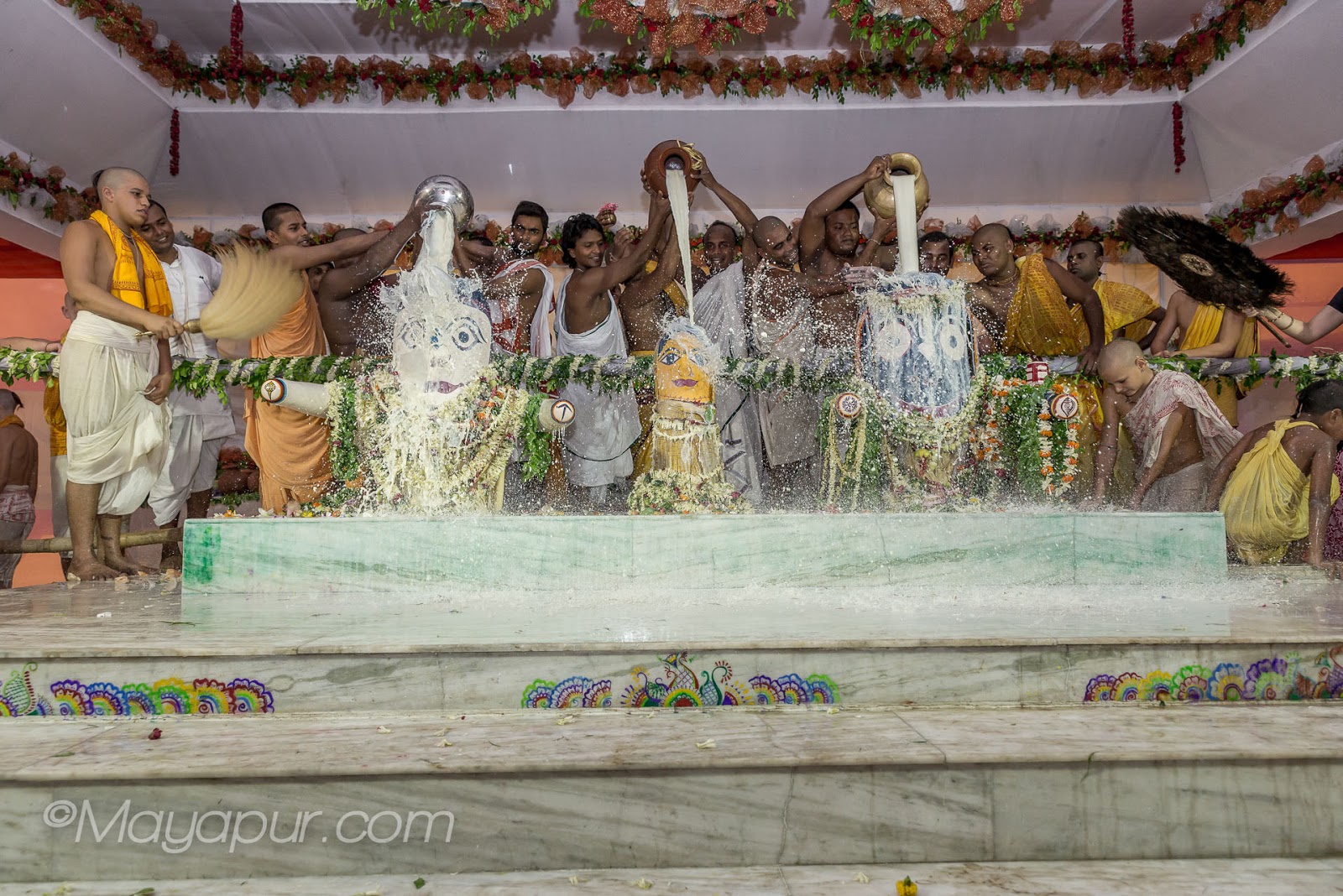
Jagannath the lord of the universe is unwell and is under medication. Sounds strange but this is true. Lord Jagannath is given a ritual bath on eve of the Snana Yatra which is celebrated on the Purnima (full moon day) of the Hindu month of Jyeshtha. It is an important festival for devotees and this festival embarks the beginning of the Ratha yatra. on this day deities of Jagannath, Baladeva, Subhadra, Sudarshan, and Madanmohan are brought out from the Jagannath Temple is brought out in a grand procession from the Garbhagriha (sanctum sanctorum) to the Snana Bedi (bathing platform) where they are given a ceremonial bath and are given Devotees come to view the deities. According to Skanda Purana when Raja Indradyumna installed the wooden Deities, he arranged this bathing ceremony. This day is considered to be the birthday of Lord Jagannatha.


Abhisheka or Bathing Jagannath Baladeva Subhadra
This bathing ceremony is believed to be a tribal ceremony and has a specialty. The Daitas and the people of Savaras tribe have the exclusive right to conduct the festival. The tribal called Saoras from southern Orissa performs a rite to bathe their Deities ceremonially on the last day of the month of Jyestha. For this, they collect water from remote jungles where it remains untouched even by the shadows of animals.
On the fourteenth day (Chaturdashi) , The Deities are taken out in procession, the whole process is called Pahandi or Pahandi-Vijaya. For the festival, the Snana Vedi (bathing platform) is well decorated with traditional paintings of trees, and gardens along with Flags and flower arches. The Deities are decorated with flowers. All kinds of perfumed items such as incense, oils, etc. are then offered.


Then the next day on Purnima day after Mangala Arati, the Suaras and Mahasuaras go in a ceremonial procession to fetch water from Golden Well in one hundred and thirty vessels of copper and gold. All of them cover their mouths with a piece of cloth so as not to contaminate it, even with their breath. Then all the vessels filled with water are preserved in the Bhoga Mandapa. The Palla-pandas then purify the water with turmeric, whole rice, Benachera, sandalwood, Aguru, flowers, perfumes, and medicinal herbs. The filled vessels are carried from the Bhoga Mandapa to the Snana Vedi by the Suaras in a long single-line procession. This water is called ‘Jaladhivasa’ water, and the ritual is called Jalabhiseka.


Due to the number of bathing liquids that are offered to cool the Lord’s transcendental body at the hottest time of the summer in India, Lord’s painted body becomes a bit washed out. This is the time when Lord Jagannath along with Baladev and Subadra are traditionally believed to fall ill and are kept in a sick room to recuperate in privacy under the care of the Raj Vaidya. this period is known as Anasara the Gods cannot be seen by devotees. During ‘Anavasara’, the Daitas offer to the Deity only fruits and water mixed with cheese, and dasa-mula medicines that is made from spices and herbs like pepper, cardamom, tulsi leaves, sandalwood, rose petals, water from the Ganges and rose water to help them cure His fever. In a devotional mood, the devotees accept that due to all the bathing the Lord becomes transcendentally tired, and therefore needs to take rest. Somewhat like human beings, They are considered to have ‘fallen ill’ and are treated by the Raja Vaidya or the Royal Physician with specific medicines (dasa-mulas) the deities are fed specially prepared ‘Kadha’ illness. This bitter kadha is offered as prasad to the devotees who visit the temple in the hope to keep the dreaded ailments at bay. This kadha has anti-fever, anti-malarial, pain-reliever, and digestive properties.

Along with the offering of kadha. Because the deities become a bit discolored due to so much bathing with water Seeing the wooden Deities in discolor, some devotees may not have the appropriate devotional attitude and may in fact feel sinful repugnance. so the Deities are kept away from public view for fifteen days and during all these days the daily rites of the temple remain suspended.  

The Deities are kept in a special “sick room” called the Ratana Vedi inside the Temple. This period is called ‘Anavasara-Kala‘, meaning improper time for worship. During these fifteen days, the Daitas (descendants of Visvavasu, the Savara) repaint and restore the Deities and Jagannatha’s fine decorations using only natural earthly mineral paints, not modern oil-based paints. The period of coloring and decorating the Deities is divided into seven short periods, each of two days duration, and a short period of one day set apart to give finishing touches. Thus the period covers the whole fortnight. On the 16th day the Deities in their newly appearing forms after renovation become ready for the public Darsana.


Hathi Vesa of Jagannath

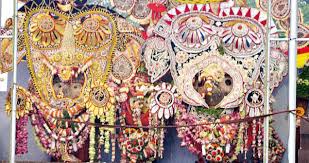
 Just after the Snan Yatra lord, Jagannath is dressed in a special costume called Haati Vesa. This is a very special Darshan. Lord Jagannatha and Lord Balarama then put on the elephant dress, Haati Vesha, and Subhadra wears a lotus flower vesa. The story behind this vesa is that a great scholar and staunch devotee of Lord Ganesha named Ganapati Bhatta, a devotee from Karnataka had come to Puri visit during Snana Yatra. He was rewarded and appreciated for his scholarship. The king asked the scholar to accompany him to see Lord Jagannatha, which he refused as he would only worship Ganesha, however after being persuaded so much he went to take darshan of lord Jagannath. There to surprise all, Lord Jagannatha appeared with an elephant-like form that resembled Ganesha. Since then, the ritual of dressing the deities in dresses like elephants (resembling Ganesha) is prevalent. Another reason being the deities are discolored so before they are painted back the deities are withheld for darshan.

Some other interpretations of this decoration is associated with Buddhism as well. Buddhists claim that the Vesa is the manifestation of Buddha’s incarnation of Lord Jagannath. Another legend goes that Lord Ganesh was invoked at the time of the construction of Shree Mandir in order to destroy all related obstacles. Some say that the idol of Shree Ganesh was brought by Gajapti Purusottam Dev after his victory over Kanchi War and the idol is worshiped in the temple as “Kanchi Ganesh“.


Why Eating Grains on Ekadashi is Most Sinful Act ?

Ekadashi the fasting occurring on the 11th lunar day is most auspicious for Vaishnavas. on this day Vaishnavas refrain from eating any sort of grains, and they are deeply engrossed in worship of the Supreme Personality of Godhead, Vishnu. we might have heard many stories of how and why Ekadashi began and why to refrain from grains but the detailed description and mention of this Vrta is in Padma Puran. in the section entitled Kriya-Sagara-Sara, 14th chapter of the Padma Purana, Uttara Kanda, during Conversation of Veda Vyasa and Jaimini, Veda Vyasa explains the Importance of Ekadashi.
Once Sage Jaimini desired to hear the benefits of fasting on Ekadashi and of its appearance from his Guru Veda Vyasa. Jaimini then asked O Gurudeva! When did Ekadashi take birth and from whom did she appear? What are the rules for fasting on the day of Ekadashi? Please describe the benefits of following this vow and when it should be followed. Who is the utmost worshipable presiding deity of Sri Ekadashi? What are the faults in not observing Ekadashi properly?
Veda Vyasa started to illustrate the story of how Ekadashi originated he said “At the beginning of creation, the Supreme Lord Vishnu created the moving and non-moving living entities within this world made of five gross material elements. Simultaneously, for the purpose of punishing evil human beings, He created a personality whose form was the embodiment of the worst kinds of sin (Paap-Purusha). The different limbs of this personality were constructed of various sinful activities.
His head was made of the sin of murdering a Brahmana, his two eyes were the form of drinking intoxicants, his mouth was made from the sin of stealing gold, and his ears were the form of the sin of having an illicit connection with the spiritual master’s wife, his nose was of the sin of killing one’s wife, his arms the form of the sin of killing a cow, his neck was made of the sin of stealing accumulated wealth, his chest of the sin of abortion, his lower chest of the sin of having sex with another’s wife, his stomach of the sin of killings one’s relatives, his navel of the sin of killing those who are dependent on him, his waist of the sin of egotistical self-appraisal, his thighs of the sin of offending the guru, his genitals of the sin of selling one’s daughter, his buttocks of the sin of telling confidential matters, his feet of the sin of killing one’s father, and his hair was the form of all sorts of less severe sinful activities. In this way, a horrible personality embodying all sinful activities and vices was created. His bodily color is black, and his eyes are yellow. He inflicts extreme misery upon sinful persons.
        This is really Ironic that according to Purusha Suktam of rig Veda Lord’s created the Brahmanas, Kshatriyas, Vaishya, and Sudras through his Mouth, Arms, Belly, and Feet. From the Supreme creator’s mind, the moon was born, from his eyes, the sun was born. and From his mouth, Indra and Agni were born his breath became the wind. The Purusha’s navel space manifested, from his head, the sky and the earth was created through his feet, his ears the directions and thus the creation was created. This very mention can be also found in Srimad Bhagavatam. But according to this particular mention of the Ekadashi story in Padma Puran, we find that through the same body parts of the Lord the Sins were also created. Thus the sins are also manifestations of the supreme.

Let us look at the story in Padma Puran further.

When this personality Paap- Purusha or sin was created Lord Vishnu felt very sad and he felt really guilty, that he had created happiness and misery both. so he felt that He needs someone to control this Paap-Purusha Lord Vishnu then created Yamaraja and the different hellish planetary systems. Those living entities who are very sinful will be sent after death to Yamaraja, who will punish them according to their sins, and send them to an appropriate hellish region to suffer.
          
After these adjustments were made, once went to the house of Yamaraja. where he heard very loud crying sounds from the southern direction. He became surprised by this and inquired of Yamaraja, ‘From where is this loud crying coming?’
          
Yamaraja in reply said,’ The different living entities of the earthly planetary systems have fallen to the hellish regions. They are suffering extremely for their misdeeds. The horrible crying is because of suffering from the infliction of their past bad actions.’
           
After hearing this Supreme Lord Vishnu went to the hellish region to the south. When Lord Vishnu saw the conditions in the Hellish Planets his heart became filled with compassion. Lord Vishnu thought to Himself, ‘I have created all this progeny, and it is because of Me that they are suffering.
So to elevate the living entities from their miseries and bring them back to his abode Vaikuntha merciful Lord suddenly manifested from His own form the deity Ekadashi. Afterward, the different sinful living entities began to follow the vow of Ekadashi and were then elevated quickly to the abode of Vaikuntha. therefore Ekadashi and the Supreme Lord Vishnu are non-different. Sri Ekadashi is the utmost pious activity and is situated at the head of all vows.
           
Following the ascension of Sri Ekadashi, Paap-Purusha was very intimidated. He then approached Lord Vishnu with doubts in his heart and began offering many prayers, whereupon Lord Vishnu became very pleased and said, ‘I have become very pleased by your nice offerings. What boon is it that you want?’
       
The Paap-Purusha replied, I am Your created progeny, and it is through me that you wanted distress given to the living entities who are very sinful. But now, by the influence of Sri Ekadashi, I am destroyed. O Keshava, After I die, all the living entities who are your part and parcel will be liberated, and thus there will be no one to carry out your eternal pastimes on earthly planets. if there is no adharma (injustice, sin)  then you would not need to descend to the earthly planets. O Keshava! If you want these eternal pastimes to carry on, then You please save me from the fear of Ekadashi. No type of pious activity can bind me apart from Ekadashi as it is Your own manifested form. Out of fear of Sri Ekadashi I have fled and taken shelter of men; animals; insects; hills; trees; moving and non-moving living entities; rivers; oceans; forests; heavenly, earthly, and hellish planetary systems; demigods; and the Gandharvas. I cannot find a place where I can be free from the fear of Sri Ekadashi. O, my Master! I am a product of Your creation, so therefore very mercifully direct me to a place where I can reside fearlessly.
         Hearing the Paap- Purusha’s Cry Lord Vishnu, began to speak with laughter  ‘O Paap-Purusha, rise up! Don’t lament. I’ll tell you where you can stay on the lunar day of Ekadashi. On the day of Ekadashi, which is the benefactor of the three planetary systems, you can take shelter from food grains. And you will be safe from my form as Ekadashi. After giving direction to the Paap-Purusha, the Supreme Lord Vishnu disappeared and the Paap-Purusha returned to the performance of his own activities.
     Therefore, those persons who are serious about the ultimate benefit of the soul will never eat grains on Ekadashi. According to the instructions of Lord Vishnu, every kind of sinful activity that can be found in the material world takes its residence in this place of grains. Whoever follows Ekadashi is freed from all sins and never enters into the hellish regions.
Nirjala Ekadashi

Pandava Nirjala Ekadashi

Today 16th June 2016 is Pandav Nirjala Ekadashi, and Prarayan or Fast-breaking time is the next day 17th June from 04:50 to 09:22 am.


Nirjala Ekadashi falls on the 11th lunar day of the waxing fortnight of the Hindu month of May/June. Ekadasi fasting is very dear to Lord Vishnu or Lord Krsna. This is a very important fasting day for Vaishnavas. According to the Markandeya Purana and the Vishnu Purana, the day of Ekadashi is itself a form of Vishnu. The vrata observed on this day is said to wash away all sin.  The importance of observing fast on Ekadashi is given in Shri Hari Bhakti Vilas.  it is said :
Ekadashi  vratam nama
sarva kama phala pradam
kartabyam sarvada viprair
Vishnu prinana karanam’
” Just by observing a fast on Ekadasi day, all your desires will come true, and one who follows the fast becomes very dear to Lord Vishnu”
Therefore, one will have to observe the vow of Ekadashi to satisfy the lord.  Happiness and prosperity will automatically follow.  As stated in Brihat Naradiya Purana “if everyone including the Brahmins, Kshatriyas, Vaisyas, Sudras, and the women observe Ekadashi then they will certainly attain liberation”.  As per the teachings of the Vedic Literature ‘paap-purusha’ (sin) resides in grains on Ekadashi and so it should be avoided in any form. I will post the Story of how Ekadasi Originated according to Padma Puran separately.

Origin of Nirjala Ekadasi

BhimaThe description of Nirjala Ekadashi occurs in Brahma Vaivarta Purana as a conversation between Vyasa and Bhima. One of the Pandava Brothers.
Once Bhima asked the great sage Vyasa that my brothers fast on Ekadasi day. They also ask me to fast as well, which I always tell them though. I know that fasting on Ekadashi is an instruction from the scriptures. But I cannot bear my hunger and so  I am unable to fast.  I can give in charity as per my capacity, and I can worship Lord Kesava with proper rules and regulations, but I cannot fast.  So please instruct me on how can I obtain the result of Ekadashi without having to fast.
Bhima also confessed that It was really impossible for him to observe fast on 24 Ekadashis every year as instructed by the Lord.  He could not even tolerate hunger for a movement. But then he said I can try to fast for a day in a year. Vyasa replied that the Ekadashi which occurs during the waxing moon in the month of May/June during the sun present in either Taurus or Gemini Rasi is called Nirjala Ekadashi.  One should observe total fast even from drinking water in this Ekadashi.  On this day one should perform Acamana for purification by drinking that amount of water in which a single mustard seed or a drop of gold can be immersed.  One should place the said amount of water in his palm which he should form to resemble a cow’s ear.  If one drinks more or less water than this then it will amount to the drinking of wine.
One must not eat anything at all on this Ekadashi otherwise his vow will be broken.  One should not drink even water from the movement of sunrise from the day of Ekadashi until the sunrise on the day of Dvadasi.  In this way, if one strictly observes this Ekadashi without drinking water then he can attain the results of observing all the Ekadashis of the year.
In the early morning on the day of Dvadasi, one should take a bath and give gold and water in charity to the brahmins.  Thereafter the follower should gladly eat with the brahmins.
By following this Ekadashi one can achieve the result of following all the Ekadashi s throughout the year.  Lord Vishnu once told me that if a person gives up all varieties of religion as stated in Bhagavad Gita 18.66 ” sarva-dharman parityajya, mam ekam saranam vraja, aham tvam sarva-papebhyo, moksayisyami ma sucah: Abandon all varieties of religion and just surrender unto Me. I shall deliver you from all sinful reactions. Do not fear. and follows this Nirjala Ekadashi which is very dear to me and is certainly relieved from all sinful reactions.
By observing this Ekadashi one achieves the benefits of visiting all the holy places.  At the time of death, such a person is not approached by the fierce-looking Yamadutas. Instead, he is approached by the divine-looking Vishnuduta to be transferred to the abode of Vishnu.  If one gives water and cows in charity after observing this Ekadashi then he is freed from all his sinful activities.
 
When the other Pandavas heard about the glories of this Ekadashi they resolved to observe it. since Bhima began observing this Nirjala Ekadashi from that day onward this Ekadashi became famous as Pandava Nirjala or Bhimseni Ekadashi.
Lord Shiva

Pradosha Vrta- Lord Shiva in his Best Mood.

Pradosham is the twilight period just before sunset and after sunset on the Trayodashi Tithi, the 13th Lunar day falling in Krishna and Shukla Pakshas, and this Vrata is very dear to Shiva. Pujas and prayers are performed during this period. Many people during this period spend time in a Shiva temple or listening to the glory of Shiva. People Worship Siva throughout the night, bath the Siva Linga with Pancamrta (namely milk, curds, ghee, sugar, and honey), homa, Japa of Lord Shiva’s names, and prayers for forgiveness are the other items involved in its observance. The person can then, at the end of Vrta, do Parana (break the fast by having Prasada). One may take a vow to observe this Vrta for 24 or 14 or 12 years. At the end of this period, the person has to perform the Udyapana, a concluding rite indicating the completion of the vow.


There is an interesting story mentioned in The Skanda Purana where this Vrta is prescribed to a Bhramin lady.


Once a Brahmin lady came to Sandilya Muni with two boys, her son, Suchivrata, and an orphan prince, Dharmagupta, whose father was killed in battle and the kingdom was taken over by enemies. Acting upon the advice of Sandilya Muni, the woman and the boys performed the Vrata with great devotion. After four months, that is, in the eighth Pradosha, Suchivrata obtained a pot of nectar and drank the divine Amruta. Prince Dharmagupta won the hand of a celestial princess and, as ordered by Lord Siva, with the help of the celestial king himself, his enemies were slain and his kingdom restored to him. Then Dharmagupta attained the Lord’s supreme abode.
A very important point to be remembered in this connection is that during this auspicious period all the hosts of celestial beings and gods come down from the heavens and attend the worship in their subtle forms. This adds immensely to the sanctity of the worship.
The mere sight of the Deity in a temple during this period will destroy all sins, and bestow bountiful blessings and Grace upon the fortunate beholder. Even a single bel leaf offered to the Lord at this unique, auspicious moment equals a hundred Mahapujas. The importance of offering Bilva to Shiva is stated in Bilva Ashtakam:
“Tridalam Trigunakaaram Trinethram Cha Triyayusham,
Trijanma Papa Samharam Eka Bilwam Shivarpanam”
I offer one leaf of Bilwa to Lord Shiva,
Which has three leaves,
causes three qualities,
that is like the three eyes of Shiva,
Which is like the triad of weapons,
And which destroys the sins of three births.

Origin of the Vrta

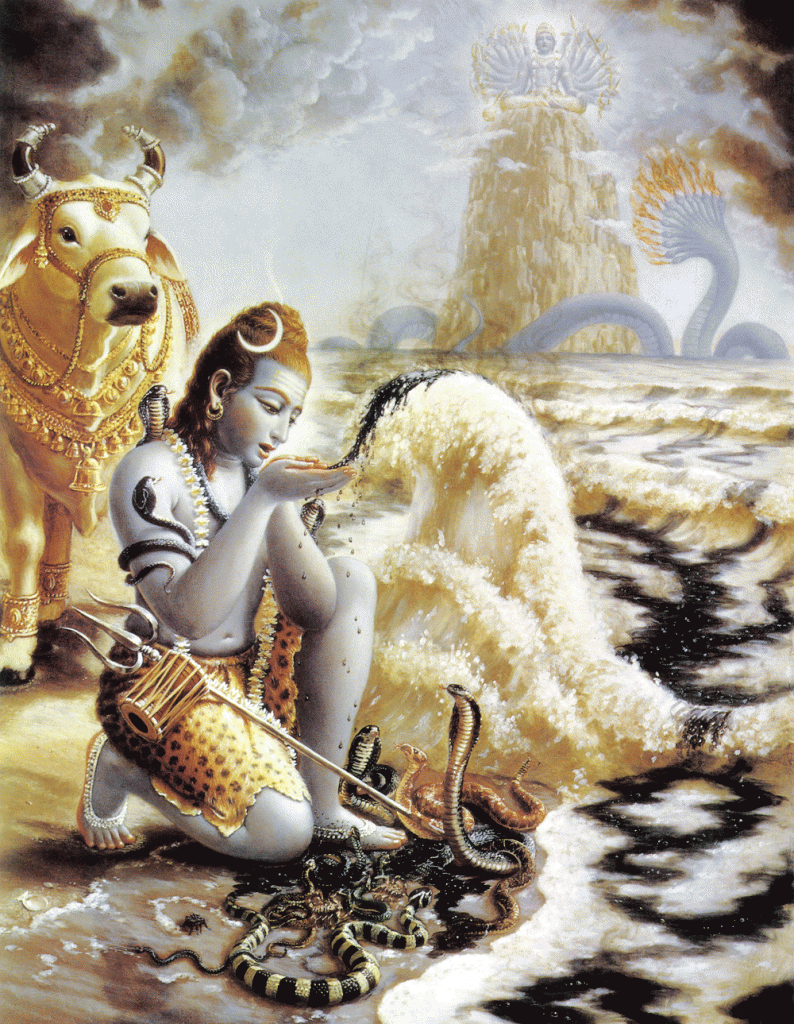
The Vrta is said to be originated during the Samudra Manthan, as mentioned in Shiva Purana, it all began with the churning of the milk ocean by the Gods and the Demons on a holy Dwadasi day. While they were churning the Ocean with Vasuki being the Rope. Lord Vishnu held Mount Meru which was used as a churner in his Kurma Avatar, the tortoise incarnation. The first item that came up was Hala Hal, the most deadly poison, that was capable of destroying the whole universe. The poison sent dreadful shivers amongst every entity in the universe.


Lord Shiva Drinking Poision Every God and Demon then started to pray to Shiva for Help, Lord Shiva came to the rescue and ordered Nandi to get the poison, and lord Shiva drank all of it. Hearing this goddess Parvati, came to save the universe. As all of the creation lies inside Lord Shiva, if the poison would reach Shiva’s belly then, the whole creation would be destroyed. Goddess Parvati grabbed Lord Shiva’s throat and made the poison stay there. Thus turning Lord Shiva’s throat bluish, giving him the name Nilkantha, or the one with a blue throat. Hala-Hala started taking its toll. The poison put lord Shiva asleep, till Trayodasi day when Lord Shiva started to Show signs of normalcy. Nandi was covered with false ego and felt that in spite of inhaling the fumes of Hala-Hal and a few drops falling in his mouth nothing happened to him.
 

He started to feel superior to Lord Shiva, seeing Nandi dance off in Ego lord Shiva, took a leap, and started to dance in between the horns of Nandi. Every time Nandi attempted to throw Shiva off, Shiva took a leap gracefully into the air. Thus Nandi and all Gods experienced the merciful and benevolent form of Lord Shiva. Therefore it is believed that Lord Shiva is most benevolent on Pradosha or Trayodashi day.

Five types of Pradosh


1. Nitya Pradosh– The evening time on all days, between just 72 minutes before sunset and the time when the stars rise or become visible in the sky.


2.  Paksha Pradosh– evening time of Shukla Paksha Chaturthi every month.


3. Maasa Pradosh– Sandhya Krishna Paksha Trayodashi every month.


4. Maha Pradosh– Sandhya time of Krishna Paksha Trayodashi which falls on a Saturday.


5. Pralaya Pradosh– The time when the entire universe gets annihilated or merged with Lord Shiva.


This is the most favorable moment for direct contact with God. We can reduce our bodily activities to a minimum when we fast and pray on that day. We can have the vision of the Lord who resides in our hearts.


Ashta Mukha Ganda Bherunda Narasimha

Ashta Mukha Ganda Bherunda- The most special and unknown form of Lord Narasimha


ugram viram maha-vishnum
jvalantam sarvato mukham
nrisimham bhishanam bhadram
mrityur mrityum namamy aham
“I bow down to Lord Narasimha who is ferocious and heroic like Lord Vishnu.
He is burning from every side. He is terrific, auspicious and
the death of death personified.”
“ॐ नमो भगवते अष्ट मुख गनड बेरुड़ा महोग्रोलको ज्वल ज्वाला सुदर्शन वाराह श्री लक्ष्मी न्रुसिम्हाया नमः “
“Om Namo Bhavathey Ashta Mukha Ganda berunda Mahogrolko Jwala Jwaala sudarshana vaaraha sree lakshmi Narasimhaya namaha”
We all know the great battle of Lord Narasimha the fourth incarnation of Lord Vishnu and the great demon Hiranyakashyipu. This incarnation appeared to save his devotee, Prahalad. There is more to the story, Lord Narsimha took a very special form of Ganda Bherunda and Asta Mukha Ganda Bherunda.
After Narasimha had slain the demon Hiranyakashipu, through the taste of blood, Narsimha did not let go of his dreadful form. No one could control his anger, Brahma and other Devatas were afraid of his rage. Brahma, accompanied by other Devatas, approached Siva and described the Narasimha Avatar. Siva took it lightly and said this is a tiny issue. He can sort it out with ease in no time; he instructed Ganesha to subdue Narasimha; when Ganesha approached Nrsimha, Narasimha severely warned and drove him away; Nandi, Kala Bhairava, Veerabhadra were sent to subdue Nrsimha. They were severely attacked by Nrsimha.


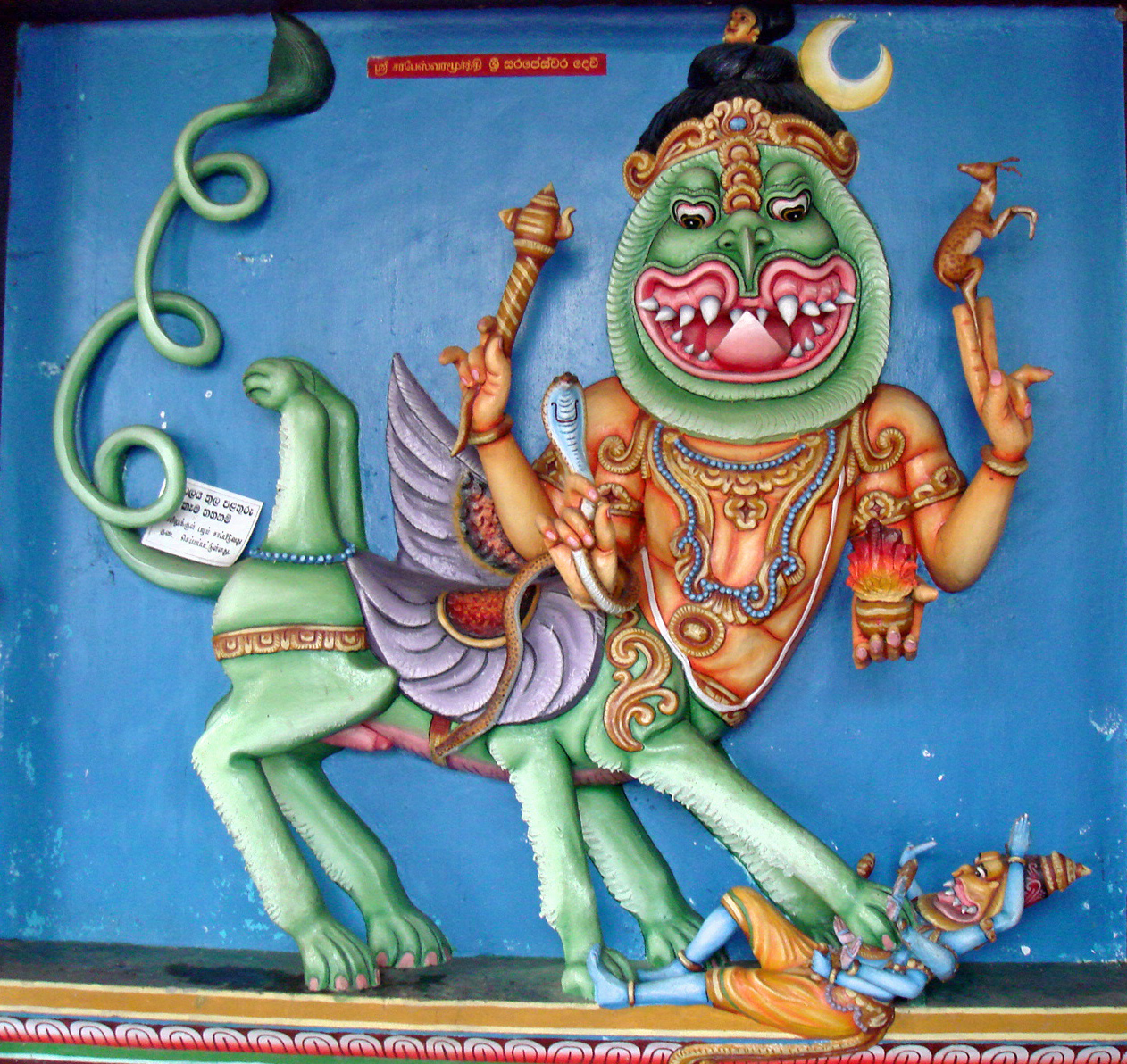
Then Shiva had to take the form of Sharabeswara a part-lion and part-bird, a form with 5 heads, 16 arms, 8 legs, Kali and Durga as his wings to cool Narasimha. In the effort, Lord Shiva lost his cool, and Lord Narasimha had to take the form of Gandaberunda, having two heads, fearful rows of teeth, black in complexion, and wide blazing wings. Gandaberunda fought with Shiva-Sharabha for eighteen days and finally held it between his two beaks and killed Sharabha,

Narasimha’s blazing fury reached its peak, and he took the form of Ashtamukha Gandabherunda Narasimha – The 8 faces are: 1] Twin-headed Ganda Bherunda facing East, 2] Adi Jvala Narasimha facing South East, 3] Maha Vyaghra facing South, 4] Hayagriva facing South West, 5] Adi Varaha facing West, 6] Aghora Vaanarendra facing North West, 7] Maha Garuda facing North and 8] Bhalluka facing North East.


Let us try to briefly look at each of the faces of Ashtamukha Ganda Bherunda Narasimha

1] The twin-headed Ganda Bherunda – A powerful two-headed bird with, fearful rows of teeth, black in complexion, and with wide blazing wings that killed the mighty Sharaba.

2] Adi Jwala Narasimha – A lion-like face with powerful claws, He is known primarily as the ‘Great Protector’ who specifically defends and protects his devotees in times of need.


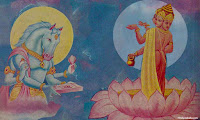
4] Hayagriva – Hayagriva is an avatar of Vishnu. He is worshiped as the God of knowledge and wisdom. Having a human body and a horse’s head, brilliant white in color. He wears white garments and is seated on a white lotus. Symbolically, the story represents the triumph of pure knowledge, guided by the hand of God, over the demonic forces of passion and darkness.

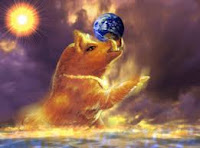
5] Adi Varaha –  Varaha is the avatar of Vishnu in the form of a boar. Varaha is listed as third in the Dashavatara, the ten principal avatars of Vishnu. When the demon Hiranyaksha stole the earth (personified as the goddess Bhudevi) and hid her in the primordial waters, Vishnu appeared as Varaha to rescue her. Varaha slew the demon and retrieved the Earth from the ocean, lifting it on his tusks, and restoring Bhudevi to her place in the universe.

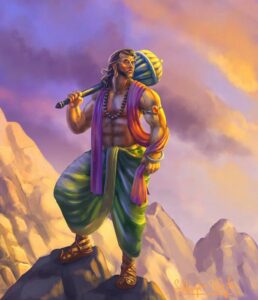
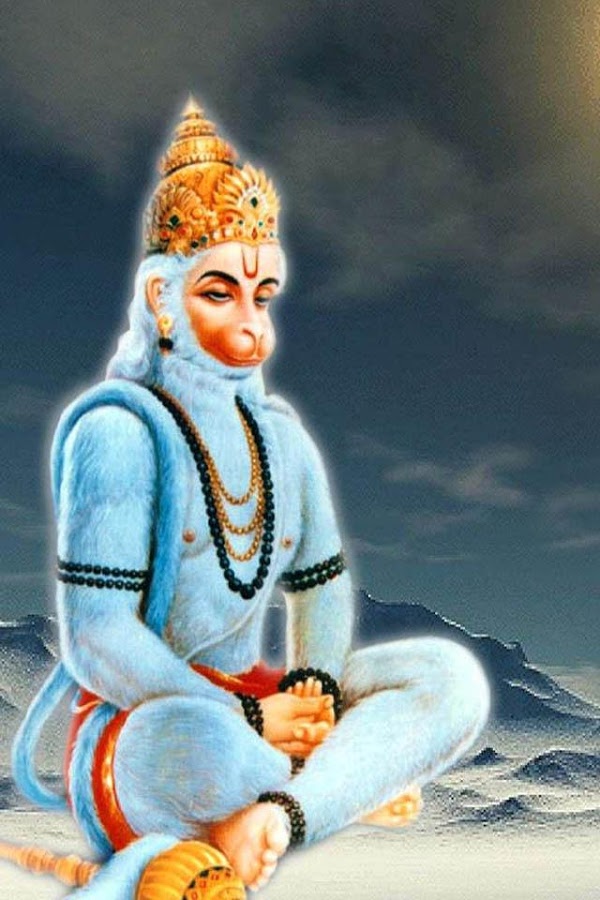
6] Aghora Vaanarendra – This is the monkey face of the Lord, some people refer this face to be of Hanuman. while interpreting I will also consider this face to be Hanuman’s. Hanuman is Lord Shiva’s Rudra avatar and A ardent devotee of Lord Rama ( Incarnation of Vishnu), Hanuman is said to be the mightiest and most powerful warrior. Also, he is referred to as one of the immortals.

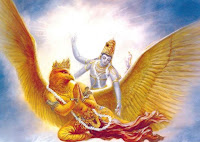
7] Maha Garuda– or the great Eagle, is the mount or vahana of the Lord Vishnu. Garuda is depicted as having the golden body of a strong man

with a white face, red wings, and an eagle’s beak and with a crown on his head or it is also portrayed as a giant eagle. This ancient deity was said to be massive, large enough to block out the sun.


The 3rd face Maha Vyagra and the 8th face Bhalluka (the bear face) are unidentifiable, as not much is mentioned about this special avatar of Ashta Mukha Ganda Narasimha. This form of lord also has the 9th face according to some sources. This 9th Hidden ninth face of the Lord sometimes referred to as Badabanala Mukha, refers to Adi Narayana and is visible to a realized ardent devotee of the lord.

This special form of the lord has all the combined power of all anthropomorphic incarnations of Lord Vishnu such as Varaha, Narasimha, Ganda Bherunda, and Narasimha.  Considering the 9th hidden face along with incarnations that serve Lord Vishnu in some manner, ( His ardent devotees) such as Hanuman ( devotee of Rama) and Garuda (The mount of Lord Vishnu), if I take the 8th face, that is the bear face to be Jambavan of Ramayana then he is also an ardent devotee of Lord Rama, and he is the mightiest and most learned bear. However, the third face of Vygra is unidentifiable. Considering all other forms, the form of Ashta Mukha Ganda Bherunda Nrsimha is really special. This form possesses every aspect of the universe, just like the universal form displayed in the battle of Kurukshetra to Arjuna. this special form of Nrsimha is really unexplored and also does not have many textual mentions.
Kuniyoshi_Utagawa_The_seven_goods_of_good_fortune

Lucky Day vs 7 Lucky Gods

Akshaya Tritiya is considered a day of luck. The Hindu community considers this day as a lucky day and believes that any venture such as a business or the construction of a building started on that day will follow betterment and prosperity.


Akshaya Tritiya is considered the golden day of the year because the word Akshaya means the most “Eternal” that which never diminishes. Any initiative made on that day or anything bought on that day is considered to be good fortune. In the Indian culture people typically starts a new business or begin a new venture on Akshaya Tritiya. This is also one of the most popular days for weddings to make plans as the spirit of this day bids them on a very long and fulfilling life journey. It was also believed that people born in that month will be very lucky and will shine brightly throughout their life.
Now when we are talking of Luck and lucky day, I guess we should also talk about the Lucky Gods, ????

Gods and Lucky, sounds strange, it is also it is not one God but its plural, and there are seven of them.

looks confusing.
But it’s not, the Japanese Shinto religion mentions seven lucky gods.
The Seven Lucky Gods of Japan are a group of deities who together bring loads of prosperity, health, long life and good luck to those who recognize them. Originally they were seen separately. During the 15th century, the seven gods started appearing as a group.
 
The 7 Lucky Gods
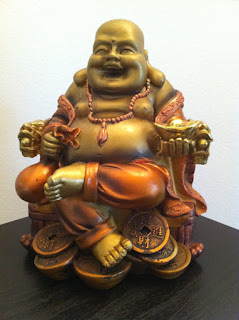
Budai


Budai Chinese god of Luck

Budai is a Chinese folkloric deity. His name means “Cloth Sack,” and comes from the bag that he is conventionally depicted as carrying. He is usually identified with or seen as an incarnation of Maitreya, the future Buddha, so much so that the Budai image is one of the main forms in which Maitreya is depicted in China. He is almost always shown smiling or laughing, hence his nickname in Chinese, the Laughing Buddha.  In the West, The image of Budai is often mistaken for Gautama Buddha and is hence called the Fat Buddha. Budai is traditionally depicted as a fat, bald man wearing a robe and carrying prayer beads. He carries his few possessions in a cloth sack, being poor but content. He is often depicted as entertaining or being followed by adoring children. He is a representation of contentment.
 According to Chinese history, Budai was an eccentric Chan monk who lived in China during Later Liang (907–923). He was a native of Zhejiang and his Buddhist name was Qieci which literally means “Promise this”. He was considered a man of good and loving character. Budai in folklore is admired for his happiness, plenitude, and wisdom of contentment. One belief popular in folklore maintains that rubbing his belly brings wealth, good luck, and prosperity. The Zen belief for Budai is that He is said to travel giving candy to poor children, only asking a penny from monks or lay, practitioners, he meets. One day a monk walks up to him and asks, “What is the meaning of Chan?” Budai drops his bag. “How does one realize Chan?” Budai then takes up his bag and continues on his way.
 

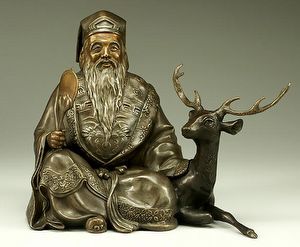
Jurōjin

Chinese Taoist god

In Japan, Jurōjin is the God of longevity. Jurōjin originated from the Chinese Taoist god, the Old Man of the South Pole. He is known as the immortal of the Northern Song dynasty (960 – 1127), and may have been a historical figure of the period. Jurōjin is identified as the personification of the Southern Polar Star. While paintings and statues of Jurōjin are considered auspicious, he never developed a following independent of the other deities Seven Gods of Fortune.
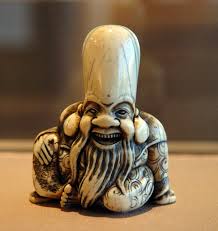
Usually portrayed as bald with long whiskers, he is said to be an incarnation of the Southern Polestar. In many depictions, Fukurokuju has an abnormally high forehead. Jurōjin walks with a staff and a fan. He is depicted as an old man of slight stature, and by tradition, less than 3 shaku.  He is depicted with a long white beard and often a very tall, bald head. He has a scroll tied to his staff, on which is written the lifespan of all living things ., The sacred book tied to his staff either contains the lifespan of every person on earth or a magical scripture. The scroll is sometimes identified as a Buddhist sutra. He is accompanied by a crane and a turtle, which are considered to be symbols of longevity. He is also sometimes accompanied by a black deer, ancient legends say a deer turns black if it is over 2000 years old.

Fukurokuju 

In Japan, Fukurokuju means happiness, wealth, and longevity.  It has been theorized that he is Japanese assimilation of the Fukurokuju Japanese GodChinese Three Star Gods (Fulushou) embodied in one deity. Most related in appearance to the Chinese star god Shou, he is the God of wisdom and longevity. According to some, before attaining divinity, he was a Chinese hermit of the Song Dynasty and a reincarnation of the Taoist god Xuanwu. It is said that during his human incarnation, he was a sennin; a philosopher who could exist without eating food. He is the only member of the Seven Lucky Gods credited with the ability to revive the dead. 
     

Bishamonten 

Bishamonten Japanese God

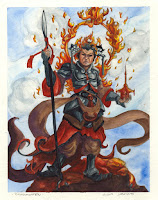
In Japan, Bishamonten is thought of as an armor-clad god of war or warriors and a punisher of evildoers. Bishamon is portrayed holding a spear in one hand and a small pagoda. On the other hand, the latter symbolizes the divine treasure house, whose contents he both guards and gives away. Bishamon is also called Tamonten “listening to many teachings” because he is seen as the guardian of the places where the Buddha preaches. He is believed to live halfway down Mount Sumeru. He is also associated with Hachiman.

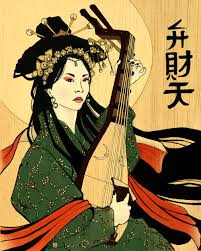
Benzaiten

Benzaiten Japanese Buddhist goddess

Benzaiten is a Japanese Buddhist goddess, who originated from the Hindu goddess Saraswati.
Worship of Benzaiten arrived in Japan during the 6th through 8th centuries, mainly via the Chinese translations of the Sutra of Golden Light, which has a section devoted to her. She is also mentioned in the Lotus Sutra and often depicted holding a Biwa, a traditional Japanese lute, just as Saraswati holds a Veena. Benzaiten is a Syncretic entity with both a Buddhist and a Shinto side.


Referred to as Sarasvati Devi in Sanskrit, Benzaiten is the goddess of everything that flows: water, time, words, speech, eloquence, music, and by extension, knowledge. The original characters used to write her name read “Biancaitian” in Chinese and “Bensaiten” in Japanese and reflect her role as the goddess of eloquence. Because of the Sutra of Golden Light
promised protection of the state, in Japan she became a protector-deity, at first of the state and then of the people.


Daikokuten


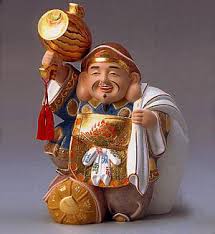
Daikokuten japanese godIn Japan, Daikokuten, is the god of great darkness or blackness, or the god of five kinds of cereal. This god enjoys an exalted position as a household deity in Japan. Daikoku’s association with wealth and prosperity precipitated a custom known as fukunusubi, or “theft of fortune”. This custom started with the belief that whoever stole divine figures was assured of good fortune if not caught in the act. In the course of time, stealing divine images became so common a practice in Japan. The Toshi-no-Ichi “year-end market” held at Sensō-Ji became the main venue for the sale and disposal of such images by fortune-seekers. Many small stalls were opened where articles including images of Daikoku were sold on the eve of New Year celebrations.
Daikoku is variously considered to be the god of wealth, or of the household, particularly the kitchen. He is recognized by his wide face, smile, and flat black hat. He is often portrayed holding a golden mallet called a Uchide no kozuchi, otherwise known as a magic money mallet. Daikoku is seen seated on bales of rice, with mice nearby signifying plentiful food.

Ebisu

Ebisu or called Hiruko is the Japanese god of fishermen and luck. He is the only one of the seven to originate purely from Japan without any Hindu or Chinese influence.

Ebisu or Hiruko the Japanese god of fishermen and luck.

In medieval times, Ebisu’s origin came to be tied together with that of Hiruko – the first child of Izanagi and Izanami, born without bones (or, in some stories, without arms and legs) due to his mother’s transgression during the marriage ritual. Hiruko struggled to survive. As He could not stand, he was cast to the sea in a boat of reeds before his third birthday.
 
The weak child overcame many hardships, grew legs (and, presumably, the rest of his skeletal structure) at the age of three, and became the god Ebisu. He remains slightly crippled and deaf, but mirthful and auspicious nonetheless (hence the title, “The laughing god”). He is often depicted wearing a tall hat—the Kazaori Eboshi holding a rod and a large red sea bream or sea bass. Jellyfish are also associated with the god and the fugu restaurants of Japan will often incorporate Ebisu in their motif.
The story tells that Hiruko eventually washed ashore—possibly in Ezo ancient Hokkaidō and was cared for by the Ainu Ebisu Saburo. It is however believed that Ebisu first arose as a god among fishermen. His origin as Hiruko was a much later conception, after his worship of him had spread to merchants and others. It is also theorized that he was originally a god known as “Kotoronushi no Mikoto,” son of Ōkuninushi.

Money

The Rich Gods

Akshay Tritiya is just 4 days away from falling on May 9th, 2016. This day is said to be the day of luck, wealth, and fortune. On this day Hindus worship the god of wealth Kubera, who is the treasurer of gods and the wealthiest god in Indian mythology. Along with goddess Lakshmi, the goddess of fortune and consort of Lord Vishnu.

It is believed that the god Kubera, the treasurer of the gods, is the richest deity. Lakshmi Tantram says that even Kubera will pray to goddess Lakshmi, the goddess of wealth and consort of Vishnu, on Akshay Tritiya. A day-long Kubera Lakshmi Puja is performed in which an image of Lakshmi is worshiped with Sudarsana Kubera Yantra, symbolizing Kubera.  Kubera is not alone as the richest god there are many gods from cultures around the world who govern the riches.

Ploutos -The Rich Greek God

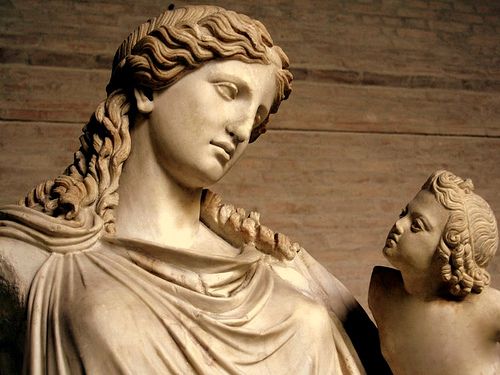
Greek God Ploutos         Ploutos was the Greek god of wealth. In agrarian Greece, he was at first associated purely with a bounty of rich harvests. Later he came to represent wealth in more general terms. Ploutos was a son of Demeter, the goddess of agriculture, who bore him after lying with the hero Iasion in a thrice-plowed field. He was blinded by Zeus so he would distribute wealth indiscriminately and without favor towards the good or the virtuous. The god was usually depicted as a boy holding a cornucopia filled with grain in the company of his mother Demeter. In sculpture, he was often shown as an infant in the arms of either Eirene, the goddess of peace, or Tykhe, the goddess of fortune. Ploutos was identified with Plouton, the god Haides in his role as the deity of the earth’s hidden stores of wealth who was also depicted with a cornucopia in this guise.

Njörð- The wealthy Nordic god

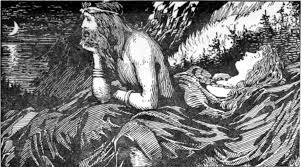
In Norse mythology, Njörðr is a god among the Vanir. Njörðr, the father of the deities Freyr and Freyja by hisThe wealthy Nordic god unnamed Vanir sister, was in an ill-fated marriage with the goddess Skaði, lives in Nóatún, and is associated with the sea, seafaring, wind, fishing, wealth, and crop fertility. In the Prose Edda, Njörðr is introduced in chapter 23 of the book Gylfaginning. In this chapter, Njörðr is described by the enthroned figure of High as living in the heavens at Nóatún, but also as ruling over the movement of the winds. Having the ability to calm both sea and fire, he is to be invoked in seafaring and fishing. High continues that Njörðr is very wealthy and prosperous. He can also grant wealth in land and valuables to those who request his aid.


Daikokuten-  The Wealthy Japanese God


Japanesse God Daikokuten

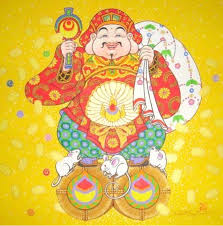
In Japan, Daikokuten, the god of great darkness or blackness, or the god of five kinds of cereal, is one of the Seven Lucky Gods. The god enjoys an exalted position as a household deity in Japan. Daikoku’s association with wealth and prosperity precipitated a custom known as fukunusubi, or “theft of fortune”. This custom started with the belief that whoever stole divine figures was assured of good fortune, if not caught in the act. In the course of time, stealing divine images became so common a practice in Japan. The Toshi-no-Ichi “year-end market” held at Sensō-ji became the main venue for the sale and disposal of such images by fortune-seekers. Many small stalls were opened where articles including images of Daikoku were sold on the eve of New Year celebrations. He is recognized by his wide face, smile, and flat black hat. Daikoku is often portrayed holding a golden mallet called an Uchide no kozuchi, otherwise known as a magic money mallet. He is seen seated on bales of rice, with mice nearby signifying plentiful food.


Yacatecuhtli- Aztec god of Business


Yacatecuhtli was the patron Aztec god of commerce and travelers, especially business travelers. His symbol is a bundle of sticks. Merchants would carry a Uttal cane as they moved from village to village peddling their wares. At night time would tie them together into a neat bundle before sprinkling them with blood from their ears. It was believed that this ritual in Yacatecuhtli’s honor would guarantee success in future business ventures.  He would also grant protection from vicious beasts and robbers on their journeys.

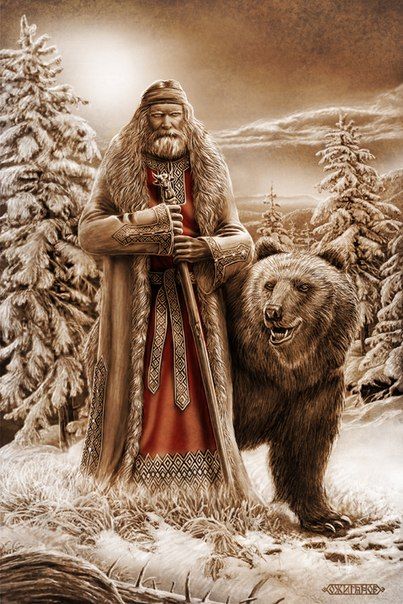
Veles Slavic god

Veles- Slavic god of cattle and money

Slavic god of cattle and horned livestock (skotnyi bog). Veles also became associated with commerce, wealth, and prosperity; merchants often sealed their agreements by swearing upon his name, and legal documents sometimes concluded with oaths to him.

The Slavic god of cattle and horned livestock (skotyi bog). Veles also became associated with commerce, wealth, and prosperity; merchants often sealed their agreements by swearing upon his name, and legal documents sometimes concluded with oaths to him. Some Baltic groups worshipped Veles as well, but connected him more with the underworld and the dead; the Lithuanian root vele means “shade of the deceased” or “shadow of death.”


Draught

Drought Demons

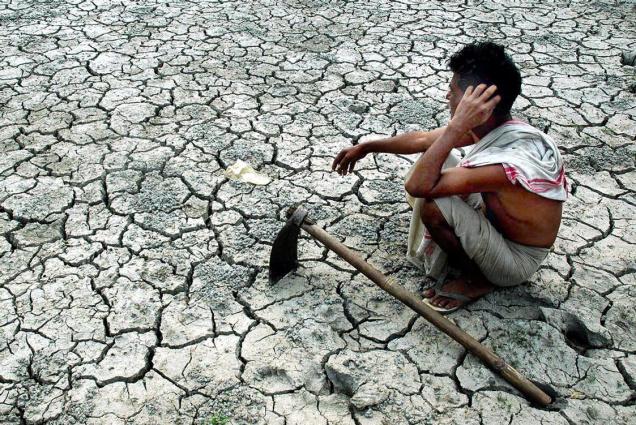
 Draught is a very serious condition that kills the water supply of the region, leading to a serious battle for survival, and if this very condition is prolonged then there comes another situation of ‘famine’. Currently, Far, more people in Maharashtra, India are facing this severe condition. Due to this we are losing so much. Farmers committing suicide, struggle to just get ample water to drink and cook. And the list of problems is so much more. Looking at the severity of Drought it just seems like there is a demon drinking or blocking away the water.
Drought is indeed caused by demons, as illustrated in Mythologies across the world. If we refer the Indian Mythology the Drought was caused by the famous demon Vritra, the famous Mentions of The great battle of Indra and Vritra from Rig Veda.
But there are many more such demons.

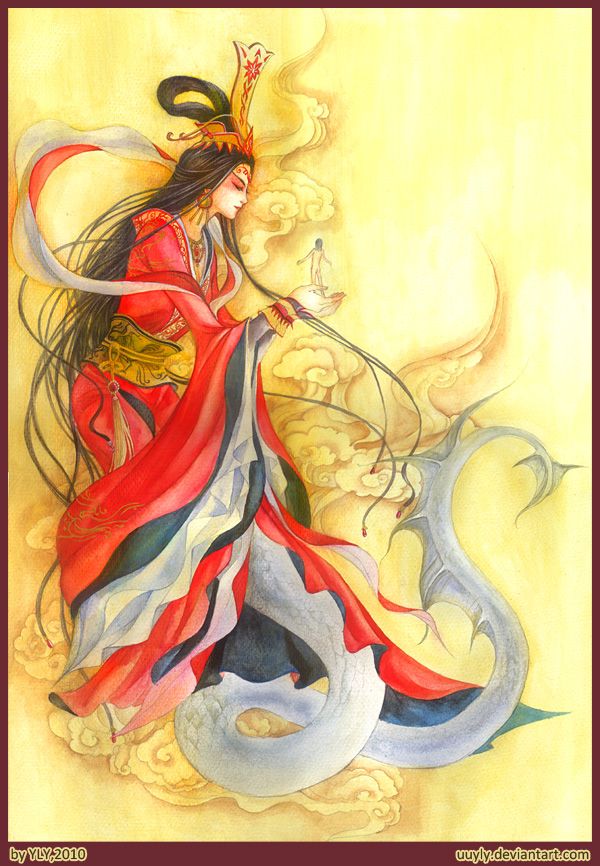
Nuwa or Hanba The Chinese drought demon.

 Nuwa or Hanba The Chinese drought demon.
          The goddess of drought in Chinese myth. She appears in several tales as an ally of Huang Di, the Yellow Emperor, to dry up a great storm that his enemy Chiyou brought against Huang Di’s army. Sometimes called Ba or Hanba (Han means drought), Nuwa is the daughter of Huang Di, the Yellow Emperor.  she was first mentioned in the Shijing, which is The Classic of Poetry, and was Composed before 500 BC.
According to The Classic of Spirits and Strange Things, which was written possibly in 386-589CE, Nuwa was a meter tall, didn’t wear clothes, and was quick to move like the wind. If she appeared, there was drought, and the only and really mean way of getting rid of her is to capture and dump her in shit. In the Shan Hai Jing (Classic Of Mountains and Rivers), she was the daughter of Huang Di and she lived in a place called the Terrace of Gonggong, which is located on Xikun mountain in the north. She wore green and was bald. When Chiyou gave Huang Di some trouble, he asked the god of the wind, Feng Bo, and the Rain Master, Yu Shi, to mess up things. But Huang Di called in Ba to help and so totally defeated Chiyou.
    Ba couldn’t return to heaven after that, and even though she was taught to stay in one place, she didn’t. After Shujun, the Cultivation God, complained, Ba was made to live by the Red River, but she didn’t agree to it and made her way ’round the world. Since she caused drought, no one wanted her around at all and so, they tried to chase her away. They’d clear the mud out of canals and ask the goddess by saying, “Goddess, don’t give us drought, go to the north, ” This custom was still practiced till 1949, in Sichuan, Shandong, and other places. In Sichuan, a man would dress as Ba and four others would be warriors, pretending to fight and chase her away. It would last for hours. In north Henan, people thought that Ba was actually the spirit of someone who’d just been buried, and when there was no rain, the farmers would open the grave, dig the corpse out and whip it so that the god would give drought during the night.

Apaosha the Zoroastrian Demon of Drought

Apaosha is the Zoroastrian demon of drought. He is the epitomized antithesis of Tishtrya, the divinity of the star Sirius and guardian of rainfall. In Zoroastrian tradition, Apaosha appears as Aposh or Apaush. In the mythology of Yasht 8.21-29, Tishtrya, as a mighty white horse with golden ears and golden tail, rushes towards the cosmic sea Vourukhasha. On his way, he is confronted by Apaosha a horrible black horse with black ears and a black tail. They battle for three days and nights until Apaosha drives Tishtrya away. Tishtrya then complains to Ahura Mazda that he was weakened because humankind did not give him his due of proper prayers and sacrifices. Ahura Mazda then himself offers sacrifice to Tishtrya, who now strengthened reengages Apaosha in battle at noon and conquers the demon of drought. Tishtrya then causes the rains to fall freely upon the earth and all is well again.

 Greek God of Sea becomes the Demon of Drought. 
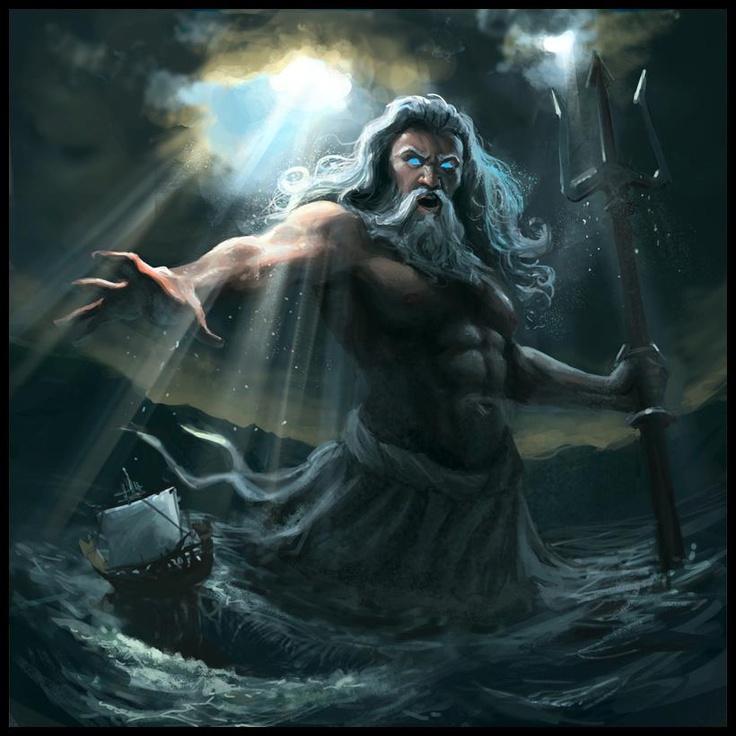
Poseidon Greek God of Sea
  Poseidon the Greek God of the Sea caused drought just because his ego was hurt and he wanted vengeance. Poseidon is the Greek god of the oceans, earthquakes, droughts, floods, water, aquatic creatures, marine weather, and horses. Poseidon was the child of Kronos and Rhea and brother to Zeus and Hades. Poseidon lived in an underwater palace and as such, ruled over the denizens of his watery world. He controlled every aspect of the oceans and aquatic regions. Poseidon was more powerful than other sea deities combined and the latter were his subordinates. Poseidon posted one of them, Proteus to the icy regions in the north, to rule over these lands.  He is also the creator of horses. Before the horse, Poseidon created the hippo, the camel, the giraffe, and the zebra, then refined the shape to create the first horses, out of sea waves.
            He fought for the patronship of many cities, mainly Athens. But when the people chose Athena, Poseidon unleashed a powerful flood. Since then, Athenians gave equal worship to Poseidon. The god once again lost control of Argos against Hera, when she won by one vote. Poseidon retaliated by massacring the local river gods, flooding the entire city and subjecting to drought. Since then, the Greeks stripped women of their right to vote. Poseidon was a patron god to a majority of the Greek cities and ports, and thus earned the title of “Protector of Greece”.


The Australian Aboriginal Frog Demon

 The Australian Aboriginal Frog DemonIn the dream-time, a terrible drought swept across the land. the land was dead and barren. After many had died of thirst, all the animals in the land met together in a great council to discover the cause of the drought. They traveled many miles. When they all arrived at the chosen meeting place in Central Australia, they discovered that a frog of enormous size had swallowed all the water in the land, and thus caused the drought. After much serious discussion, it was decided that the only way to obtain the water again was to make the frog laugh. The question now arose as to which animal should begin the performance, and, after a heated argument, the pride of place was given to the Kookaburra
The animals then formed themselves into a huge circle with the frog in the center. Red Kangaroos, grey Wallarus, rock and swamp wallabies, kangaroo rats, bandicoots, native bears, and ring-tailed possums all sat together. The emu and the native companion forgot their quarrel and the bellbird chimes. Even a butcher bird looked pleasantly at a brown snake, and the porcupine forgot to bristle. A truce had been called in the war of the bush.
          Now, the Kookaburra seated himself on the limb of a tree, and, with a wicked twinkle in his eye, looked straight at the big, bloated frog, ruffled his brown feathers, and began to laugh. At first, he made a low gurgling sound deep in his throat, as though he was smiling to himself, but gradually he raised his voice and laughed louder and louder until the bush re-echoed with the sound of his merriment. The other animals looked on with very serious faces, but the frog gave no sign. He just blinked his eyes and looked as stupid as only a frog can look. The Kookaburra continued to laugh until he nearly choked and fell off the tree, but all without success. The next competitor was a frill-lizard. It extended the frill around its throat, and, puffing out its jaws, capered up and down. But there was no humor in the frog; He did not even look at the lizard, and laughter was out of the question. It was then suggested that the dancing of the native companion might tickle the fancy of the frog. So the native companion danced until she was tired, but all her graceful and grotesque figures failed to arouse the interest of the frog.
          The position was very serious, and the council of animals was at its wits’ end for a reasonable suggestion. In their anxiety to solve the difficulty, they all spoke at once, and the din was indescribable. Above the noise could be heard a frantic cry of distress. A carpet snake was endeavoring to swallow a porcupine. The bristles had stuck in his throat, and a Kookaburra, who had a firm grip of his tail, was making an effort to fly away with him.  Close by, two Bandicoots were fighting over the possession of a sweet root, but, while they were busily engaged in scratching each other, a possum stole it. They then forgot their quarrel and chased the possum, who escaped danger by climbing a tree and swinging from a branch by his tail. In this peculiar position, he ate the root at his leisure, much to the disgust of the Bandicoots below.
After peace and quiet had been restored, the question of the drought was again considered. A big eel, who lived in a deep water hole in the river, suggested that he should be given an opportunity of making the frog laugh. Many of the animals laughed at the idea, but, in despair, they agreed to give him a trial. The eel then began to wriggle in front of the frog. At first, he wriggled slowly, then faster and faster until his head and tail met. Then he slowed down and wriggled like a snake with the shivers. After a few minutes, he changed his position, and flopped about like a well-bitten grub on an ant bed.  The frog opened his sleepy eyes, his big body quivered, his face relaxed, and, at last, he burst into a laugh that sounded like rolling thunder. The water poured from his mouth in a flood. It filled the deepest rivers and covered the land. Only the highest mountain peaks were visible, like islands in the sea. Many men and animals were drowned.
            Let the demons not trouble you and cause this epidemic of drought, let us take collective measures and save our land and restore the waters. Let us make the Frog “Laugh” or chase away the goddess to “north” or just let Poseidon win for a start.
duryodhana

Worship of the Greatest Villain- Duryodhana

Duryodhana a Major Character in Epic Mahabharata, he is also said to be the greatest warrior and villain of all time, he was the one who led to the fierce battle of Mahabharata leading to the Slaughter of Millions of Soldiers and great warriors. The word Duryodhana is derived from two words which are- Dur (दुर्) and Yodha or Yodhana (योध or योधन). Dur means difficult or unconquerable, Yodha means ‘fighting’ and Yodhana means ‘warrior. So this name has two meanings. Either it is, ‘the one with whom fighting is difficult’ or ‘unconquerable warrior’.
No doubt that in the Epic he was a great Villain, who led the slaughter, but was he Good or Was he bad? If he is Good then Why he is a Villain, if he was bad then Why Worshipped? Worship of Duryodhan may sound a bit odd but there are a number of temples in Uttrakhand’s Kumaon region and also one in Kerala.

Duryodhan Temple in North India

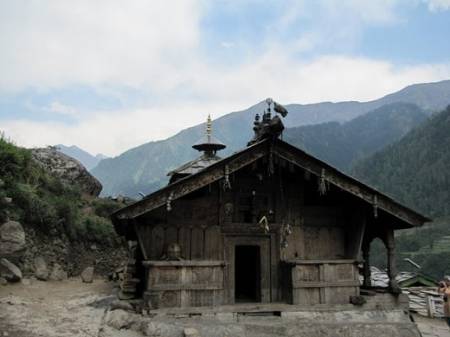
 Duryodhana Temple in North IndiaOne of the largest temples dedicated to Duryodhana in the Mahabharata is found at Oslo in Uttarkashi District in Uttarakhand.  The popular belief is that the soldiers and people who supported Duryodhana escaped from the Kurukshetra and took refuge in this area of Uttarkashi. They built temples in memory of Duryodhana and Karna here. Today they are the protecting deities of the region.
          A couple of temples dedicated to Duryodhana can be found in the region at Saur, Sarnaul, Gangar, and Datmir. Oslo village is on the way to Har Ki Doon, a popular location with trekkers. From Mussoorie, one has to travel through Yamuna Bridge, Naugaon, Purola, Saur, and Sankri to reach Osla.


Duryodhan Temple in South India

Duryodhana Temple in South India

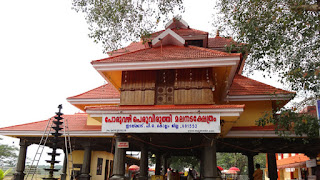
Poruvazhy Peruviruthy Malanada, popularly known as Malanada is located at Edakkad Ward (Kara) of Poruvazhy village in Kunnathoor Taluk of Kollam district Kerala State, India.

Malanda Means There is a Temple (Nada) on the Hill (Mala). Unlike other temples, It is believed that the ‘Sankalpa Moorthy ‘at Malanada is ‘Duryodhana’, the Great Epic Hero of Mahabharatham. The myth unravels: as part of his efforts to trace out the ‘Pandavas’ in exile, Duryodhan traversed the forests in the south and reached Malanada hill. By that time he was much tired and went to a nearby house on the northwest of Malanada and asked for drinking water. An elderly woman gave him toddy which was customary at that time as a mark of respect.

The king enjoyed the drink but realized after seeing the ‘Kurathali’ worn by the woman that she belonged to an untouchable lower cast. The king consoled himself and appreciated the divinity of the place and its people who possessed supernatural powers (Siddha). Thereafter, in furtherance of his ‘Rajadharma’, the king sat on the hill and worshipped Lord Siva, praying for the welfare of his people. As an act of charity, he gave away 100s of acres of agricultural land and paddy fields as freehold to the ‘Devasthanam’. Even now the land tax of the above property is being levied in the name of ‘Duryodhana’.

Jambukeshwar Temple Trichy

Jambukeshwar- The Water Shiva Linga

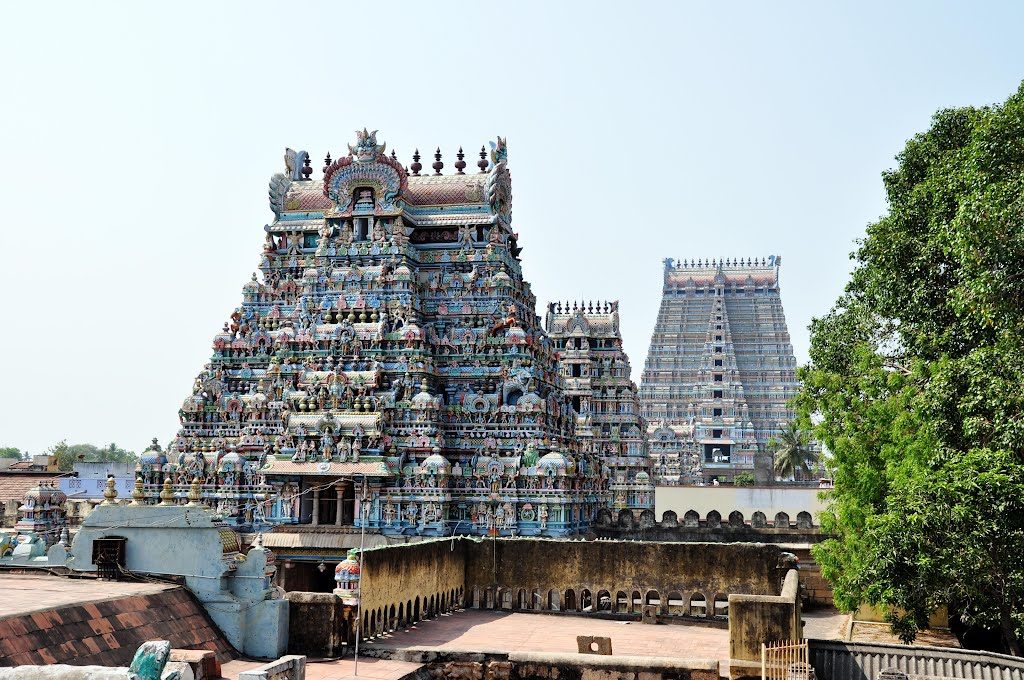
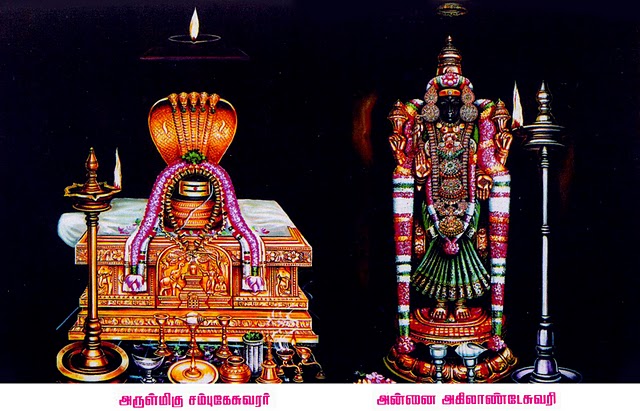
Jambukeshwar or Thiruvanaikava is a famous Shiva temple in Tiruchirapalli (Trichy), in the state of Tamil Nadu, India. The temple was built by  Kochenga Chola, one of the Early Cholas, around 1,800 years ago. It is located on Srirangam island, which has the famous Ranganathaswamy temple.JambukeshwarJambukeshwar is one of the  Panchabhoota Sthalams representing the Mahābhūta or five great elements; this temple represents the element of water. The sanctum of Jambukeswara has an underground water stream and in spite of pumping water out, it is always filled with water. the stream of water which is said to emerge from the linga is usually demonstrated as the soaking wet clothes in which Lord is draped. The water flow increases significantly during the Monsoon. The main deity of the temple is Jambukeswara, representing the element water. Jambukeswara is depicted sitting under a jambu tree, which grows over a small stream that engulfs the deity during the rainy season. The temple is also considered the abode of the goddess Akilandeswari, one of the forms of the goddess Parvati. As Akilandeswari worshipped Lord Shiva in this temple, even today at noon the priest dresses like a female and does Pooja to Jambukeswara and ‘Go Maata’ (Cow).  Legend maintains that the wall was built by Shiva working with the laborers. The temple’s deities are installed opposite to each other – Such temples are known as Upadesa Sthalams. As the Devi was like a student and Jambukeswara like a teacher in this temple, there is no marriage conducted in this temple for Shiva and Parvati, unlike the other Shiva temples. The garbhagriha of the goddess Akilandeshwari and the garbhagriha of Prasanna Vinayaka are in the shape of the pranava mantra called “Om”. It is believed that the Amman in the temple was in deep anger hence during one of Adi Sankara’s visits he installed the Prasanna Ganapathy idol right opposite to her Sannathy and installed a pair of Sri Chakra ear-rings to reduce her anger.  The holy tree here is the White Jambuka, found growing along the south-eastern wall of the sanctum sanctorum. 

Jambukeshwar Shiva Linga

           The sanctum sanctorum is divided into the Ardha Mandapam or Antaralam (whose western wall bears the window) and the Garbha Griha where the deity of Jambukeswarar is housed. At the center, the Brahma Sthana is the self-manifested linga of Jambukeswarar. The upper conical part of the Linga is of the color of copper, whereas the Yoni-Bhaga or the pedestal is of black granite. A brass ring is seen at the point of attachment of the Linga to the pedestal. The height of the Linga is about 3 feet from the floor of the sanctum. The Garbha Griha and the Ardha Mantapa are unadorned from the inside, the only source of illumination within the sanctum being ghee lamps.


Sthala Puranam- The Story

Elephant and spider storyOnce Parvati mocked Shiva’s penance for the betterment of the world. Shiva wanted to condemn her act and directed her to go to the earth from Kailasa (Shiva’s abode) to do penance. Parvati in the form of Akilandeswari as per Shiva’s wish found Jambu forest to conduct her penance. She made a lingam out of the water of river Cauvery under the Venn Naaval tree and commenced her worship. The lingam is known as Appu Lingam (Water Lingam). Siva, at last, gave darshan to Akilandeswari and taught her Siva jnana. Akilandeswari took lessons facing East from Shiva, who stood facing west.
Another story is about two Siva Ganas ‘Malyavan’ and ‘Pushpadanta’ Who lived in Kailasa. They always quarreled with each other and fought for one thing or other. In one fight ‘Malyavan’ cursed ‘Pushpadanta’ to become an elephant on earth and ‘Pushpadanta’ cursed back making him become a spider on earth. The elephant and the spider came to Jambukeswaram and continued their Siva worship. The elephant collected water from river Cauvery and conducted ablution to the lingam under the Jambu tree daily. The spider constructed his web over the lingam to prevent dry leaves from dropping on it and prevent sunlight directly falling on it. When the elephant saw the web and thought it was dust on the lingam. The elephant tore them and cleaned the lingam by pouring water and the practice continued daily. The spider became angry one day and crawled into the trunk of the elephant and bit the elephant to death, killing itself. Siva, in the form of Jambukeswara, moved by the deep devotion of the two, relieved them from the curse. As an elephant worshipped Siva here, this place came to be known as Thiru Aanai Kaadu (Thiru means holy, Aanai is an elephant, Kaa (Kaadu) means forest). Later the name ‘Thiruaanaikaa’ become ‘Thiruvanaikaval’ and ‘Thiruvanaikoil’.  
As an outcome of making sin by killing the elephant, in the next birth, the spider was born as the King Kochenga Chola and built 70 temples and this temple is the one among them. Remembering his enmity with the elephant in his previous birth, he built the Siva sanctorum such that not even a small elephant can enter. The entrance on the sanctorum of Jambukeswara is only 4 foot high and 2.5 foot wide.