Mehul Vora

God doesn’t exist

A man went to a Barbershop to have his hair cut and his beard trimmed. As the barber began to work, they began to have a good conversation.

They talked about so many things and various subjects. When they eventually touched on the subject of God, the barber said: “I don’t believe that God exists.”
“Why do you say that?”asked the customer.
“Well, you just have to go out in the street to realize that God doesn’t exist. Tell me, if God exists, would there be so many sick people? Would there be abandoned children? If God existed, there would be neither suffering nor pain. I can’t imagine loving a God who would allow all of these things.”

 The customer thought for a moment, but didn’t respond because he didn’t want to start an argument.

 The barber finished his job and the customer left the shop. Just after he left the barbershop, he saw a man in the street with long, stringy, dirty hair and an untrimmed beard. He looked dirty and un-kept. The customer turned back and entered the barber shop again and he said to the barber:

“You know what? Barbers do not exist.”

“How can you say that?”Asked the surprised barber. “I am here, and I am a barber. And I just worked on you!”

“No!” the customer exclaimed. “Barbers don’t exist because if they did, there would be no people with dirty long hair and untrimmed beards, like that man outside.”
“Ah, but barbers DO exist! What happens is, people do not come to me.”
“Exactly!”- affirmed the customer. “That’s the point! God, too, DOES exist! What happens, is, people don’t go to Him and do not look for Him. That’s why there’s so much

pain and suffering in the world.

The Humble Dal

Dal has been a staple food for centuries. Dal is a soup-like preparation made from different pulses. It is one of the simplest, most humble, and most comforting foods. Each state in India has its favorite selection of Dals and method of preparation. Toor, masoor, chana, urad, and moong dal are the most commonly used Dals in India. Each region of India, right from north to south and east to west has its distinct tempering to the dals, giving an aroma and fragrance that is incomparable. 

Ancient History of Dal 

Dal gets its name from Sanskrit verbal root dal- “to split”. The pulses have always been an integral part of Indian cuisine. Dal preparation differed from region to region right from the Vedic civilization. In the Vedic Civilization in around 1200 B.C, pules have known to be consumed, widely. The Yajur and Rig Veda mention the use of Masura (masoor), Masa (kidney beans), Arhar (Tuvar), Mugda (Mung), gram, and pea. In the Vedic period, Masa (Urad Dal) was commonly used as food as well as in rituals. Masa or kidney beans were stewed and mixed with a little jaggery and oil to make the dish Kulmasha. This was the poor man’s food during the Vedic times and the rich ate only when there was scarcity. 

Pulses were first cooked as a soup during the sutra period, (800 B.C. TO 300 B.C) we find the dish ‘supa’ or soup. This is believed to be the first preparation of Dal the way it is prepared today.  This preparation is mentioned in Panini’s Astadhyayi. Out of the pulses from the Vedic period Masa (Urad dal), Mudga (Mung), and Kulattha (Horse gram) continued to come into use. During the Buddhist and Jaina Era as well Dal Preparation was common, it was known as Yusa.

Invented by Bheema Loved by the Mughals

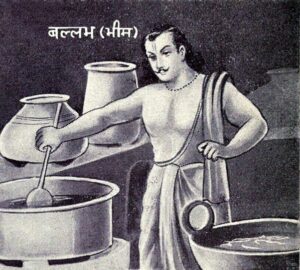
According to folk narratives of the Mahabharata, It is during Agyata Vaas, Pandavas were hiding at king Virat’s Kingdome. There Pandavas took menial jobs to serve the king and protect their identities. Bhīma became Vallabh, a cook. He would cook for the king. One day Bhīma mixed five of the dals that were available and slow-cooked it, this became the first ‘Pancharatna dal’ otherwise known as ‘Panchamel dal’.


In the Mughal period, we see the Panchmel dal, as one of Jodha Bai’s favorite dishes. The Panchamel dal is a flavored mix of Moong Dal, Chana Dal, Tur Dal, Masoor Dal, and Urad Dal. It’s believed that Jodha Bai introduced this dal to the kitchen of Akbar. Moradabadi dal is another creation of the succulent dal of the Mughal period, this dal is made of Moong dal, This delicacy came into being when Prince Murad Baksh( the third son of Shah Jahan) established the megacity of Moradabad in 1625.

Even in Maurya and Sunga (300 B.C. to 75 AD.) period Soup prepared from it is expressly mentioned in the texts of those times. In the Epic age use of Chanaka or Chana Dal had come into use.

The Gupta period, (300 A.D. to 750 A.D) saw a rise in preference for the green Mudga or Mung beans and a decline in the use of Masa (urad dal) on medical grounds, as people felt it was difficult to digest. However, Kulatha was widely used. This period also saw the use of Rajamasa (Rajma or Kidney beans), Masura (Masoor Dal), and gram during Sraddha rituals, according to the Puranas.


In Manasollasa we find Mentions of Spiced Mung Dal preparation, it is said that A soup prepared with Mudga(Mung), asafetida, pieces of ginger, pieces of lotus stalks fried in oil or the seeds of Priyala is also mentioned.

Superstitions around Dal 

Dal later grew much more popular with the development of culinary art. Dal also has an emotional connect with people, mere cooking of dal has great significance in cultures in India. For instance, in Gujarati cuisine, a traditional meal is incomplete with Gujarati dal, bhaat (rice), roti and shak (subzi). The khatti-meethi or sweet and tangy dal is of great importance to them. It is said that ‘Jeni dal bagdi teno divas bagadyo’ (the day is ruined for one whose dal is ruined). Such emphasis is given to cooking a perfect dal. It is the aroma of the dal being cooked that defines the taste and perfection of the dal.


The are many dishes that have evolved from the traditional dal, which have an interesting story of origin as well. Some of the extensions have evolved by accident or experimentation. The two most famous ones are sambar and Dal Makhani.


Dal Makhani


During the horrors of Indian independence Jaggi along with Kundan Lal Gujral, migrated to Delhi. They then set up the famous Moti Mahal restaurant in Daryaganj. The place where butter chicken was born. Once Jaggi decided to use the tomato-based butter chicken gravy loaded with butter and cream for the black Punjabi dal they were serving. The dal would not taste right. They then slow-cooked it for hours over a slow flame, the combination proved to be a masterstroke, and the fabled Dal makhani was born.


Sambar

This is a hot, tangy, and spicy extension of dal mixed with vegetables is appetizing in aroma and taste. Sambar originated during the Maratha period, in the 17th century. This dish was a last-moment ‘everything into pan’ move. As per popular reads, this dish originated in the kitchen of Thanjavur Maratha Ruler Shahaji, he had a special liking for a dish called ‘Amti’. One day great Maratha Ruler Shivaji Maharaja’s son Sambhaji was visit

ing his cousin Shahaji. Shahaji wanted to serve Amti to his cousin, however, the key ingredient ‘kokum’ ran out of supply, Shahaji himself experimented with the dish with Toor dal, vegetables, spices, and tamarind pulp and served his cousin, Sambhaji. The other narrative says that Sambhaji himself cooked dal with Tamarind Pulp and whatever he had found in the kitchen when his chef was away. Sambhaji loved this dal so much that he gave his name to this dish, and this dal became Sambar.

Outing justo morbi wild

Aliquam sed in egestas gravida amet mattis sagittis, semper morbi vitae, egestas blandit duis facilisis adipiscing fermentum aenean nunc nibh accumsan, ornare enim at interdum mi arcu, ut magna ultrices odio dictumst aliquam tincidunt dictum pharetra vestibulum aliquam aliquet suspendisse.

Sed et aliquam tincidunt ut sed porttitor nunc et etiam molestie arcu donec venenatis nulla nunc massa tellus mauris vitae lorem sit semper natoque fusce lectus urna.

Pellentesque viverra

Mauris viverra mi sollicitudin est nunc, tincidunt risus massa nunc proin ipsum fames aliquet vel etiam nulla pretium magna quam a porta vitae eget pellentesque nunc malesuada at nisi purus orci, fermentum consectetur iaculis eu morbi elit mauris in felis massa in vitae parturient purus magna aliquet phasellus odio in suscipit arcu amet, magna molestie in iaculis augue condimentum cras molestie vestibulum pharetra risus.

Eget elementum on train

Aliquam sed in egestas gravida amet mattis sagittis, semper morbi vitae, egestas blandit duis facilisis adipiscing fermentum aenean nunc nibh accumsan, ornare enim at interdum mi arcu, ut magna ultrices odio dictumst aliquam tincidunt dictum pharetra vestibulum aliquam aliquet suspendisse.

Sed et aliquam tincidunt ut sed porttitor nunc et etiam molestie arcu donec venenatis nulla nunc massa tellus mauris vitae lorem sit semper natoque fusce lectus urna.

Pellentesque viverra

Mauris viverra mi sollicitudin est nunc, tincidunt risus massa nunc proin ipsum fames aliquet vel etiam nulla pretium magna quam a porta vitae eget pellentesque nunc malesuada at nisi purus orci, fermentum consectetur iaculis eu morbi elit mauris in felis massa in vitae parturient purus magna aliquet phasellus odio in suscipit arcu amet, magna molestie in iaculis augue condimentum cras molestie vestibulum pharetra risus.

Visit sagittis malesuada vestibulum

Aliquam sed in egestas gravida amet mattis sagittis, semper morbi vitae, egestas blandit duis facilisis adipiscing fermentum aenean nunc nibh accumsan, ornare enim at interdum mi arcu, ut magna ultrices odio dictumst aliquam tincidunt dictum pharetra vestibulum aliquam aliquet suspendisse.

Sed et aliquam tincidunt ut sed porttitor nunc et etiam molestie arcu donec venenatis nulla nunc massa tellus mauris vitae lorem sit semper natoque fusce lectus urna.

Pellentesque viverra

Mauris viverra mi sollicitudin est nunc, tincidunt risus massa nunc proin ipsum fames aliquet vel etiam nulla pretium magna quam a porta vitae eget pellentesque nunc malesuada at nisi purus orci, fermentum consectetur iaculis eu morbi elit mauris in felis massa in vitae parturient purus magna aliquet phasellus odio in suscipit arcu amet, magna molestie in iaculis augue condimentum cras molestie vestibulum pharetra risus.

Sudarshana Narasimha- A rare Combination.

It was in the month of March, I visited Srirangam, a temple town in the Trichy district of Tamil Nadu, to take darshan of  Ranganatha swami, a huge deity of Lord Vishnu lying down on Seshanag. When I reached the temple vicinity I saw many gates, each with beautifully carved and colorfully painted gopurams. Passing through about 7 gates I reached a giant temple complex made of stone. The day I reached the temple was a busy day, there was a long queue, and devotees were penitently waiting for their turn to take darshan of the lord of the universe. Since this is the only temple with Lord Vishnu deity lying on Seshnag and goddess Laxmi massaging his lotus feet, the temple attracts many devotees. Soon the time passed by contemplating the divine form of the supreme lord and it was my turn to take darshan, I took darshan of the divine lord who had big sparkling eyes and was carved in single black stone, the deity was as large enough to accommodate two rooms. On the extreme end, Lakshmi Devi was massaging his feet, and right before the original deity was Utsava Murti of the lord, the deity to which puja is done or is brought out for the procession. The Utsava Mutri was golden in color, may be made of gold. Lord Vishu was in the center with two of his wives Lakhmi Devi and Bhumi Devi. After paying obeisance to the lord of the universe, I came out of the sanctum and proceeded to take darshan of other shrines. Out of a couple of shrines present in the temple complex one shrine caught my attention. It was a shrine of my favorite deity, Narasimha Deva. Lord Narasimha here was in Yogananda form, seated in padmasana with the yoga bands around his knees. But the most intriguing part was he was right behind Sudarshana chakra. So one side of the deity was Narasimha and the other side was Sudarshana chakra. Behind the two deities, a pentagram with six sides was connecting them and a flaming circle enclosed the deities.

Seeing the divine form I remembered my visit to Vardaraja Kovil in Kanchipuram, where I saw the same form of Sudarshana  Narasimha. I know that Sudarshana chakra is the weapon of Lord Vishnu and Narasimha is one of the Dashavatars. But the Narasimha form is never seen holding the chakra.

The divine form of Sudarshana  Narasimha mesmerized me and looking at the two sides, immediately remembered the concept of duality in nature. The existence of yin-yang, the Purusha-Prakriti, Shakti- Shaktiman, concept. Then I thought for a while, in the idea of Pursha Prakriti the union is between male and female counterparts whereas, in the case of Sudarshana Narasimha, both the deities belong to the male gender. Can they be united?

I started by drawing parallels between Narasimha and Sudarshana .  Narasimha and Sudarshana chakra both have appeared to fight the evil and protect the devotees. It is believed that when lord incarnates he comes with all his possessions. For example, during the Rama avatar, Sheshnag came as Laxman, Lakshmi appeared as Sita, and lords Shankara and Sudarshana chakra incarnated as Bharat and Shatrughana. Similarly, according to Agama Shastras, this Sudarshana chakra incarnated as the tusk of Varaha, the axe of Parshurama, and nails of Narasimha. Sudarshana chakra accompanied lord in his various avatars.

The Agamic and tantric texts mention that Sri Lakshmi becomes the Moola Prakriti or shakti of Vishnu. The Purusha and Prakrti are inseparable and their union leads to the creation of the universe. Lakshmi Tantra, Chap. 29-35, mentions that the entire system of creation is conducted day and night by the Vyuhas, Pradyumna, Anirudha, Sankarshana which are direct expansions of the kriya shakti of Lakshmi. Further, it is said that this Kriya shakti manifests as the Sudarshana chakra. It is believed that no single act by Vishnu can be performed without Sudarshana.

The Kriya shakti manifests as the Sudarshana chakra when sustaining and absorbing creation. This supreme Kriyasakti born from a part of Lakshmi is identical with Agni that pervades the whole of creation from Brahma to a tuft of grass in six different courses of creation. This Kriya shakti consists of the body of Agni who combines all weapons and sharp instruments. This shakti resides in the heart of Sudarshana. The text further describes Sudarshana possessing sixteen arms, standing in the posture of ‘Pratyalldha’ facing the enemy. He is decorated with muscular arms raised, as it were, to strike; in his right hands proceeding upwards from the lowest, he holds the flaming spear, the sword, a hundred-flamed fire, the goad, the staff, the burning dagger, the axe, and the disc, while his left arms proceeding from the uppermost downwards are (decorated with) the blazing weapons viz. the conch-shell, the bow and arrow, the noose, the plough, the thunder, mace, the club and also a lance. He is enwrapped in a profusion of flames from the fierce fire caused by the luster of his teeth and is encircled with the vanamala, which effuses the realities.  He drives away the frightened king of the demons and titans with his fierce laughter.

Looking at the perspective from the Lakshmi Tantra the form of Sudarshana Narasimha is a union of Sudarshana chakra as Kriya Shakti and Narasimha as the supreme Purusha. Some interpret the six corners as the Chakras in the body and Narasimha in Yogananda form as a symbol of dhyana, meditation to awaken Kundalini, and gain self-realization.

The origin of Yogananda form of Narasimha is mentioned in the 87th chapter of the Uttara Kanda of the Brahmanda Purana, the text says that a sage did penance on the banks of the Padma Thadagam, as it was filled with lotus flowers, near the Gaja Giri Kshetram (the present Anaimalai) seeking progeny, and wanted the lord to appear in his Narasimha avatar. The lord appeared as Ugra Narasimha and the heat that emanated from him was unbearable. Even the celestials were affected by it and they all came to Gaja Giri Kshetram and prayed to the lord to calm down. The lord could not be pacified and then they sought the help of Prahlada, whose arrival calmed him to some extent. They prayed to the goddess Mahalakshmi, who also took her abode in him as Narasingavalli, after which he became Yoga Narasimha.

The Ahirbudhnya Samhita draws parallels between Narasimha and Sudarshana chakra, the text mentions that both Sudarshana and Narasimha are the remover of miseries, protectors of devotees and killer of the demons, the chakra is attributed to a mighty Jwala, with the radiance of thousand suns. This mighty Jwala is the symbolized with Jwala Narasimha , the fierce form who killed Hiranyakashipu and protected Prahalad.  The presence of Lord Narasimha in the wheel is mentioned for the first time in the Padma Samhita, a Pancharatra Agama text. Also, a description of Lord Narasimha with sixteen arms (Shodasa Ayudha aspect) is a trait shared by the Sudarshana Chakra. Sudarshana Narasimha is indeed a mesmerizing incarnation.


Bimala – A Goddess who eats only Jaganath Mahaprasad

Food is the building block of life, any living entity when born cannot survive without food and nourishment. God has made such arrangements that the food of that living entity comes into the planet before even the living entity does. Thus food is very dear to us became a worthwhile of offering to God as gratitude.  This sacrifice later took the form of Prasadam during the Puranic era. Prasadam means a gracious gift, a devotee offers food, clothes, or anything he wishes and considers acknowledged.

Anything that is acknowledged by a mere glance of God either by physical offering or mental offering becomes the Prasadam.  In Bhagavad Gita 2.65, Krsna glorifies Prasad to be the destroyer of all miseries, prasade sarva-duhkhanam hanir asyopajayate. “The devotees of the Lord are released from all kinds of sins because they eat food which is offered first for sacrifice. Others, who prepare food for personal sense enjoyment, verily eat only sin.” (B.G 3.13)

The Srimad Bhagavatam says that if someone eats Prasadam unknowingly, sinful reactions of seven lifetimes are counteracted. If someone does that knowingly, sinful reactions of one million lifetimes are counteracted. The Vishnu Purana says that simply by honoring Prasadam once, one gets the credits of fasting for 6 months. The Brahma Vaivarta Purana says that when a person is full of Prasadam and he walks on the earth, he purifies the earth; when he goes to the holy place, he purifies the holy places; when he touches someone, that person is purified. Honoring Prasadam is equivalent to performing millions of Ashavamedha.

Such are glories of Prasadam. Devotees are eager to have Prasadam and only desire to eat Prasadam and nothing else. In Jagganath puri, Goddess Parvati in the form of Vimla eats only Mahaprasada of Jagannath. The goddess is described as surviving on the remnants (Uchchhishta) of Jagannath’s meals. There are no separate offerings are cooked for goddesses. Only Mahaprasad of dried rice mixed with grated coconut, paneer, curd, and butter is offered.

Only during the Durga puja non-vegetarian offerings are made and animal sacrifices performed in secrecy during pre-dawn hours before the opening of the main Jagannath temple. Devotees of Jagannath are barred from witnessing the worship and offering and only a few who witness the ceremony are given the Bimala parasada.

According to a narrative, Once Shiva went to visit Vishnu in Vaikhunta, he saw that Vishnu had just finished his meal, and a few rice grains had fallen on the ground. Spotting the Mahaprasada of Vishnu he quickly picked up the grain and ate it. Unknown to Shiva a half grain of rice had stuck in his beard. When Shiva returned to Kailash he saw Narada waiting for him, As soon as Narada spotted the half grain of Mahaprasada he quickly ate it. This angered Paravati as she missed her rightful share of Mahaprasad. She rushed to Vishnu to complain. Vishnu pacified her and promised her that during kali yuga when Vishnu would reside in puri as Jagannath, Parvati would reside as Vimala, and daily she would honor Mahaprasad of Jagannath. 

After reading the story a question may arise, why does Shiva the supreme being according to Saivites need to honor Vishnu prasadam, and why Adi Shakti would want to live on Mahaprasada of Vishnu? To this the Srimad Bhagvad (12.13.16) mentions  nimna-gānāṁ yathā gaṅgā ,devānām acyuto yathā vaiṣṇavānāṁ yathā śambhuḥ, purāṇānām idam tathā. Just as the Gaṅgā is the greatest of all rivers, Lord Acyuta is the supreme among deities, and Lord Śambhu [Śiva] the greatest of Vaiṣṇavas, so Śrīmad-Bhāgavatam is the greatest of all Purāṇas.

In the Krsna Janma Khanda of Brahman Vivarta Purana Shiva speaks to the devatas

adhunaa pancha-vaktrena yan naama-guna-kirtanam 
gaayan bhramaami sarvatra nishprhah sarva karmasu

With my five faces (Sadyojata, Vamadeva, Aghora, Eshana, Sadashiva) I chant His name and qualities while I wander everywhere without involving myself in anything.

sarva brahmaanda samhartaapy aham krtyunjayaabhidhah 
schiram tapasaa yasya guna-naamaanu-kirtanaat

By reciting His name and qualities while performing my austerities for a long time, I have achieved the power to destroy all the universes and have conquered even death.

The puranas also say that both are non-different

शिवाय विष्णु रूपाय शिव रूपाय विष्णवे
शिवस्य हृदयं विष्णु विष्णोस्च हृदयं शिवः

śivāya viṣṇu rūpāya śiva rūpāya viṣṇave
śivasya hṛdayaṁ viṣṇu viṣṇosca hṛdayaṁ śivaḥ

Vishnu always helps Shiva by taking Mohini avatar, destroying Sati’s body so that Sati can be reborn, by killing Madhu Kaitab as Hayagriva. And Shiva always loves to enjoy the pastimes of Vishnu. Shiva comes to take darshan of baby Krsna, Shiva helps Arjuna to learn some war skills. Shiva is worshipped by Rama before marching to Lanka.


Therefore it would not be surprising that Shiva could not miss the Mahaprasad of Vishnu and Parvati getting angry for not getting her share.

Seven Personas of Eve – A Book Review

Life is very funny it may take you to a point where you may just breakdown. But the real battle is won only if you can fight through the challenges of life. Like Arjuna broke down in front of Krishna where he says I cannot fight my own relatives in the great war , instead he would happily die from their hands. Arjuna says (B.G 1.45) Better for me if the sons of Dhṛtarāṣṭra, weapons in hand, were to kill me unarmed and unresisting on the battlefield. To which Krishna says (B.G 2.3) O son of Pṛthā, do not yield to this degrading impotence. It does not become you. Give up such petty weakness of heart and arise, O chastiser of the enemy. We do not surrender to the challenge but we fight it out straight. We always feel that only we have biggest of the problems, but there are some challenges that are beyond imagination.

I recently came across a book that can be a true motivation to many, The book “Seven Personas of Eve” is a book written by Dr Anju Kapoor  and Harry Kurup. This book has 7 short stories that will inspire, motivate, or may be open a new perspective to life.

A woman who witnessed a war, and had to move on with four children to an unknown city and to her surprise she was also abandoned by her husband. Kaushalya had to raise her four children by herself in poverty, pain and agony brought upon her by her husband who deserted her.  But when her husband truly needed her she stood by him and took care of him till his last breadth. Today we keep grudges on tiny things that hurt us, often about things that don’t even matter. But Kaushalya overcame years of hardship and trauma that her husband caused, she  instead stood by her husband every minute he needed her.

Another story of a differently abled girl Akriti, who is mocked by the society for being the way she is. Instead Akriti makes the society believe that different is not to be shunned but only accepted with love and affection. We need to find a way and not excuses.  She finds a way for each and every challenge that comes her way.

There are more such inspiring stories through which book really motivates the reader to accept and fight back to whatever the life throws at them. The book actually gives the reader seven life altering revelations with each story.

As rightly said in the Blurb “Kaushalya will lead you through threshold of life and priya will guide you through a dilemma. If have a failed relationship Parineeti will tell you it’s alright. Saral will teach you to be independent and Shraddha will help you to soar high. And finally Goodbye Madamjee will reveal the secret of true happiness.”

I remember a story Kisa Gautami who lost her son at a very early age, she could not believe that her son has left her, she would go to every doctor and ask them to revive her son, soon people started to believe that she is crazy. Then one gentleman advised her to see Buddha, Buddha told her that bring mustard seeds from the house that has seen no death ever, and your son will be revived.  She went is search for such a house but failed drastically. She realized that her problem is actually nothing as compared to things she heard. Soon she understood and accepted the truth of life. We get inspired and motivated to fight back when we hear or see bigger challenges of life. It is only then we get a realization and our perspective changes.  

Just as mustard seeds played a catalyst and changed Kia Gautamai’s perspective of life, similarly hope that this book “Seven Personas of eve” becomes the catalyst in changing perspective of life of the readers.  

Kamakhaya :- The Bleeding goddess

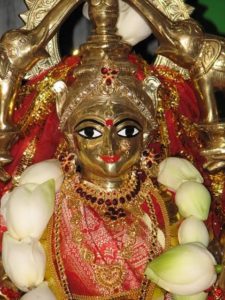
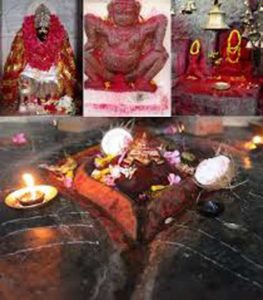
Positioned atop the Nilachal Hill in Kamprup district near Guwahati, Assam resides the Kamakhya Devi or the bleeding goddess, Kamakhya means “renowned goddess of desire. This is one of the oldest and most important of the 51 Shakti Peethas. The temple is also known as yoni peetha the deity worshipped here is the yoni of Sati, wife of lord shiva. The Yoni is covered with a red silk sari and spring of river Brahmaputra flows beneath the yoni. Along with the Yoni, the temple complex has individual temples of Dasaha Mahavidyas Kali, Tara, Sodashi, Bhuvaneshwari, Bhairavi, Chhinnamasta, Dhumavati, Bagalamukhi, Matangi and Kamalatmika. Among these, Tripurasundari, Matangi, and Kamala reside inside the main temple whereas the other seven reside in individual temples. It is believed that these Mahavidyas are present here as an incarnation of goddess Kamakhya. The Mahavidyas are non-different from Kamakhya herself.

Kalika Puran mentions Kamakhya as one of four primary shakti peethas: Kalika Purana (the Asthashakti) and various Tantras recognize the four major Shakti Peethas as Adi Shakti Peethas. Like (Bimala, Pada Khanda) inside the Jagannath Temple, Puri, Odisha, (Tara Tarini) Sthana Khanda (Breasts), near Brahmapur, Odisha, (Kamakhya, Yoni khanda) in Guwahati, Assam and (Dakshina Kalika, Mukha khanda) in Kolkata, West Bengal originated from the limbs of the Corpse of Sati. In a hymn, the Kalika Purana (Asthashakti) clearly says:

 “Vimala Pada khandancha,

Stana khandancha Tarini (Tara Tarini),

Kamakhya Yoni khandancha,

Mukha khandancha Kalika (Kali)

Anga pratyanga sangena

Vishnu Chakra Kshate nacha……”

Every year during monsoon, the goddess menstruates, and the temple is closed down for three days. It is also when the Tantric fertility festival or Ambubachi Mela is celebrated here, till the fourth day when the temple reopens. It is also said that the underground spring of river Brahmaputra that flows in the sanctum of the temple turns red on these three days. Devotees are offered a piece of the red cloth used to cover the yoni vigrha during the days of menstruation as ‘prasad’.

Iconography

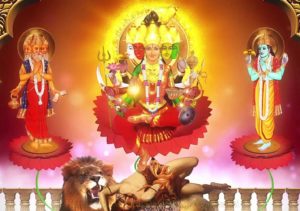
Kamakhya is pictured as a young 16 years old goddess or Sodashi, with twelve arms and six heads of varying colors, representing a powerful goddess who is omnipotent, omniscient and omnipresent. She is wearing opulent jewelry and red flowers of hibiscus. She holds in each of ten hands a lotus, trident, sword, bell, discus, bow, arrows, club or scepter, goad, and shield. Her remaining two hands hold a bowl, which is made either of gold or a skull. She is seated upon a lotus, directly on top of Lord Shiva, who in turn lies atop a lion. To each side of her sit Brahma and Vishnu, who are each seated upon a lotus. Devi Kamakhya’s ‘Ashtashaktis’ or eight associates are Guptakama, Srikama, Vindhyavasini, Kotishvari, Vanadurga, Padadurga, Dirgheshvari, and Bhuvaneshvari.


Legends of Kamakhaya

Kamakhya is also called yoni peetha because Sati’s yoni (vagina) fell here. According to Legend in Devi Bhagavata, Sati’s father Daksha Prajapati held a grand Yagya once, he invited everyone except Shiva and Sati. Daksha found the appearance and lifestyle of Shiva embarrassing. Hearing the news of the Yagya sati insisted ongoing, as a daughter needs no invitation to go to her father’s house. Upon the arrival of Sati, her father insulted her and Lord Shiva. Sati being sinned by hearing the blasphemy of her husband self-immolated in the sacrificial fire. This enraged Shiva and Shiva was seen in most Aggressive and emotional state of mind. He threw locks of hair that caused Bhadra kali and Veera Bhadra to appear. these fearsome and bloodthirsty associates of Shiva were sent to kill everyone present in Daksha’s Yagya. They created havoc and a trial of bloodbath followed. Shiva also appeared there, he lifted the corpse of Sati and was wandering throughout the universe. According to Vedic customs, a body must be destroyed to process the reincarnation. Lord Vishnu using his Sudarshan chakra cut of the body parts of Sati, those cut-off body parts fell on the earth and thus originated Shakti peethas. Kamarupa, formed of desire, is the region in which the yoni is said to have fallen to earth, and the Kamakhya temple was said to have been constructed on this spot. Hence the place is considered as a symbol of women’s power and fertility.

Kamakhya is mentioned in the Kalika Purana as the most important goddess of Tantric worship and is referred to in the text as Mahamaya, the “great goddess of illusion”, who takes on many forms depending on her mood. Devotees also call her Kameshwari (“beloved goddess of desire”), and consider her as an expansion of Maha Tripura Sundari, also called Shodashi. She is identified with Kali in the Kalika Purana, Yogini tantra and Kamakhya Tantra, each of text confirms that Kamakhya is non-different from kali.

Kamakhya finds its name from the Hindu God of love, Kamadeva. according to a legend, that Lord Shiva cursed Kamadeva that he would not be able to enjoy his romantic powers anymore. He was free from his curse after seeking out Sati’s vaginal part at the location of the temple. As a tribute to Shakti and her ability to lend back Kamadeva his potency, the deity of Kamakhya Devi was installed and continues to be worshipped until today.

Narakasur was a demon with great might, lord shiva had given him five boons and his mother Bhudevi had promised him a long reign on earth. Just as all demons do Naraka also conquered all the kingdoms of earth along with the Indra’s heaven. He had also abducted 16,000 princesses belonging to various kingdoms. According to a popular narrative, Narakasur was killed by Lord Krishna. But according to folklore or sthala Purana, he was killed by Devi Kamakhya.

Once Narakasura, motivated by his desire, wanted to marry Kamakhya, When proposed, the Goddess playfully put a condition before him that if he would be able to build a staircase from the bottom of the Nilachal Hill to the temple within one night before the cock crows to indicate Dawn, then she would surely marry him. Naraka took it as a challenge and tried all with his might to do this huge task. He was almost about to accomplish the job before it was dawn. When Kamakhya Devi got this news, she playfully strangled a cock and made it crow untimely to give the impression of Dawn to Naraka. Duped by the trick even Naraka thought that it was a futile job and left it halfway through.

Devi Kamakhya appeared in Narakasur’s lair in her glorious form. Kamakhya empowers all the 16,000 women present there to fight Narakasur’s demon army. Meanwhile, Narakasur is fallen to the ground by Kamakhya Devi. Kamakhya then enumerates the five boons that Lord Shiva had given and the last one being that he will die only when he calls upon his death.

Kamakhya Devi tells him that she is none other than the Supreme Goddess Mahakaali, who is the creator, preserver, and destroyer of all. Narakasur sees the horrific Goddess Mahakali, standing in full view, in his front. Upon seeing Kamakhya as Mahakaali, Narakasur was scared. The demon begs Goddess Kamakhya for a death that would make him remembered as a devotee and not a demon. Kamakhya grants the same. Kamakhya kills Narakasur with her trident and frees all the 16,000 women.

Yoni symbolism

Yoni has a special symbolic significance; it is believed to be the source of creation and epicenter of the ultimate creation. The creation cannot happen with the union of Shakti and Shaktiman, the energy and implementation of energy. The Asian concept of Yin and Yang is the counterpart of this phenomenon. There is no Shiva without Shakti, Shiva being the supreme being is incomplete without Shakti. It is only through the transcendental union of the Linga with yoni the creation comes into being. The Shiva Linga is, therefore, the ultimate symbol of power as it is situated on top of the yoni. Yoni is the ultimate manifestation of the primordial Shakti. The Yoni tantra eulogizes the worship and sadhana of the yoni as ultimate sadhana.

 Temple rituals

A very special form of Sindoor, available here, made from rock and called Kamakhya Sindoor, which is believed to be a blessing bestowed by Kamakhya Devi herself, to the wearer

The Yogini Tantra mentions that the religion of the Yogini Pitha is of Kirata origin. According to Banikanta Kakati, there existed a tradition among the priests established by Nara-Narayana that the Garos, a matrilineal people, offered worship at the earlier Kamakhya site by sacrificing pigs. Shakti worship is always connected with animal sacrifice, therefore many Animal sacrifices take place during these pujas such as goat, pigeon, buffalo, etc. The sacrifice of a female animal is strictly prohibited in this temple complex.

The goddess is worshiped according to both the Vamachara (Left-Hand Path) as well as the Dakshinachara (Right-Hand Path) modes of worship, most of Kaul tantras originated from Kamrupa. It is believed that for a tantric to be completely powerful, he must pay a visit to Kamakhya and pay his offerings and prayers to the goddess Kamakhya. One will find many Aghori sadhus in and around the temple complex. There are pujas done to free people of suffering from black magic, dark spirits, and ghosts. The tantric here can also help people with various problems of life be it relationship, prosperity, and diseases.

Dhumavati- A Widow Tantrik Goddess

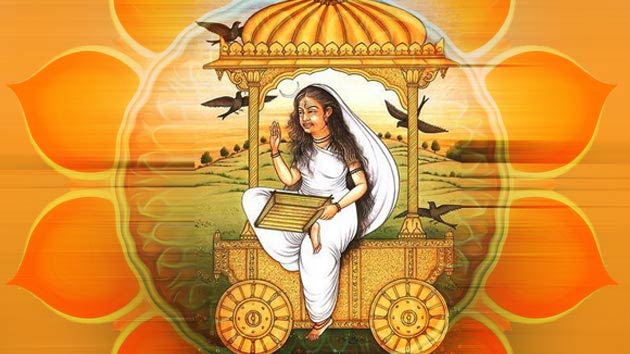
Dhumavati is a tantric widow goddess in the Dasha Mahavidya pantheon. She is the only Mahavidya without a consort. Unlike other Goddess that have exhibit immense beauty and attractive appearance, Dhumavati is old and rather ugly widow associated with strife, loneliness, unfulfilled desires and inauspicious things of life. Dhumavati is the embodiment of tamas guna, associated with ignorance and darkness. She likes meat and wine, both tamasic in nature. As an ancestor or Grandmother Spirit, she embodies a great teacher and guide, granting knowledge of the ultimate truth of life and death. Dhumavati is called ‘Arikshyaykar’ or ‘one who destroys both the external as well as the internal enemy’.

The Dhumavati Tantra describes her as an old and ugly widow with a body made of smoke (Dhumara). She is thin, tall, unhealthy, and has a pale complexion. Her face is wrinkled without any charm. She is described as restless and wicked. Unadorned with any jewel, she wears old, (Galit Ambara )dirty clothes and has disheveled hair (Mukta Keshi ). Her eyes are (Ruksha Netra) dry and fearsome, She has a long crooked nose along with ugly rough ears. She possesses long fang-like teeth (Viral Danta )of which some have fallen out, leaving her smile with gaps. Her ears are ugly and rough; her breasts hang down. In one of her trembling hands, she holds a (Shurp Hasta) winnowing basket, while the other makes a boon-conferring gesture (varada-mudra) or knowledge-giving gesture (chinmudra).

She rides a chariot pulled by crows and has a flag with crow emblem (Kak Dwhajini). She has a voice of howling jackals.  Dhumavati is also said to be fierce, frightening and fond of blood. She is astute and crafty. Always hungry and thirsty, Dhumavati initiates quarrels and invokes fear (Kalaha Priya). Dhumavati is often said to appear at the time of Maha-pralaya, the great dissolution of the cosmos and is equated with the dark clouds that rise during Pralaya.

In the Prapancasarasara-samgraha, Dhumavati is described as having a black complexion and wearing ornaments made of snakes. Her dress is made of rags taken from cremation grounds. She holds a spear and a kapala in her two hands. The spear is sometimes replaced by a sword. Another description in the same text says Dhumavati is aged with a wrinkled, angry face and cloud-like complexion. Her nose, eyes, and throat resemble that of a crow’s. She holds a broom, a winnowing fan, a torch, and a club. She is cruel and frowning.  she wears the simple clothes of a beggar. Her breasts are dry and hairs are disheveled, grey, her teeth crooked and missing, and her clothes old and worn.

She is attracted to smoke as smoke symbolizes destruction. She prefers insane offerings and smoke from the pyre; also she likes white flowers and clothes, liquor or wine, Bhang , cigarettes or chillam , especially salted items. She does accept the offering which is not made up of smoke.

The Shaktisamgama Tantra says that Dhumavati can be worshipped for the Uchhatana (eradication) of a person. A worshipper should imagine the world and the goddess’s mantra as grey. He should blacken his teeth and wear black clothes and observe regulations, such as eating little, sleeping on the ground, and subduing his senses. In this worship procedure called kakakarma (crow-procedure), he should “transform his mind into a crow” by which one can cause harm to a person.

Dhumavati’s worship is performed in the night in a cremation ground, bare-bodied with the exception of a loincloth. The fourth lunar day of the dark fortnight (Krishna Paksha) is considered the special day to worship her. The Sadhaka should observe a fast and remain silent for a whole day and night. They should also perform a homa (“fire sacrifice”), wearing wet clothes and a turban, repeating the goddess’ mantra in a cremation ground, forest, or any lonely place

Though legends connected to the origin of Goddess Dhumavati is not very – popular, we can still find references in the texts.

In Durga Saptasati (5.120) Durga vows that “He who conquers me in battle, removes my pride and is my match is strength in the world shall be my husband.” Since It has not happened so far, she is still unmarried. She is without wealth and husband. 

According to Pranatosini-Tantra Once Parvati, the spouse of Lord Shiva sat near him in Kailash. She was extremely hungry and her body racked with pain. She urged Lord Shiva to give her something to eat, as she was famished. Lord Shiva, told her to be patient and to wait for some time, after which he would give her whatever she wanted to eat. Saying this, he went back to continue with his meditation. She appealed, again and again, urged her husband to provide her with some food to eat, but Shiva again told her to wait for a while. After urging for a long time, she lost her patience as she felt that she would starve to death.

Lord Shiva was also not paying proper attention towards her asking for food. Soon she became indignant and put Shiva himself inside her mouth and gulped him down. After a little while, Lord Shiva persuaded her to disgorge him, as smoke began to rise from Parvati’s body. She appeared with smoke covering her entire body; this smoke was her Maya or Magical Power of illusion. Then Lord Shiva came out of her body and shouted, O Devi! You are a woman without a husband, it’s called a widow. She must remove her ornaments and marks of married women. The smoke from her took the form of Dhumavati.

Another story in Devi Bhagavat says that when Sati performed self-immolation at the yagya of Daksha Prajapati, While getting burnt, Sati came out of her body in the form of smoke and came to be known as Dhumavati. 

 The Moola mantra of Dhumavati is

“Dhum Dhum Dhumavati Svaha”, It has the Dhumra Beeja ‘Dhum’.

 The old and widowed appearance of Dhumavati symbolizes Shaktiman or Purusha, which is Shiva the enjoyer of Shakti or Prakriti. Energy cannot be utilized in pure form, it needs to be used through a medium. The medium is Shiva, when the energy is enjoyed by Shaktiman it is bright, opulent and happy. When there is an absence of the enjoyer, everything becomes barren, ugly and spreads unhappiness. For example, if there is no rain the fertile earth cannot produce and becomes dull and barren.

Another symbolism associated with Dhumavati points out to the negative aspects of life, asking us to develop a sense of detachment and ultimate perfection. She guides devotees to rise above the glimpse of material opulence to the real truth of life that is the state of ultimate knowledge which is above the Opulence. By obscuring or covering all that is known, Dhumavati reveals the depth of the unknown. Dhumavati obscures what is evident in order to reveal the hidden and the profound. Dhumavati’s youth and freshness are burnt out, and what remains is the smoke of her spent  life. And like smoke, she is restless and wandering.

Dhumavati also symbolically portrays the disappointments, frustrations, humiliation, defeat, loss, sorrow and loneliness that a woman endures.   Goddess also represents a stage of a woman’s life that is beyond worldly desires, beyond the conventional taboos of what is polluting or inauspicious. Dhumavati is the knowledge that comes through hard experiences after the youthful desires and fantasies are put behind. 


The bowl of fire she holds burns ignorance, ego and also indicates that all things are eventually destroyed. The winnowing basket is “viveka” or intelligence, the power of discrimination that separates the grain (real) from the chaff (unreal). On an outer level, she seems like poverty, destitution, and suffering, the great misfortunes that we all fear in life. But in truth, she directs us to look beyond the small ambitions.

Dhumavati’s worship is considered ideal for bachelors, widows, Sannyasins, and   Tantrics, It is advised that people who are married should not worship Dhumavati, as She instills a desire to be alone and an aversion to worldly things. She encourages a certain kind of aloofness and independence; and sets one on the spiritual path; this can hinder the married life.

Dhumavati is the primordial darkness and ignorance, from which rises the world of illusion. She represents the darkness/ignorance before creation and after decay. This ignorance, which obscures the ultimate reality, is necessary because, without the realization of this ignorance, true knowledge cannot be achieved. Dhumavati also represents Yoganidra, the pre-creation state of consciousness or the voids in which all creation would dissolve and reach the ultimate reality of Brahman. This void is pure consciousness, the cessation of movements of the mind, and silence. Dhumavati’s ability to spread disease is also considered positive, as disease punishes the wicked and restores cosmic order. Dhumavati is also associated with the heart or middle region of the body.

Dhumavati also shares her characteristics with Nirriti, Jyeshta and Alakshmi. All three goddess personify inauspiciousness, ugliness, poverty, quarrels and never-ending hunger.